The November-December issue of Touchstone contains an article on Charles Williams's novel Many Dimensions. I dislike reading about books I haven't read but which I intend or at least hope to read. With a lot of classics that's almost impossible, because so much has been written about them. But Williams is relatively obscure, and I've read and liked at least three of his seven novels, and intend to read the others. So I decided that before reading the Touchstone piece I would read the novel itself. Having had all seven on my shelf for many years, I picked this one up.
But as soon as I'd read the first few paragraphs I realized that I had already read it.
The Persian, sitting back in his chair, and Sir Giles, sitting forward on the edge of his, were both gazing at the thing which lay on the table. It was a circlet of old, tarnished, and twisted gold, in the center of which was set a cubical stone measuring about half an inch every way, and having apparently engraved on it certain Hebrew letters.
The description of the stone told me that this was a book I'd read roughly thirty years ago, and liked. But I didn't remember it very clearly, so I proceeded.
Someone asks if the letters are important:
"They are the letters of the Tetragrammaton," the Persian said drily, "If you call that important. But they are not engraved on the Stone; they are in the centre–they are, in fact, the Stone."
The circlet in which the Stone is set is the crown of Suleiman ben Daood. It wasn't until I was twenty or thirty pages along that it dawned on me that "Suleiman ben Daood" is "Solomon, son of David." To say that the Stone has magical powers would be to trivialize it. Even to say that it has powers is not fitting: it is power in some sense. In fact it seems to be everything in some sense. It's not God, but it is somehow very intimately connected with God. At one point it is called the First Matter, the first thing created by God, and said to have been in the possession of Adam in Eden. For many centuries it has been in the possession of Muslims, who have kept it secret and dormant. But it has been stolen and sold to Sir Giles Tumulty.
Tumulty is a kindred spirit to Josef Mengele (though the book was written in 1931, before Mengele's name and deeds were known), an amoral inquirer who seeks knowledge as a means of power and is psychopathically devoid of human sympathy. Also present at the meeting described above is his nephew Reginald Montague, who wants to use the Stone to make money. The Persian is Prince Ali, attached to the Persian Embassy in London, and outraged by the blasphemy of Tumulty's possession of the Crown and the Stone. Tumulty and Montague discover that a person holding the Stone and willing himself to be somewhere else will be instantly transported there. So Montague immediately conceives a business plan: to sell chips of the Stone at enormous prices to wealthy people who would like to be able to travel anywhere instantly.
Unsure about several legal aspects of the venture, Montague decides to consult another uncle, Lord Christopher Arglay, Chief Justice of England. He and Tumulty take the Stone to Arglay, show it to him and to his young secretary, Chloe Burnett, and demonstrate the one power that they've so far discovered. They also learn that an attempt to chip off a piece of the Stone creates a duplicate of it–a copy in their word, a Type in the word of those who have more understanding of it.
And thus is set in motion a story which is both exciting and profound. It is fundamentally a three-way struggle over the Stone. There is the Tumulty-Montague party, which wants to use it for various instrumental purposes, including especially the making of large sums of money, though Tumulty himself is not interested in that possibility–he is less human than that. Soon there are multiple Types of the Stone abroad, and more powers are discovered, powers that bring people into conflict with each other. One such power is that of healing, so now there is a party that wants to distribute it everywhere and heal every physical ill. But that is not in the interests of those who want to sell it as a means of transportation and need to keep it rare and expensive. And so on.
Then there are the Persians, led by Prince Ali, who want to retrieve the Stone and put it back where it belongs (wherever that is) and are quite willing to kill any infidel who possesses it, or one of its Types.
And there is the party which wants to do what is right, what is most in keeping with the nature of the Stone. This party consists chiefly of Lord Arglay and Chloe Burnett, with a few allies, including a wise Muslim called the Hajii who objects to Ali's violent single-mindedness.
Arglay, Chloe, and Tumulty are the chief characters. Tumulty is simple enough, perhaps a little overdone in his brutality and spiteful pride. But Arglay, Chloe, and their relationship could be studied at length. Arglay's concern with Law and Justice assumes cosmic significance. And Chloe–well, she is really in many ways the center of things, eventually…well, that would be giving away too much. The relationship between them is a beautiful picture of the masculine and feminine dynamic. It's not romantic–he is many years older than she and more of a father, even addressing her as "child." But if it's father and child, it's not father and son, which would be a very different thing. He is master and she is both daughter and servant. And yet it is she who leads the way in their understanding of the Stone. She alone of all the characters has a direct intuitive grasp of what it represents, and of how one ought to comport oneself toward it, beginning with reverence. She doesn't learn this by reasoning or study; she simply sees it, and teaches him. Arglay asks her what she "would have the Stone to be," which seems to mean at least as much "What do you believe it to be?" as "What do you want it to be?"
"I am afraid of it but I–don't laugh–I love it."
Lord Arglay looked at her thoughtfully. Then, "Do you believe in God?" he asked.
"I suppose so," Chloe said. "I think I do when I look at the Stone. But otherwise–I don't know."
"Well," said Lord Arglay, "I will make you a fair proposal–I will if you will. It's all perfectly ridiculous, but since I saw those people [Tumulty and others of the first party] this morning I feel I must be with them or against them. So I suppose I'm against them. Not, mind you, on the evidence. But I refuse to let you believe in God all by yourself."
Chloe looked up at him, her eyes shining. "But dare I believe that the Stone is of God?" she said. "And what do I mean by God–except…" she half added and stopped.
"Except–?" Arglay asked, but she silently refused to go on and he said: "If you will believe this way, then I also will believe. And we will set ourselves against the world, the flesh, and the devil, and not sit in the seat of Giles Tumulty…."
If that dialog intrigues you, read the book. Philosophy and theology aside, it is really quite a good story.
I'll also note in passing the very respectful treatment of Islam in the novel. Christianity in fact is hardly mentioned at all; the English characters (and one American), are pretty much the sort of post-Christian moderns we know well, even, more or less, Arglay and Chloe in the beginning. Interestingly, Prince Ali is representative of the fanatical and violent aspect of Islam with which we are too familiar–he threatens to rouse "all the places of Islam" against the English until the blasphemy is avenged and the Stone returned. But the Hajji (see Wikipedia for a bit of information about the title) is a deeply devout and very wise man. And one whom the prince, for his own well-being, would have done well to heed.
I know I've written about Williams more than once here. I think this post is the first; it's mainly about All Hallows' Eve. And there is this book review of Descent Into Hell which was published some thirty-five years ago, but which seems still fairly well on target to me. As with these others, there is a good deal in Many Dimensions that I don't understand very clearly.
I'm fairly sure that I've read at least one other Williams novel but I'm not sure now (obviously) which one it was. Now that I think of it, I believe it involved the Holy Grail. War In Heaven, perhaps.
The Touchstone piece, by the way, focuses on the Stone, and the uses to which those who see it as an instrument wish to put it–as a metaphor for technology and its perils. It's an interesting piece, but I'd like to know more about the Stone itself. I don't entirely understand what it is supposed to be, and I don't know to what extent it and its powers are Williams's invention, and to what extent, if any, he is drawing upon existing legends.
This review of a Williams biography at The University Bookman is a nice brief overview of his life and work. I quibble with that opening sentence, though: at least since the early '80s, when Eerdmans reissued his novels, Williams is considered one of the Inklings, and has been known for many years among those who are interested in Tolkien and Lewis. Relatively obscure, yes, but certainly not forgotten until 2008, as the writer seems to imply.
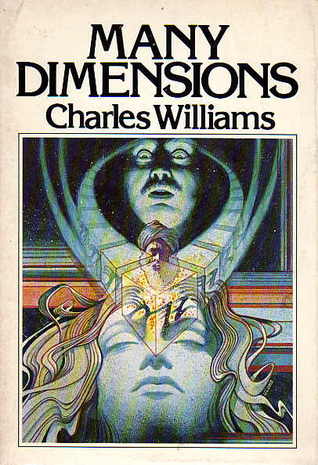
This is the cover of the edition of Many Dimensions that I have. On the lurid side but well-founded in the book.
 Light On Dark Water
Leave a reply to Janet Cancel reply