One Sunday afternoon a few weeks ago some friends invited my wife and me to go to a flea-market-sort-of-thing with them. I didn't really want to go until they told me there would be books. There were–and records, too.
Part of the market seemed to be someone's estate sale, and it was interesting and more than a bit sad to see what must have been someone's prized possessions laid out on tables, priced at a nickel or a dime on the dollar of what the owner had paid for them, stripped of any personal association except perhaps the owner's name on the flyleaf of a book or the back of a record jacket, or notes and underlinings in the text.
I was seriously tempted by a box of two dozen or so opera recordings (on LP). They seemed to be in pretty good shape and I've been wanting to get more widely acquainted with opera, but I don't want to invest in CDs, and streaming is unsatisfactory without a libretto, to me anyway. But I don't have room for another two feet of LPs. And would I even get around to listening to them…?…. In the end I decided to let them go, although I hate to think that they might end up being discarded. Yes, a huge revival of interest in vinyl has been in progress for some years, but I don't know if it extends to opera.
And I only bought one book. I've been making a serious effort to limit my acquisition of books to ones which I have a definite intention of reading in the not-too-distant-future. I'm resisting those in the might be interesting, heard it's good, and maybe someday categories. I deduced from the selection here that the person who had owned these books was around my age or not more than ten years older, as there was a certain amount of junk that recalled to me my mid-1970s tenure in bookstores. Some Watergate stuff, some pop psychology and self-help stuff–that genre really flowered in the '70s–and, the only specific title I remember now, The Joy of Sex. I resisted the temptation to open it.
The one book was The Oxford Book of American Literary Anecdotes. I've been enjoying the English counterpart of this book since I bought it in roughly 1978. I read a fair amount of it in the first couple of years I had it. Then life became very busy and since then it has sat undisturbed on the shelf for years at a time, until some whim takes me, I pick it up and read a story or two at random, then put it back on the shelf, and let years go by before I open it again. I'm pretty sure there are still anecdotes in it that I haven't read.
For some reason, though, I read this American version more or less straight through, off and on in a matter of weeks. Part of the reason is that it's shorter, because there just isn't as much interesting American literature as there is British. And the anecdotes themselves tend to be shorter. It's a potato-chip sort of book: it's hard to read just one. Or maybe it's a cheese-curl sort of book: it's hard to stop until the whole bag is gone.
This is probably my favorite item from the book: Henry James explains how he came to catch a cold on a visit to New York.
I had brought availably with me two overcoats, one somewhat heavier and one somewhat lighter, and in Boston I had worn with comfort the somewhat lighter overcoat and was carrying, for possible immediate need in New York, the slightly warmer overcoat on my arm. All had gone well, until I found myself here, seated in a cab beside my friend, David Munroe, known to you doubtless as a fellow-editor, albeit much older, editing, yes, The North American Review, and so faithfully replete with welcome and so instantly exacting of responses that I was only vaguely, though somewhat venially, aware of my impulse and need to doff the somewhat lighter overcoat and to don the slightly heavier overcoat, which I by all means should have done, to be sure, on account of a rapid change in temperature, or else a difference in temperatures at the place where my journey began and the place where it ended, or perhaps merely a change in hour, but a change all in all,–and, as I have noted, my good friend, David, so engrossed me in greetings and reminiscences and interrogations that I continued, despite a disquieting chill in my marrow, to wear the somewhat lighter overcoat, protecting only one arm with the slightly thicker overcoat, which I should assuredly have been wearing in order to avoid this probably thus avoidable touch of influenza with which I must begin my–under otherwise auspicious aspects–visit to New York, and all, let me charge, on account of your beastly, and by me long foresworn, climate.
Delightful as this is, I am not at all sure I believe it. Witter Bynner claimed to have written it down at the time James said it–to him, I assume. But could anyone really have retained this long enough to write it down? And anyway, Witter Bynner was one of the conspirators in a famous literary hoax, the Spectric school of poetry. I remember reading about that hoax in my teens, and being a little puzzled, because I couldn't really see any difference in the hoax poems and some of the seriously-intended work of the early 20th century, or for that matter of the then-present, and even the now-present.
I also learned from the American anecdotes volume that Edgar Allan Poe's mother called him Eddie.
*
Tom Waits has a very poignant song about an estate sale or a flea market and the sadness of keepsakes that eventually are no longer kept, "A Soldier's Things".
A tinker, a tailor, a soldier's things
His rifle, his boots full of rocks
Oh, and this one is for bravery
Oh, and this one is for me
And everything's a dollar in this box
*
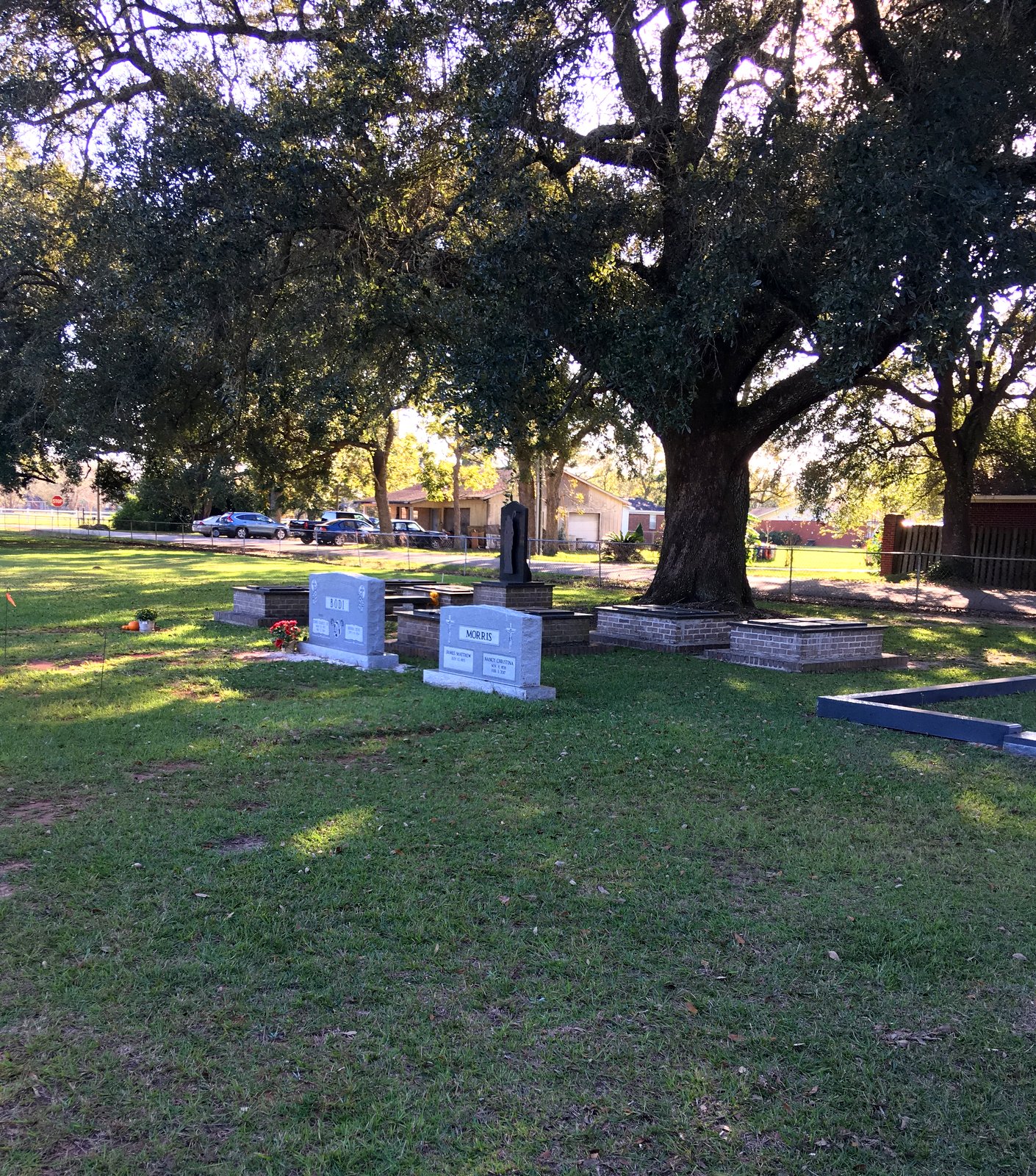
I didn't start this post intending to dwell on mortality, but: it just happens that Saturday afternoon I had the new and decidedly odd experience of seeing my future grave site. My wife and I have been saying for some years that we should go ahead and make some of those arrangements so that when the time comes the one still living and/or our children won't have to deal with it.
There is a Catholic cemetery on this side of the bay, six or seven miles from our house, in an area called Belforest. A little before the turn of the 20th century there was a significant migration of Italians into this area. They were prominent in the founding of the little town of Daphne, and many of them farmed the flat and open land out in the county east of town. Their names are still prominent locally, which gives the place a slightly different flavor from the very Anglo northern end of the state where I grew up. They established the first Catholic parish of modern times in this immediate area, and, a few miles out in the country, a cemetery. It's relatively small, four or five acres I'd guess, and only about half-populated. It's much less out in the country than it was when we first moved here in 1992; at the time it seemed isolated, which is not necessarily a bad thing, but also a little raw and unappealing, just a bit of flat land fenced off from the surrounding flat fields. But it doesn't seem isolated now, so many people having moved into this area (a phenomenon I strongly dislike) that there's a big subdivision across the road, and I suppose in another twenty or thirty years, fifty at most, it won't even seem rural anymore. And I suppose I'd rather have the isolation, modern development being the ugly business that it is. But more importantly, it's planted with live oaks that have grown significantly since I first saw them twenty or so years ago. And it's a Catholic cemetery, consecrated ground, though I'm not at all sure what the import of that is.
It's a little absurd that one should wish to be buried in a location that is pleasant. But I like the fact that this one is. So is the name Belforest, presumably "beautiful forest." Though it surely can't matter to me, the climate here is such that I don't like the idea of being buried in a place that has no shade. Our plot is over in that open space to the left of this tree, which my wife has already referred to as "our tree."
 Light On Dark Water
Leave a reply to Robert Gotcher Cancel reply