The 500th anniversary year of the Protestant Reformation, as dated from Luther's famous 95 theses, is almost over. From my perspective it seems to have been a rather muted observance. One local Presbyterian church which I pass by occasionally has a big sign out front announcing it, but offhand I can't think of any other visible evidence of it around here. But then I suppose it's not something that most Protestant churches would treat as a major public event. Maybe part of the reason–if my impression is even accurate–is that its legacy is so fragmented in this country. It's a long way, both chronologically and theologically, from Lutheranism to non-denominational evangelicalism.
The discussion of the anniversary in Touchstone, which describes itself "A Magazine of Mere Christianity," and is genuinely ecumenical in a way which I share, and whose writers tend a bit more Protestant than Catholic or Orthodox (I think), has been distinctly muted. I don't think it was discussed at all outside of the September/October issue, and there is certainly no Protestant triumphalism there. There is a brief history of the "Reformations" by James Hitchcock, who is Catholic, which, as the title suggests, treats not only the birth of Protestantism but the reforming movements within Catholicism at the time, all pretty objectively, not pressing the point of who was right and who was wrong. (You can read it here.) The lead editorial, which usually presents an opinion representative of all the editors, stops very far short of treating the birth of Protestantism as a good thing. (You can read it here.) I suppose the similarly-minded First Things must have dealt with the subject this year, but even though I'm a subscriber (after many years of reading only the bits that they put online), I have not been reading it regularly. (That has to do with the fact that my subscription is electronic-only, which I should probably change–the "out-of-sight-out-of-mind factor is at work).
A Catholic naturally has some difficulty in using the word "Reformation" alone to describe the events of 1517 and after which produced Protestantism. I have to qualify it: not "the Reformation," but "the Protestant Reformation." (I resist the practice of some Catholics in calling it "the Protestant Rebellion" or "the Protestant schism" even though the terms are technically accurate, because they sound unnecessarily negative.)
I recall a conversation with one of my uncles shortly after I became Catholic. He was not hostile but, as I think tends to be true of Protestants raised in parts of the South where Catholicism is, at least until recently, almost nonexistent, he didn't seem ever to have considered the possibility that the rise of Protestantism was not a good thing. "Could you have had reform without Martin Luther?" he asked me. Well, yes. Luther did nothing to reform the Catholic Church. He repudiated it, left it, and took half of Europe along with him. You can argue that his rebellion goaded the Church toward reforming itself, or that reform would not have happened if he had not rebelled, so in that sense you might argue that he was necessary. And it should go without saying that reform was desperately needed. But the reformation was not his work.
It's difficult now to speak of Protestantism as such in any general way. The term encompasses so many beliefs that the only really accurate description of the whole field would be something like "forms of Christianity which are neither Catholic nor Orthodox." What does a conservative Baptist have in common with a progressive Episcopalian? Almost nothing beyond a historical separation from and continuing opposition to Catholicism. (Even the Anglo-Catholics are more Protestant than they want to recognize.)
Similarly, as has often been observed in recent years, an orthodox Catholic has more in common with an orthodox Baptist (for instance) than with many "progressive" Catholics whose theology is not really distinguishable from that of progressive Protestants. My casual working definition of "Christian" is that it includes anyone who can say the Nicene Creed and mean it pretty much as written, with a bit of wiggle room allowed on the definition of the Church. I might therefore be more inclined to give the name to some Protestants than to some Catholics who seem not to believe the traditional teachings of the Church. This, however, neglects the Catholic concept of the Church as mystical body of Christ, in which "Church" refers to a specific visible body. That progressive Catholic and I are still members of that body, unless he has done something so dramatically wrong, or denied the teachings of the Church so clearly, as to be excommunicated. And however much I might have in common with that Protestant, he is not a member of that body. In Catholic eyes this membership has a supernatural aspect which my friendship and theological kinship with a Protestant does not.
The existence of the gulf can't be wished away. One of the strengths of the Touchstone/First Things approach to ecumenism is that it does not attempt to ignore substantive differences; their Catholics are Catholic and their Protestants are Protestant. It's not possible to eliminate the gulf by saying "Well, we agree on the essentials, so let's not worry about everything else," because we don't agree on what is essential. Much of what Catholicism regards as absolutely essential–for instance, the authority of the Church–is not just inessential but flat wrong from the Protestant point of view.
I have the impression, based on very limited data, that the tendency of orthodox Protestants now is more to lament than to celebrate the Protestant Reformation: as a sad necessity, maybe, but still sad. There's an increasing willingness to concede that it was a tragedy, and that it resulted in a state of disunity is contrary to the will of God. That's actually a pretty long way from Luther and Calvin, I think. This piece from several years ago by the Methodist theologian Stanley Hauerwas is a good example.
Now that so much is going wrong in the contemporary secularized world, there may also be more of a willingness to admit that the development of Protestantism is linked to the dominance of secularism and the diminishment of Christianity. It seems pretty obvious to me that the skepticism that the first Protestants turned on the Catholic Church is related to the skepticism that was soon turned on the Bible and on Protestantism itself. I won't say that Protestantism caused the various more or less atheistic developments which have transformed what used to be Christian society, but it seems pretty obvious that it was a part of that larger trend, which perhaps has roots much deeper than we can see. If Luther can defy and deny the Church, why can't I deny and defy Luther? That happened within Luther's lifetime, and just from the anthropological point of view seems an inevitable tendency. At any rate the connection between Protestantism and modernity is pretty much taken for granted by a lot of well-informed people, many of whom take it as an obviously good thing.
The theological arguments for Protestantism don't have much force for me anymore. The concept of scripture alone as the source of authority for Christians now strikes me as almost self-evidently wrong. It seems starkly obvious that Protestantism began in the 16th century, while the Catholic and Orthodox churches began in the 1st, and therefore that only they have any remotely plausible claim to be the early Church continued into our time. The worship of the Church in the beginning looked like theirs, not like a Baptist service. And so on. But though I don't think highly of Protestantism as a body of doctrine, I think very highly of many Protestants, among whom are most of my relatives and many of my friends. I'm grateful for everything I received from my Protestant upbringing (Methodist, to be specific), and would never repudiate it. But as Hauerwas says of Reformation Sunday, the 500th Anniversary of the Protestant Reformation "does not name a happy event for the Church Catholic; on the contrary, it names failure."
I'm not going to end this with any sort of prediction about the ecumenical future. Well, ok, just one: the official talks between the Catholic Church and various Protestant communions will never result in formal unity. I won't even speculate about whether any other path to unity exists or can succeed. But I'm pretty sure that one won't.
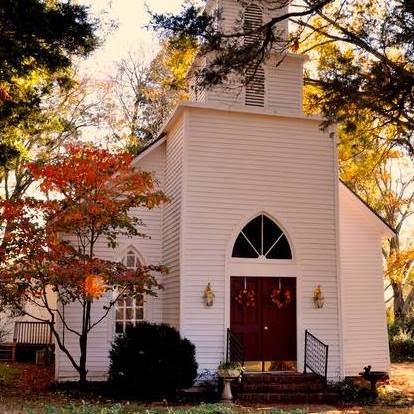
I lifted this picture of my childhood church, Belle Mina Methodist, in Belle Mina, Alabama, from the church's Facebook page. I don't think they'll mind.
 Light On Dark Water
Leave a reply to Mac Cancel reply