How, how is it possible that this is the year 2018 A.D.? I have a clear memory of sitting in Mrs. Bruce's 6th grade class, which means it was 1959 or '60 and I was eleven or twelve years old, and wondering for the first time (as far as I remember) how old I would be in the year 2000. I remember doing the arithmetic to find out…borrow one, ten minus eight is two, nine minus four is five.
2000
-1948
52
Astonishing! Inconceivable! I truly had no way to conceive of that length of time, much less what it would be like to be that age.
A few years later I was reading science fiction, much of which was set in that far-distant time. As late as 1969 Arthur C. Clarke and Stanley Kubrick thought it reasonable to set their drama of the next step in human development (guided by those substitute gods, super-intelligent extraterrestrials) in 2001. They furnished their vision with a space travel infrastructure comparable to that which existed for air travel at the time. Well, that has strikingly failed to appear, along with many other visions of a future set in or just beyond the beginning of the millennium. The bright sleek shiny ultra-modern future has in general strikingly failed to appear (as has the dystopia that apparently became the preferred vision sometime after the 1960s). The only really significant technological development since 2000 has been the emergence and spread of the pocket-size supercomputer, otherwise known as the smart phone. Arguably the web of information and communication, and the computers which constitute and give access to it, are the only really significant technological development since 1970–at least if by "significant" we mean something that changes daily life in some important way for almost everyone.
And culturally–well, some would say we've advanced, some that we've declined, and I favor the latter view, but all in all the change has not been so dramatic as science fiction writers expected. We've been pretty well stalled for most of the past fifty years, actually: the cultural revolution of the late 1960s happened, and things were rather different in 1975 from what they had been in 1965. But since then they've been fairly static, really, at least domestically–the culture war started and the antagonists have been locked in a struggle ever since, neither side winning a clear and decisive victory.
Most striking to me is the swiftness of the passage of the eighteen years since 2000. It's a tiresome thing for an old person to say, I know, but it keeps occurring to me because it's so astonishing. The turn of the millennium is roughly as many years in the past for us no as the end of the Second Word War was at the arrival of the Beatles. This year, children born in 2000 will be finishing high school. They've gone from being newborns with everything to learn to having at least some level of education and ability to manage for themselves. But for me it's mostly been a sort of plateau, and I've traversed it very quickly.
For someone my age the phrase "the year 2000" once had the aura of distant, exciting, hardly imaginable futurity. Now it's just an ordinary and rather dull bit of the past, and for me not a very far distant past, as it must be for someone who will be, say, just old enough to vote and buy alcohol this year.
And fifty-two seems fairly young. Or at least not old.
I'm happy to say, by the way, that I never was much worried about the Y2K disaster. There was a guy who gained a fair amount of fame for himself at the time by predicting, with a great deal of confidence and a fair amount of irrelevant or invented data, that civilization as we know it could not survive. I thought he was nuts, unless he was lying. A few years after the day had come and gone with barely a ripple, I went looking online to see what he had to say about having been proved wrong. I couldn't find any trace of him.
*
I'm also happy to say that I've managed pretty well to keep to my resolve to stay out of the controversy surrounding Amoris laetitia, and in general the controversies surrounding the papacy of Pope Francis. I've not only stayed out of them but have gotten pretty good at ignoring them. But yesterday someone recommended to me this piece by Christopher Altieri at Catholic World Report as being "the most balanced explanation" of the situation he'd read. Well, to be honest, he actually said "of the current mess." And it does seem to be something of a mess. Maybe it shouldn't be, maybe it's really much ado about nothing. But in that case the fact that it seems so important would have to be counted as part of the mess. At any rate, Altieri's piece does seem a pretty good explanation of why it isn't crazy (pharasaical, etc.) to have concerns about what the pope seems to want to do.
It strikes me, and it is not a happy stroke, that what's going on in the Church looks a lot like what's going on in American politics: bitter factions hurling invective at each other, "Pope Francis can do no wrong" vs. "Pope Francis can do no right." As with the political situation, though, I don't really see that much effect in my own life and in my own place. My diocese, the parishes within it, and my Ordinariate group muddle along as usual, trying to practice the faith to the best of our ability. The Pope is far away and the fight doesn't directly affect us (not counting the clergy, for whom it may have immediate practical import in their ministry). I think I'll be glad if the era of the celebrity pope fades away. Much as I loved John Paul II, I was always a little concerned about that.
One happy effect of all this, as Altieri notes (though not happily), is that the folks at America magazine, and the similarly-minded, now have the opportunity to denounce their opponents as "dissenters." It's a pretty silly charge, but it must feel pretty good to be able to make it, after several decades of digging in their heels against the last two popes. So let them have their fun, I say.
*
I've been meaning to mention that Francesca Murphy is now doing a bi-weekly blog post at First Things. They're excellent, and I think this piece, "The Secrets of the Confessional," is my favorite so far, a reflection on the fact that "Feeling great after confession is probably the most widespread experience in Catholicism, a religion not founded on religious experience as such."
*
I never was very good at learning the rules of grammar, and am only bothered by the mistakes which I don't usually make. One such has been bothering me lately. Isn't it the distinction between "transitive" and "intransitive" verbs that describes whether the subject is doing something or having something done to it? Whatever the correct terminology is, the distinction seems to be breaking down. I keep running across sentences which seem to be misusing transitive verbs, if that's the right way to describe it. For instance, I was about to subscribe to a certain magazine a few days ago, and the web site referred to "the Spring issue which releases in March." Shouldn't that be "is released"?
And this: if you do this or that on your computer, you're told, "a message displays." Shouldn't that be "is displayed"?
And this: "It transforms into…." Shouldn't that be "is transformed into"?
Like I said, I don't really even know the rules. I just play by ear. But these are like off-key notes to me.
I'm giving up on "I'm going to lay down" and "He said to John and I." Those battles are hopelessly lost.
But I reserve the right to laugh when I hear individual persons referred to as "they" and "them" in deference to gender-bending fads. As in "My boyfriend has recently come out as transgender, and they are saying I'm a bigot because I'm thinking of breaking up with them." I actually read something like that a few days ago, though I can't find it now. As I've mentioned before, those who think Donald Trump is inaugurating the reign of Orwellian Newspeak and thoughtcrime are barking up the wrong tree entirely.
*
We had an actual cold snap last week. By "actual" I mean that the temperature was low enough (mid-20s Fahrenheit) and the wind from the north strong enough (mid-20s MPH), to qualify as being, so to speak, objectively cold. Sometimes in winter, or in a hurricane that hits at the right angle, a strong north wind can blow much of the water right out of the bay. That was the case when this picture was taken on New Year's morning. Under normal conditions the only thing you would see besides water and sky in this picture would be the top of that furthest post. This debris by the way is partly trees fallen years ago and partly the remains of the city's original sewer line. I really should try to get them to remove it.

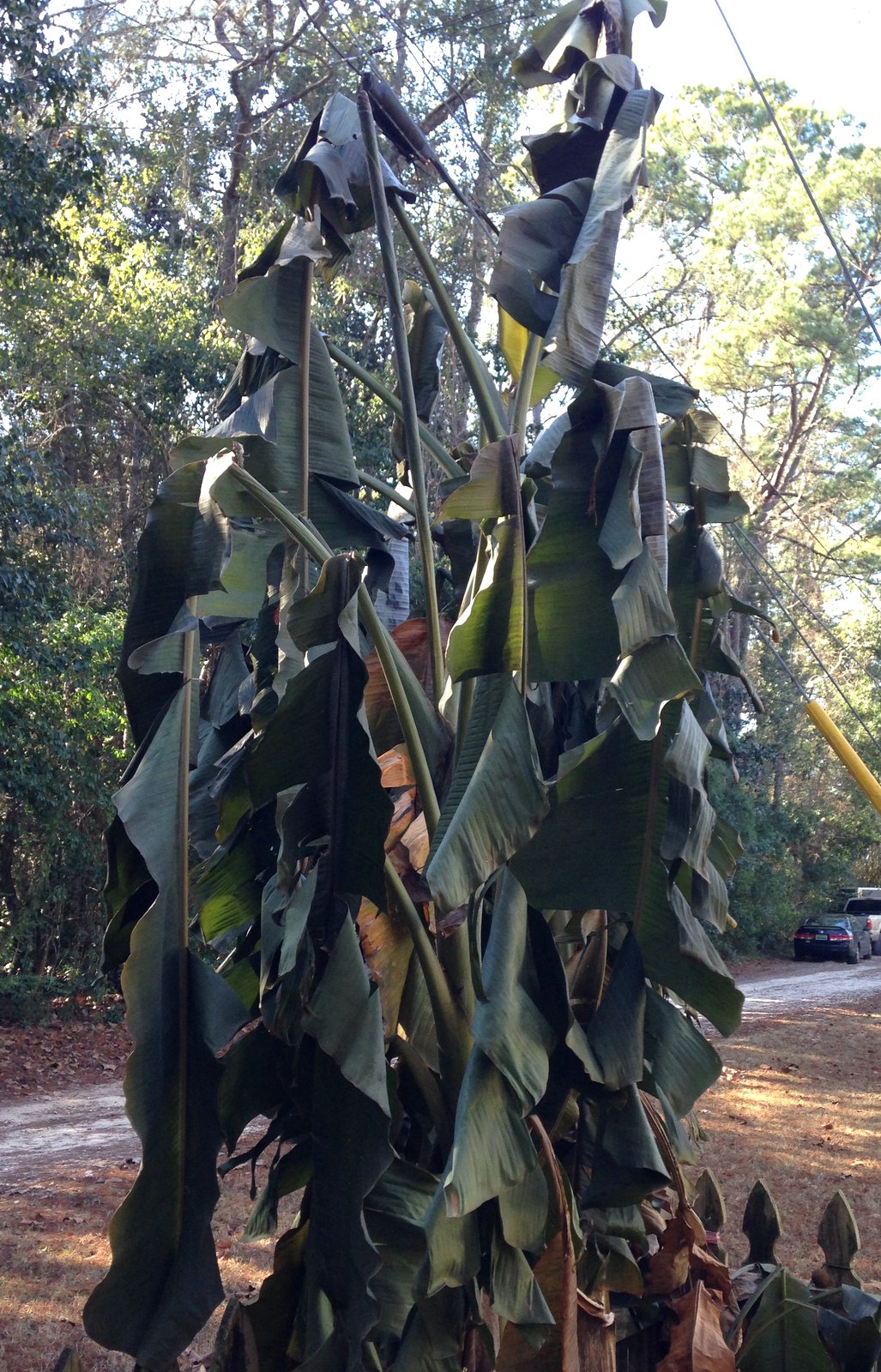
Banana trees do not take the cold very well. This was taken the following morning.
 Light On Dark Water
Leave a reply to Robert Gotcher Cancel reply