The world is changing. Those words recur several times in The Lord of the Rings, and they keep recurring to me about these times and this country, and in particular over the past few weeks about the gun control debate. It seems to me that a slow transformation in the way Americans think about their country, especially about its political system, is under way. I tend to think the change is overall for the worse, but perhaps I'm wrong. Perhaps when the new order stabilizes it will prove to be, on the whole, an improvement. But it will be different. It may preserve the forms of the Constitution, but the document will in effect no longer mean what it was intended to mean.
Somewhere in something of Chesterton's there's an observation about the prudent approach to ancient structures. I have no idea which book or essay or newspaper column it's in, so I can only paraphrase the general idea, which is this: The impulse of many people when they come upon something–a fence, for instance–that seems to have no purpose is to say "I don't see the purpose of this. Let's tear it down." But the wiser response is to say "I don't see the purpose of this. We'd better leave it alone until we figure out why it's here."
After Donald Trump won the electoral college, and therefore the presidency, a lot of people started demanding that we get rid of the electoral college. Most of them seemed to have no idea why the system was designed that way, that it's meant to distribute power more widely and prevent a situation where a few highly populated areas exercise complete control of the federal government. They also seem to have almost no idea at all that the state governments are not simply branch offices of the national government. They seem to see the country as being organized like a huge corporation, with its main office in Washington and every aspect of government, all the way down to your county courthouse, existing to implement the will of corporate HQ. This is not explicit, but it's the picture of the way a large organization works that they carry in their minds. But it's not what the Constitution prescribes.
Moreover, and worse, they tend to see the president as the equivalent of a corporate CEO, whose word, for all practical purposes, is law for as long as he holds the job: in short, as a king. This view has been growing for a long time and it seems to get worse every four years, which is why presidential elections are now so bitter; there is more at stake than there really should be. I think some of these people are genuinely surprised that the president cannot simply order the removal of all guns from private hands. Or, if they do realize that he doesn't have the power, they think he (or she) ought to–which is pretty odd considering that for the most part those who think this would be a good state of affairs also think Donald Trump is a fascist.
I don't think many people under the age of forty or so really have a lot of knowledge of or sympathy with the old constitutional vision. I get the impression that they are not educated in that way, as earlier generations were. When they speak of democracy they mean an extremely crude version of it–that a numerical majority of citizens, counted nation-wide, should determine every question of policy. They don't mean the careful balancing of powers and interests that the Founding Fathers explicitly intended to prevent the likely result of pure democracy: the tyranny of the majority.
The Constitution implies, more or less presupposes, and is meant to foster the development of a nation of free citizens: farmers, tradesmen, craftsmen, and mechanics who are free to manage their own affairs within very broad limits, and can be trusted to do it in a reasonably responsible way. The existence of slavery, the many crimes against the Indians, and all the other ways in which this vision was denied do not negate the intention.
What I see developing now is an entirely different conception of what the nation should be. Instead of the ideal of free and responsible citizenry governed by representatives chosen from among themselves, the new paradigm sees two sorts of people: sheep and shepherds. The vast majority of us are the sheep, of course. We are stupid, ignorant, irresponsible, not knowing what is in our own best interests, at the mercy of the herd instinct–and worse, unlike sheep, always ready to do violence and other sorts of evil if the hand of the state isn't there to stop us. For the good of each of us and of all the other sheep, we need to be guided and protected by the strong hand and sound judgment of shepherds, who are few in number but great in wisdom and power. Many of the sheep class themselves see it this way, which is why democratic means are being used to transfer more and more power to the shepherding class. No one would put it that way, of course; no one wants to think of himself as being of the sheep, and no one who wants to be one of the shepherds would dare to use those words.
The 2nd amendment makes a good deal of sense in the context of the old vision. Even setting aside the amendment's strong implication that private ownership of firearms is first of all meant to provide a ready defensive militia, its presumption is "Why should a citizen not be allowed to own a gun?" But in the sheep-and-shepherd context the question is "Why should anyone except the shepherds and their agents be allowed to have a gun?"
I think this accounts for some of the mutual incomprehension of the two sides in the gun control debate. The shepherding party says "You don't need that gun." The free-citizen party says "That's not for you to decide." The shepherding party sees anyone with a gun as being likely to commit murder at any moment for little or no reason. The free-citizen party sees most people as responsible and murderers as being rare anomalies.
The gun-owning citizen also wonders why, given all the other menaces to life and health in this country, he and the tens of millions like him should be held morally responsible and have their traditional rights nullified when one person runs amuck with a firearm. And why this one terrible but rare problem should get more attention and generate far more emotion than other ills. According to Charles Cooke, whom I'm inclined to trust to get the numbers right (he provides a link for the second):
By the time the clock strikes midnight, an average of 21 Americans will have been killed by drivers aged between 16 and 20. Tomorrow, on average, eleven teenagers will die because they were texting while driving.
So if we raised the legal driving age to 21, thousands of young lives might be saved, vastly more than will be killed by lunatics attacking schools. The people who die in this manner are just as dead, and their families just as bereaved, as those murdered in Parkland, Florida. But there is no general public emotion, no journalistic outcry, and few or no calls for government action. Obviously deliberate killing creates more shock and outrage than accidents, but if the accidents are killing far more people, and are (in theory at least) preventable, something else is at work in the disproportionate demand for action against guns. I think what I've said here is part of that something else.
The change in our conception of the commonwealth, if it is as big and lasting as I suspect, is ultimately a change in the people. The Constitution means what the Supreme Court says it means, and in the long run that will be determined by the people. It almost seems inevitable, since the whole drift of the past fifty years and more in our culture has been toward the loosening of all self-restraint. And it's an iron law of human nature that people who cannot control themselves will be and must be, for everyone's sake, controlled by others.
*
Apropos of nothing in particular, but before I forget it, here's the funniest thing I've heard anyone say about the president:
Everything Trump says makes sense when you just preface it with, "Donald from Queens, you’re on the air."
*
Here, via a link at Dappled Things, is an interesting conversation about mystery novels from two Catholic writers of same. One of them, T.M. Doran, I've heard of, and I have to admit it was not an enthusiastic recommendation, but still, it's interesting.
*
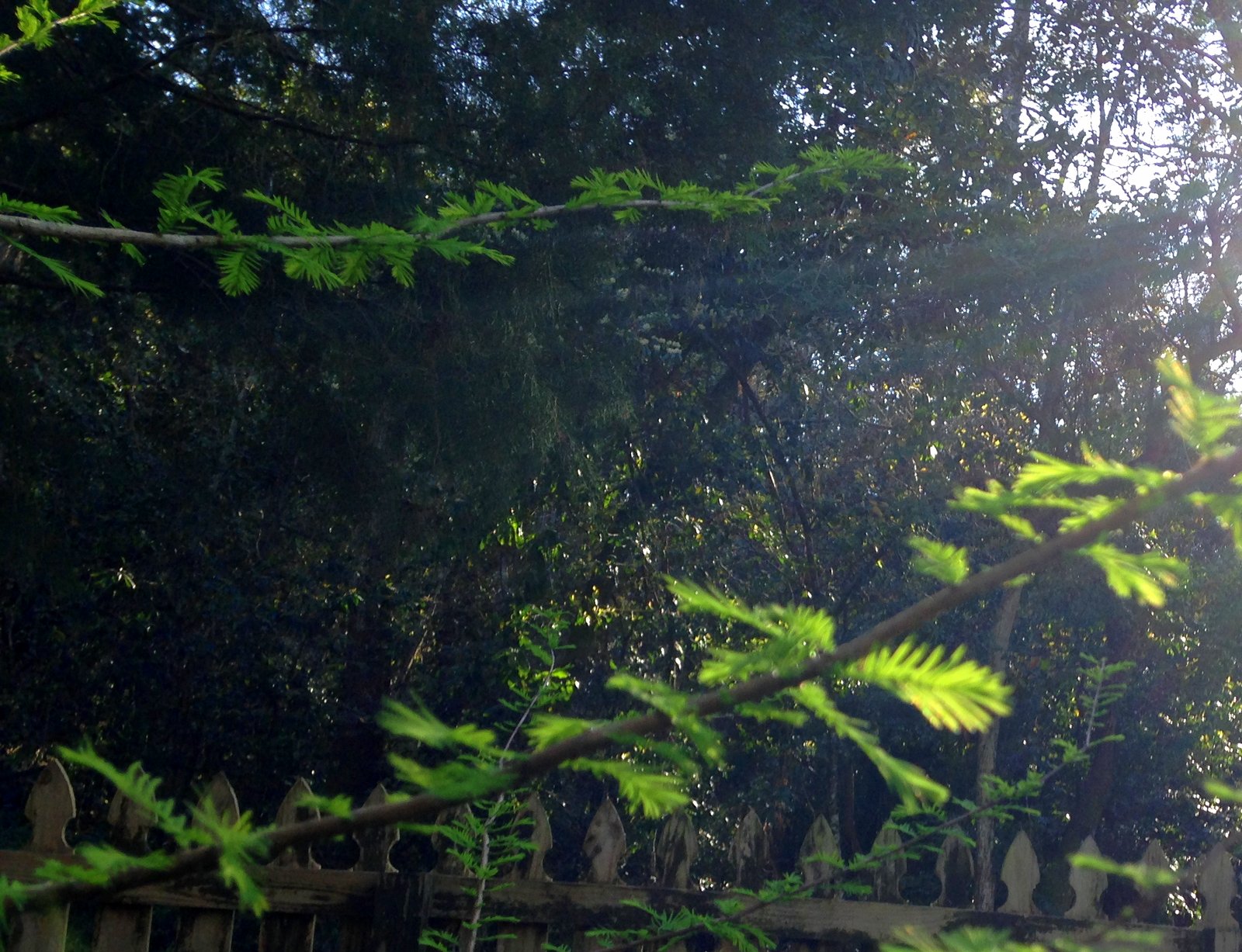
Sorry it's out of focus, but new cypress needles are one of my favorite spring colors, especially when they catch the sunlight.
 Light On Dark Water
Leave a reply to Rob G Cancel reply