Easter Sunday
When I was twelve years old, an aunt and uncle gave me two books for Christmas, both part of a series or set called The Looking Glass Library. These were The Haunted Looking Glass and The Looking Glass Book of Verse. The first was a collection of classic ghost stories, though of course I didn't know they were classic and didn't recognize names like M.R. James or even Bram Stoker; I think Charles Dickens was the only name I knew. I loved it and read most of the stories several times over the next five or six years. It included "The Monkey's Paw," which is a great story, but also a peculiarly disturbing one. I've sometimes thought I might better not have read it, because it colors my attitude toward prayer. (If you don't know it, suffice to say that it's probably the ultimate be-careful-what-you-wish-for tale.)
The Haunted Looking Glass was edited by Edward Gorey, and illustrated by him. That explains why, years later, in the early or mid-'70s, when there was a sort of Edward Gorey vogue, his work looked so familiar to me. The illustrations are rather brilliant: there is almost nothing at all in their subject matter that's directly frightening, but they manage to communicate a sense that something uncanny is invisibly present and about to act.
The Book of Verse, however, I don't remember reading at all. I must surely have looked into at least, but obviously it held little appeal for me. I still have both books. Sometime in the relatively recent past–i.e. sometime in this century–I got out the Haunted one, recalling that I had thought the stories very good when I was twelve, and discovering that I had been reading classics of the genre. The other book, though, had been sitting unopened on various shelves as it moved around with me over the years.
One day last week a discussion here about ghost stories reminded me of The Haunted Looking Glass, and that in turn reminded me of its companion, and I wondered for the first time in many years what was in it. I found, somewhat to my surprise, and somewhat to my embarrassment, that it is a very fine anthology perhaps more fit for adults than for children, certainly more so than for my twelve-year-old self. Name any great poet (in English) that you like, and he or she is included here, including some very surprising names like Elizabeth Bishop.
The editor is someone name Janet Adam Smith, of whom I had never heard, but she certainly had excellent taste in poetry. The biographical note in the book makes her sound interesting:
…born in Scotland in 1905, [she] is literary editor of the British weekly, The New Statesman. She is also the author of books on mountaineering and of a critical study of Robert Louis Stevenson, and is at present writing a biography of John Buehan [sic–surely that was supposed to be Buchan].
Moreover, this anthology is a revision of her The Faber Book of Children's Verse, made "more suitable for American readers." And the fact that I'd never heard of her says more about my ignorance than her obscurity: here's her Wikipedia entry. Yes, that is supposed to be "Buchan."
Perhaps I would have found the book more interesting at, say, sixteen, than when I received it that Christmas, as by then there was some poetry I liked, but as far as I can recall I never looked at it. I hate to admit that an anthology of this quality was beyond me, though I suppose it was just as much a lack of interest in poetry that stopped me, as there are plenty of poems in the book that would have been accessible and entertaining to me, had I given them a chance. I doubt a similar project done today would be of this quality. And if it were intended for general audiences, it wouldn't contain the explicitly Christian poems that this one does.
All of this is to get around to saying that as I flipped through the book my eye was caught by the name of Christopher Smart, which I was surprised to see. And I read this poem of his, which strikes me as a great Easter piece:
Glorious the sun in mid career;
Glorious th' assembled fires appear;
Glorious the comet's train:
Glorious the trumpet and alarm;
Glorious th' almighty stretch'd-out arm;
Glorious th' enraptur'd main:Glorious the northern lights a-stream;
Glorious the song, when God's the theme;
Glorious the thunder's roar:
Glorious hosanna from the den;
Glorious the catholic amen;
Glorious the martyr's gore:Glorious—more glorious is the crown
Of Him that brought salvation down
By meekness, call'd thy Son;
Thou that stupendous truth believ'd,
And now the matchless deed's achiev'd,
DETERMINED'D, DAR'D, and DONE.
Ordinarily I would be put off, at least, by that use of capital letters, but in this case it seems perfect: "a blare of trumpets for the Lord," as one of the Psalms puts it. I wondered at first if they were Janet Smith's doing, as various copies of the poem which I found online don't have it. But it seemed very unlikely that she (or any anthologist) would have taken such a liberty, and such an odd one. This PDF version from W.W. Norton, though, does have it.
The poem is untitled in the book, and that's because it's only a bit, the last bit, of a much longer poem called "Song To David," which is what you'll see at that link. I wondered who "thou" in the last stanza is meant to be. I thought at first it was the reader, but in the context of the whole poem I think it must be David.
DETERMINED'D, DAR'D, and DONE: Happy Easter.
Christopher ("Kit") Smart, as you may know, was confined to a madhouse for some years because of his "religious mania." Here is what his friend Samuel Johnson had to say about that:
My poor friend Smart showed the disturbance of his mind by falling upon his knees and saying his prayers in the street, or in any other unusual place. Now although, rationally speaking, it is a greater madness not to pray at all than to pray as Smart did, I am afraid there are so many who do not pray, that their understanding is not called in question.
And on another occasion:
I did not think he ought to be shut up. His infirmities were not noxious to society. He insisted on people praying with him, and I'd as lief pray with Kit Smart as anyone else.
*
Here's a list of all the Looking Glass Library titles. I never had any but the two I've mentioned.
*
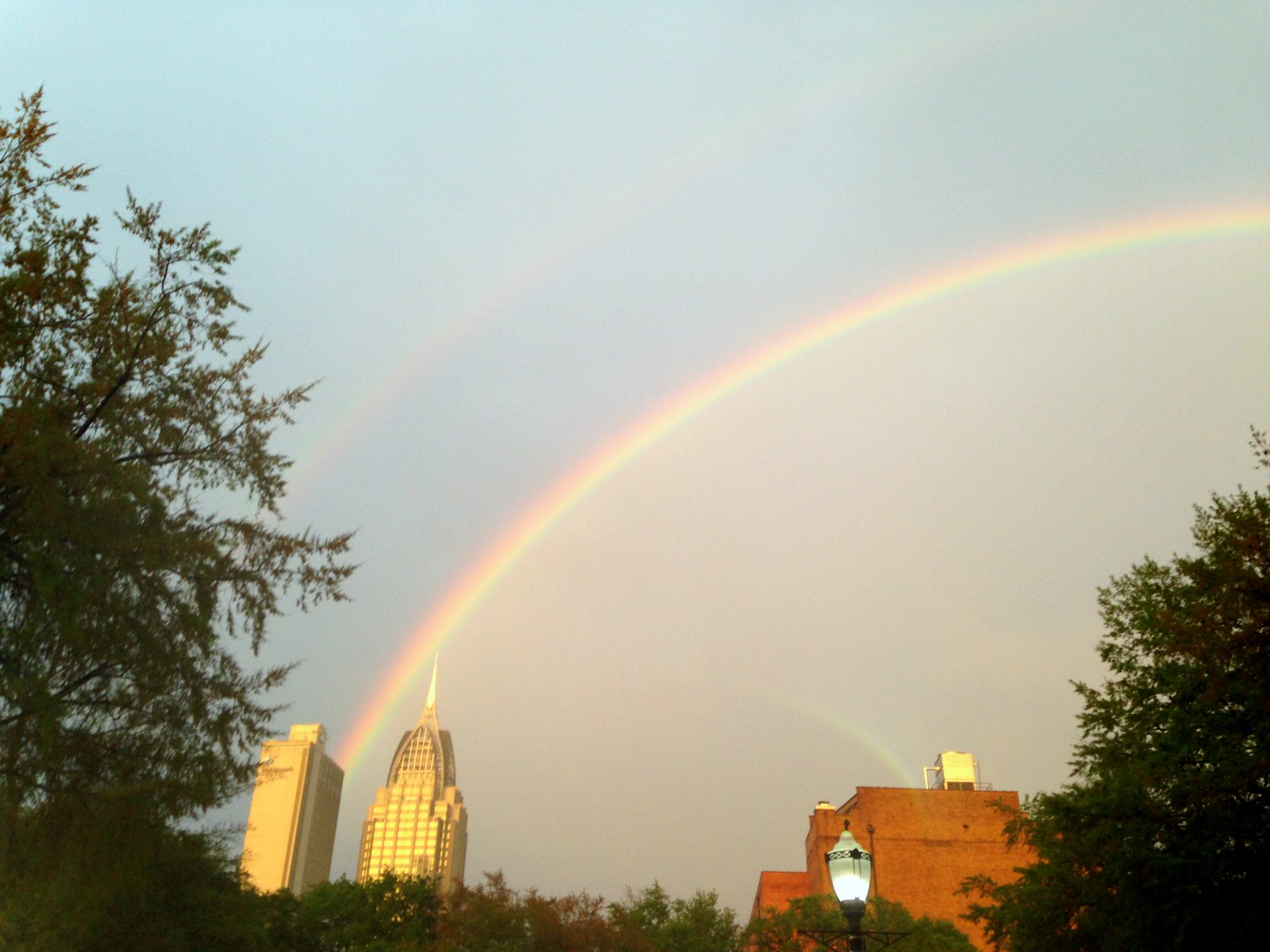
We went to the cathedral in Mobile for Mass on Holy Thursday. This was the view when we came out. The whole arc of the brighter rainbow was visible, though partly obscured by trees.
 Light On Dark Water
Leave a reply to Robert Gotcher Cancel reply