I finally decided to pay a little attention to the Jordan Peterson phenomenon, which I have pretty much been ignoring. I first heard of him by way of this post by Neo-neocon, in which she discusses the video in which Peterson is interviewed by an apparently well-known British journalist named Cathy Newman. I soon realized that Peterson's work in general, and his persona, and this video in particular were becoming famous. And I thought Neo's analysis of the interview was fascinating, as she notes the ways in which Peterson uses (so she says) the techniques of a psychotherapist (which he is) to deal with Newman's hostility and her attempts to paint him as a Bad Person. Newman is fond of the low "So you're saying…" gambit, widely favored in political arguments.
"I think nations have the right to control their borders."
"So you're saying immigrants have no rights."
Both sides do it of course.
"I think we have an obligation to take care of immigrants."
"So you're saying we should let the whole world move in and go on welfare."
I thought it was a good thing that someone successfully countered the bullying of a TV journalist, especially someone asserting reason and fact in the face of ideological-emotional aggression. But I did not actually watch the video. (I don't usually watch news-related videos, or for that matter listen to podcasts. I'm not sure exactly why but it often has to do with impatience–just give me a transcript and let me read it, which will take a lot less time than listening to you say it all.)
I didn't, however, intend to investigate Peterson any further. If a writer of self-help books is writing sane advice in defiance of popular cant, good for him, but a book called 12 Rules For Life is on the face of it not my cup of tea.
Then I saw a piece by Caitlin Flanagan of The Atlantic called "Why the Left Is So Afraid of Jordan Peterson." Caitlin Flanagan is usually interesting; she is one of those people who are more or less on the progressive side but don't wear ideological blinders, so I thought I would read the piece. But I had not gotten around to it when I came across a rather fevered attack on Peterson by a liberal Catholic on Facebook (friend of a friend kind of thing). He may be a theologian. At any rate he's pretty knowledgeable on the subject, and went into a vigorous attack on Peterson's ideas as being incompatible with various Catholic beliefs as articulated by various theologians. I thought this was odd: why get upset about a non-Catholic psychologist's deviations from Catholic teaching? I'm not perturbed by Oprah's heterodoxy.
That caused me to go and read Flanagan's piece. Now I understand. I'll let her say it:
The left has an obvious and pressing need to unperson [Peterson]; what he and the other members of the so-called “intellectual dark web” are offering is kryptonite to identity politics. There is an eagerness to attach reputation-destroying ideas to him, such as that he is a supporter of something called “enforced monogamy”….
There are plenty of reasons for individual readers to dislike Jordan Peterson. He’s a Jungian and that isn’t your cup of tea; he is, by his own admission, a very serious person and you think he should lighten up now and then; you find him boring; you’re not interested in either identity politics or in the arguments against it. There are many legitimate reasons to disagree with him on a number of subjects, and many people of good will do. But there is no coherent reason for the left’s obliterating and irrational hatred of Jordan Peterson. What, then, accounts for it?It is because the left, while it currently seems ascendant in our houses of culture and art, has in fact entered its decadent late phase, and it is deeply vulnerable. The left is afraid not of Peterson, but of the ideas he promotes, which are completely inconsistent with identity politics of any kind. When the poetry editors of The Nation virtuously publish an amateurish but super-woke poem, only to discover that the poem stumbled across several trip wires of political correctness; when these editors (one of them a full professor in the Harvard English department) then jointly write a letter oozing bathos and career anxiety and begging forgiveness from their critics; when the poet himself publishes a statement of his own—a missive falling somewhere between an apology, a Hail Mary pass, and a suicide note; and when all of this is accepted in the houses of the holy as one of the regrettable but minor incidents that take place along the path toward greater justice, something is dying.
There is a joyous quality about those first two sides. The other two are good, but to my taste not as. "Turn On Your Love Light," which people of a certain age may remember hearing in Bobby "Blue" Bland's hit version on the radio ca. 1960, occupies all of side 3. Side 4 begins with "Death Don't Have No Mercy," a sort of gospel blues with typically stark lyrics:
Death don't have no mercy in this landCome to your house, he don't stay longYou look in the bed, see your mama is gone
Say what you will about summer in the South, it does frequently make available the experience of being soaked to the skin by heavy rain but not getting chilled. I had that experience yesterday. There's a creek that empties out into the bay near my house, and it wanders around depending on the prevailing winds and tides. I won't bore you with the details, but its course for most of this summer has been causing some extremely unwelcome beach erosion. So I've been trying to change its course by digging an alternative channel in the sand. I was doing that yesterday when this storm came up.
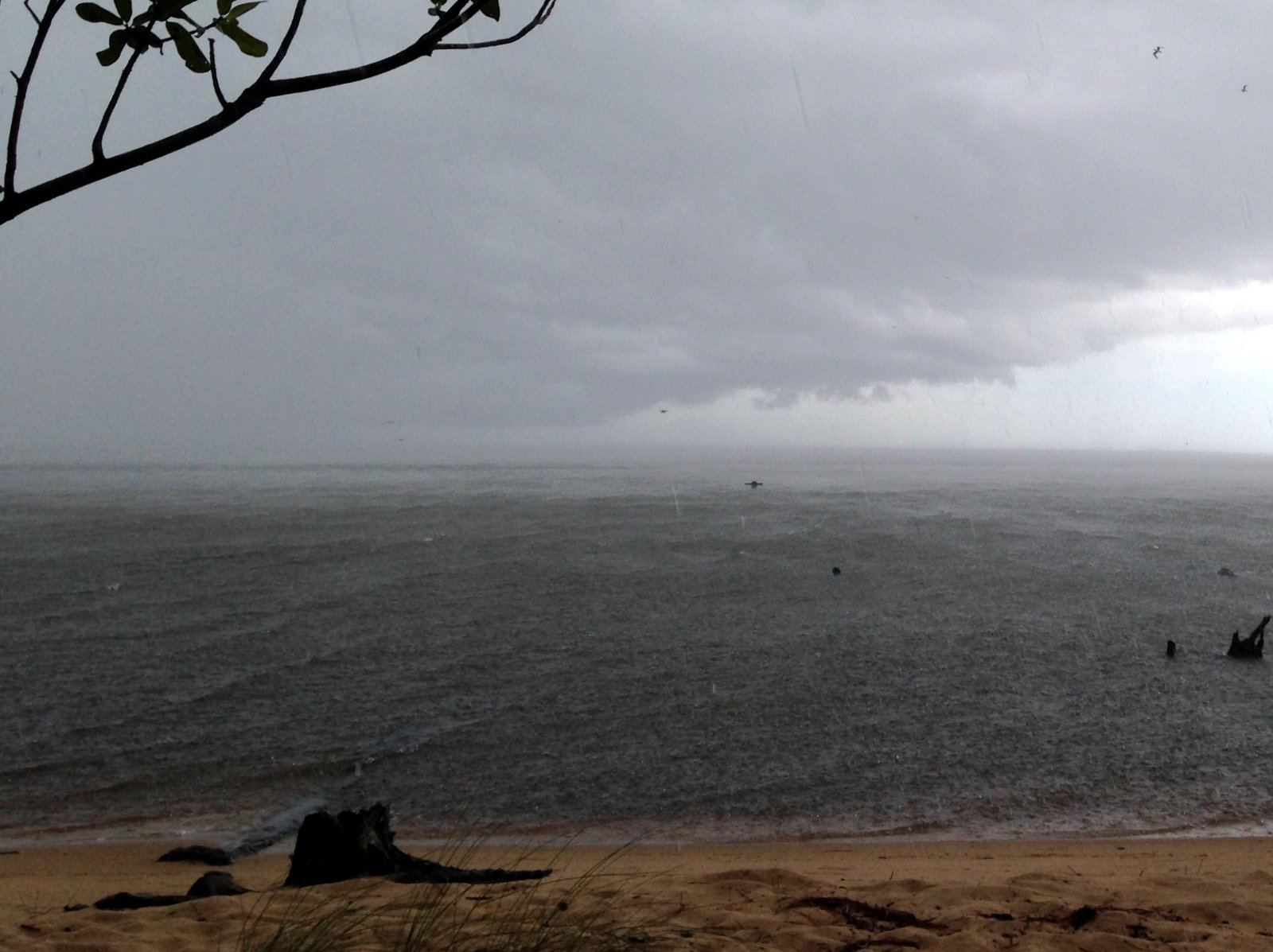 I just went on digging for an hour or so in the pouring rain, which was actually preferable to sun under those circumstances. Sand is heavy, and wet sand even heavier.
My channel was working when I left, but filled in again overnight, which I pretty much expected, because the tide was going to be pretty high. I had to try, though. Here is an instance from earlier in the summer where I succeeded. This is the day after the dig–the new channel is fairly well established.

Three or four days later:
The creek is still more or less in this position, though a bit further to the north (right). Better than it was, but I want it to be another fifty feet or so south.
 Light On Dark Water
Leave a reply to Mac Cancel reply