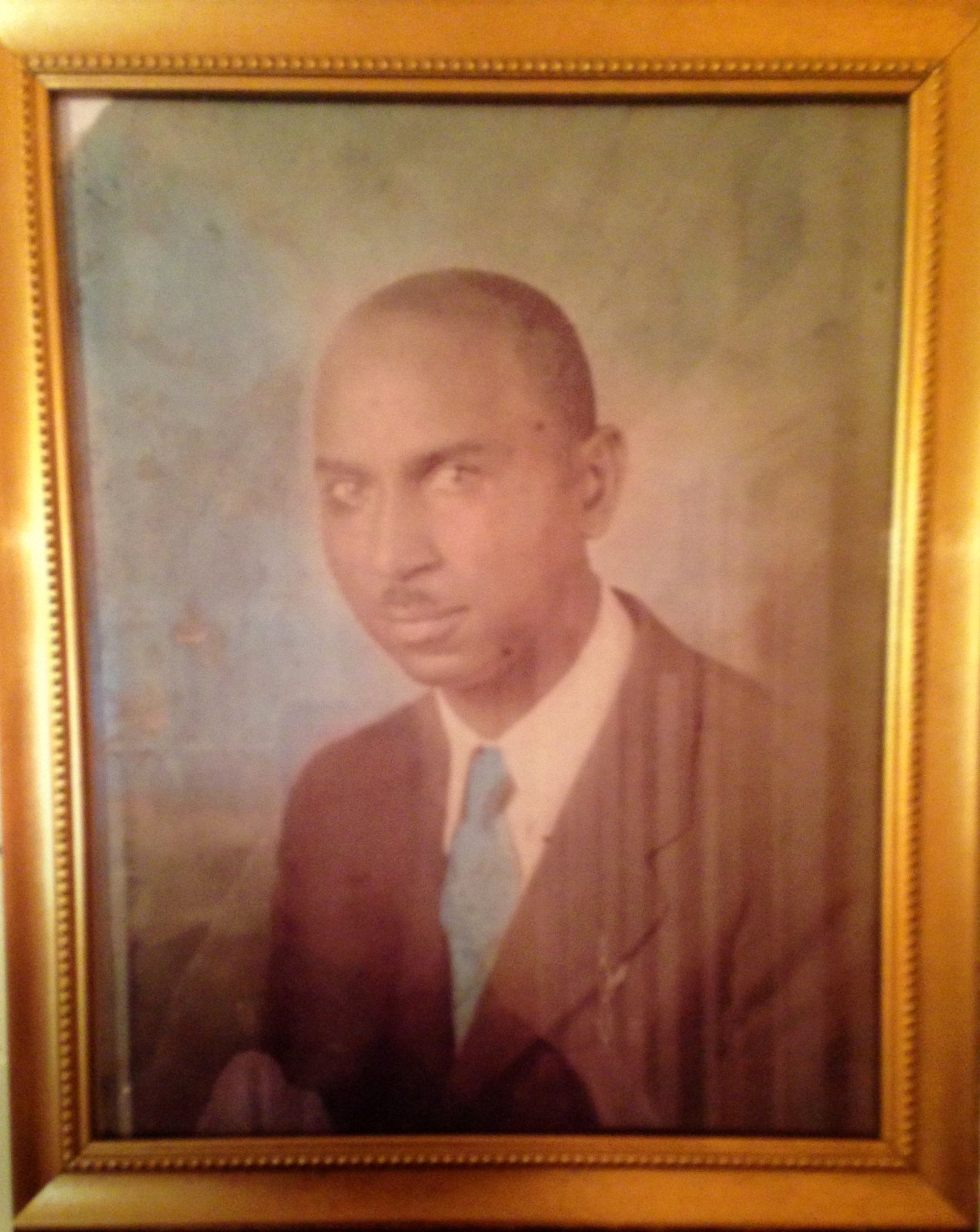
Several weekends ago my wife and I went to the opening at the Mobile Medical Museum of an exhibit which featured Dr. James A. Franklin, Sr., and his work: "Dreaming at Dawn: African Americans and Health Care, 1865-1945." This rather inadequate photo is of the portrait of him displayed in that exhibit:
This is a photo of the placard accompanying the portrait:
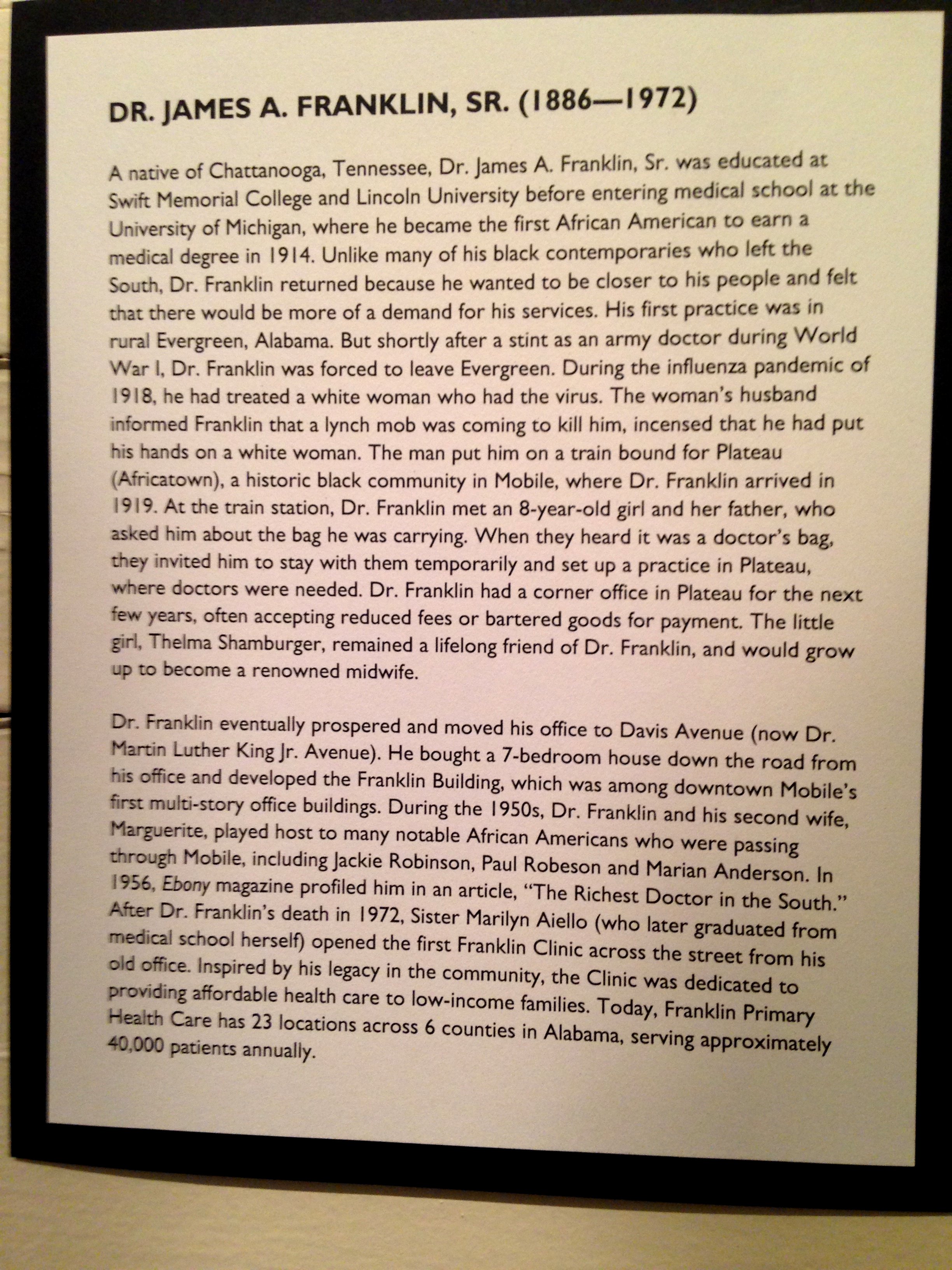
I don't know whether you'll be able to read it or not, so I'll give you the high points. James A. Franklin, Sr., was born in Chattanooga. In 1914 he became the first African-American to receive a medical degree from the University of Michigan. Instead of escaping permanently from the segregated South, he wanted to return there "because he wanted to be closer to his people and felt that there would be more of a demand for his services." (That last part was probably an understatement.) He landed in Evergreen, Alabama, a small town a hundred miles or so north of Mobile. During the 1918 influenza epidemic a local white farmer asked him to treat his wife. Franklin did–successfully, we were told at the opening–but then was forced to leave town under threat of being lynched for touching a white woman. He moved to the Mobile area and established a very successful medical practice, so successful that he was written up in Ebony magazine as "The Richest Doctor in the South."
I would not have known this was happening except that my wife is the archivist for the Mobile Archdiocese, and she had provided several photographs from the archives for the exhibit. This was one of them:
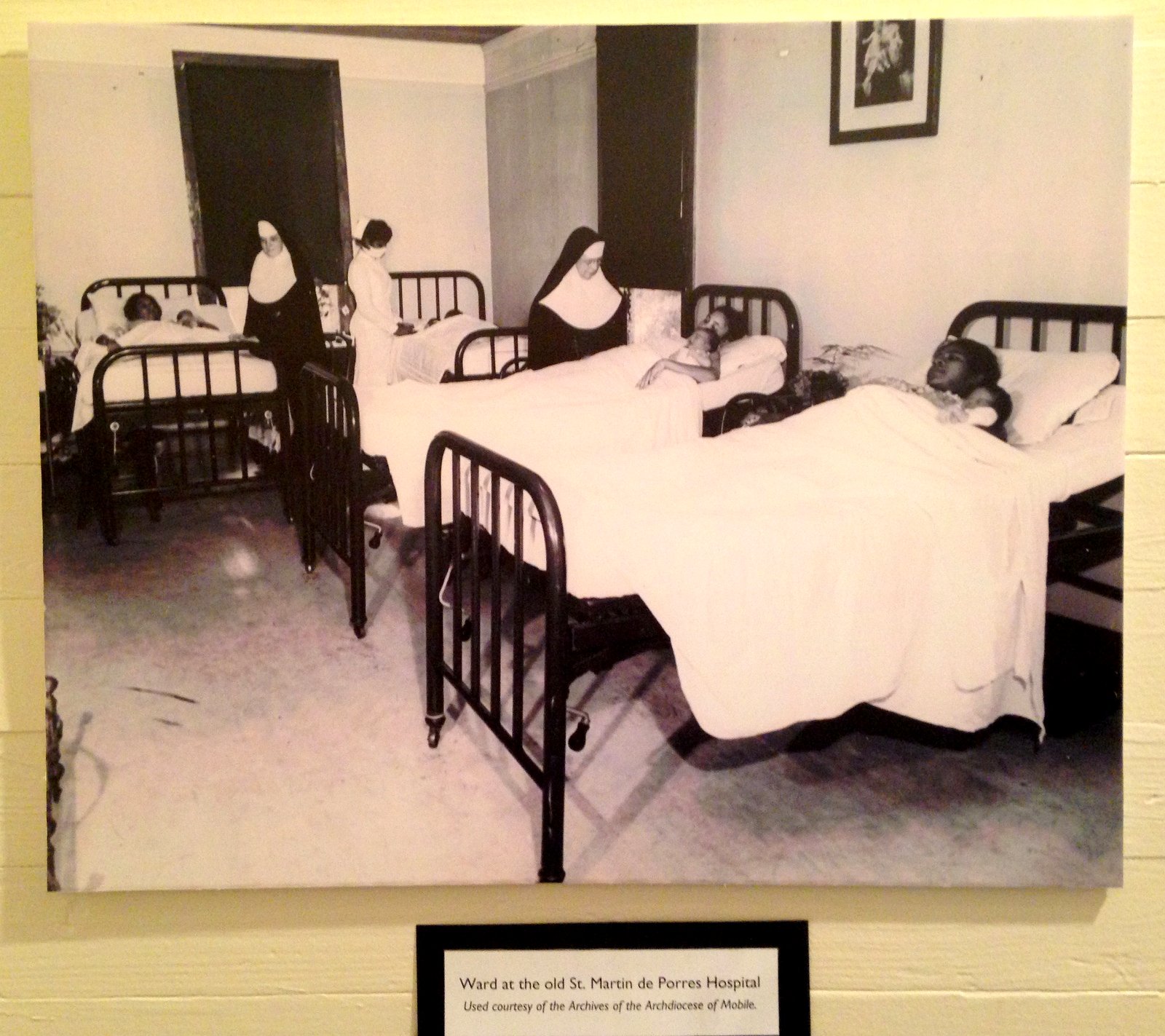 In case you can't read that card under the photo, the picture is of a ward in the St. Martin de Porres hospital, a Mobile hospital for African-Americans, established by the Archdiocese in 1947 and run (I think) by the Sisters of Mercy.
The opening was very simple affair but a somewhat moving one for me. A couple of prominent members of the black community gave brief speeches. I didn't catch the name of one (well, okay, I missed it altogether, because we were a little late), but the other was Karlos Finley, a well-known local lawyer/politician who is, if I understood correctly, the son of Dora Finley, who for many years was the regular Sunday morning lector at the Cathedral and whose father was Dr. Franklin. Also present were several teenagers, Karlos Finley's children, Dr. Franklin's great-grandchildren, which I found particularly touching.
I was moved both by Franklin's story, by what he did in the face of racial hatred, and also by the distance we've come in removing racial barriers and hostility. Sometimes, reading the national news, and even more reading national opinion, I feel despair about the racial situation in this country, and fear that we are heading in a direction that can only lead to more and worse conflict. There are a lot of people, or at least some very loud and prominent ones, who seem intent on inflaming racial hostility and grievance rather than working for harmony. In a strange twist, the loudest, most prominent and prestigious of these are now on the left, where for many the comprehensive racialization of almost everything seems to have mostly replaced the old liberal ideal that race shouldn't matter. In an even stranger twist, many of these are white people vilifying other white people–but then that's basically just another front in the culture war, another reason to hate the enemy whom you would hate in any case.
I think some of this is fueled by people who see our existing problems and despair. And I also think most of these are too young to understand just how much things have changed for the better, and might not despair if they did understand it. No one under sixty or so can have much personal memory of it; for younger people, segregation and the civil rights movement are just things in history books. But I saw them both, up close, and I remember it very well, and I know that the change has been vast.
I'm encouraged by the fact that the vitriol that emanates from the most politically vocal, and the conflict that seems to exist in some places, mainly the big cities, just don't seem to be major factors in everyday life where I live. I would certainly not claim that the Mobile, Alabama area is a paradise of racial harmony. Tensions exist. De facto segregation very much exists. I'm sure old-time hard-core racism still exists, though it isn't respectable.
Yet I don't have the sense of intense and furious conflict, of outright hatred at work, that I get from activists and the media. People get along tolerably well. They are reasonably courteous in public spaces, they work together, go to school together, shop together, eat at the same restaurants, cheer the same football teams, which are often predominantly black but no less loved by white fans. Social interaction is less common but it certainly happens. Inter-racial dating and marriage happen. Black politicians can get elected with a fair share, in some cases a majority, of the white vote. Fairhope, where I live, is a predominantly white town which had a black police chief until he retired a couple of months ago.
My local grandchildren started attending a "magnet" school this fall–a predominantly black school, in a less-than-upscale area of town, which emphasizes academics in an effort to attract white students and achieve more racial balance. My wife and I went to Grandparents' Day there a couple of weeks ago. We found neat and orderly classrooms full of bright and eager children, teachers who struck me as sharp and engaged, and a lot of very attentive parents and grandparents. My grandsons are in the minority there, but at least at this point (middle school and high school may be a different matter) I'm not worried about them. (I mean, about their schooling. I'm plenty worried about a lot of other dangers they face in these times.)
And so on. In short, the problems are real, and I emphasize that I'm not denying them. But they don't seem apocalyptic.
*
On Tuesday night I went to see Dylan at the Saenger in Mobile. I hadn't planned to go, as the tickets were expensive and I've seen him three times before, but the mother of the two aforementioned grandchildren talked me into it. "It may be the last time he ever tours!" And it may very well be, as he's 77. I was glad I went. You don't go to a Dylan concert to hear a reprise of his greatest hits of days gone by, as you might with some old band of the '60s or '70s (or '80s or '90s) which hasn't done anything very interesting for a quarter of a century or more. You go to hear him rework those old songs, and some new ones, with the help of a really fine band. For the most part the songs are unrecognizable until or unless you make out some of the words. And the results are often really effective, in spite of the fact that I'm not sure Dylan's vocalizing now should even be called singing. My only real complaint was that they were too loud for the space, so that the sound bounced all around and muddied everything up. I was sorry I hadn't brought earplugs, not to protect my ears–it wasn't that loud–but to suppress the sludge and clarify the sound.
Some YouTube user called Sad Eyed Lady Of The Lowlands has posted a lot of audio-only recordings of recent Dylan concerts. They sound very much like the one I heard, with very similar set lists. Here's one from just a couple of weeks ago, in Tucson. Click on "Show More" and you'll see a set list with links which will take you to specific songs. Try a couple that you know well and you'll see what I mean.
By the way Dylan never so much as touched a guitar during the performance. He was behind a piano except for two songs where he stepped out and sang at a standalone microphone.
 Light On Dark Water
Leave a reply to Stu Cancel reply