Górecki: Symphony #3

Subtitled "Symphony of Sorrowful Songs." If you were paying much attention to music in the early 1990s, you probably were aware of it, even if you weren't especially interested in contemporary classical music. This recording was something of a crossover hit:
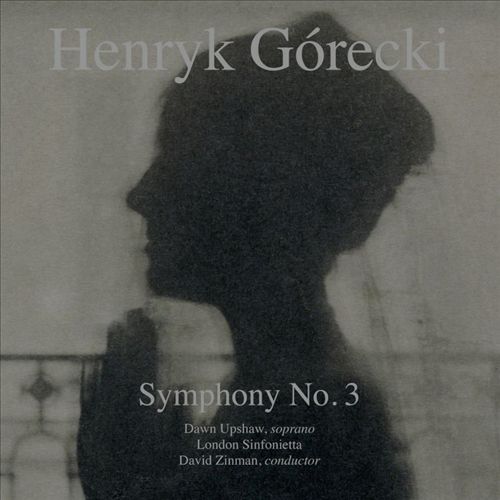
Gorecki3You can read all about the piece itself and its fortunes, especially the fortunes of this recording, at Wikipedia. I bought it, though it must have been somewhat after its heyday, because I don't think I had a CD player in 1992. And I have to confess that I didn't really listen to it very closely. I thought "Well, that's nice (in a slow-moving, almost ambient sort of way)," and was glad that so many people were drawn to it, and at least not put off by its religious imagery. I also confess that I heard a couple of dismissive critical opinions and thought perhaps those critics might have a point, that it is fundamentally a bit on the dull side, and probably over-rated. This idea got a further grip on me because I listened to it in the car, where some significant portions of it are inaudible.

Rob G mentioned here recently that a new recording in which Beth Gibbons (of the band Portishead) is the soprano will be released soon. As I said in that discussion, I can't imagine her singing it. I mean, I guess as classical vocal music goes this is probably not the most demanding, but I would think singers who aren't trained that way would find it pretty difficult. 

Anyway, that conversation caused me to put the CD on, sit in a chair, and listen attentively. And I hereby renounce all my reservations. This is a beautiful, powerful work. I'll leave it to the listeners and critics of the future to decide on its true and permanent place in the scheme of musical things, but I think it's extremely good.

It always seems a little weird to select and recommend music for Lent. Silence is probably more fitting. But if you do want to hear some appropriate music, this certainly qualifies.


,

15 responses to “Górecki: Symphony #3”

  1. “put the CD on, sit in a chair, and listen attentively”
    Good to hear that I’m not the only person I know that still does this. 😉
    Although the Upshaw/Zinman recording is widely considered the reference recording for this work, I prefer the recording on Naxos with Zofia Kilanowicz and Antoni Wit. Kilanowicz’s use of vibrato is less prominent than Upshaw’s, and she also has a way of finishing some of her lines with a slide, a technique that recalls folk rather than typical operatic singing.
    Also there’s just something about having all Polish forces perform a work that’s so steeped in Polish history and religion. There’s no way to tell whether this resulted in a recording that has more emotional depth or “feeling,” but one could imagine that a certain heightened sympathy might be present in the performance.

  2. Someone who speaks Polish tells me that it’s better if you know Polish. Probably so.
    I think it’s unusual for the Naxos recording to be preferred. 🙂

  3. I think that was probably true about Naxos in its early days, but they’ve come a long way. I think that they now regularly receive awards and nominations just like the biggies!
    Although I bought it quite a few years after it came out, I recall the Naxos version having several very strong reviews, which is probably why I bought it (I already had the Upshaw/Zinman CD).

  4. My experience (very limited) is that they’re not bad but not the best. I’m sure there are a lot of exceptions, especially once you get outside the standards.

  5. Yes, it’s in the realm of the standards where they’re most likely to suffer by comparison, if only due to the huge amount of competition.

  6. https://www.gramophone.co.uk/review/g%C3%B3recki-symphony-no-3-olden-style-pieces
    A review from the time of the Naxos CD’s release. I find it interesting that what I described as Kilanowicz’s voice having less vibrato the reviewer puts down to a conscious interpretive move on her part to at times suspend it.

  7. Very interesting. So I wasn’t mistaken in my impression that the symphony is sort of looked down on by critics.

  8. grumpy in recovery

    hello I am just taking Laetare Sunday off from Lent. Can anyone say where the LODW discussion about Julien Green was?

  9. This is the blog post where I talked about having just read it:
    https://www.lightondarkwater.com/2018/09/sunday-night-journal-september-9-2018.html
    And it’s mentioned in the comments on this post:
    https://www.lightondarkwater.com/2018/09/sunday-night-journal-september-9-2018.html
    But all we said about it there was that we remembered it being discussed more extensively sometime in the past, and that it must have been back when I was using Haloscan for comments, which is quite some time ago now, and so those discussions were lost, alas.

  10. Hope your wrist is healing well.

  11. Thanks very much! Its very slow change is gonna come I hope

  12. It probably will. At a certain age it does come more slowly.

  13. Got the Gibbons/Gorecki album and listened to it over the weekend, but I think I’m going to have to give it another spin to be able to talk about it intelligently. My initial reaction is that it’s very good, with the positives considerably outweighing the negatives. But that may change somewhat one way or the other, after the novelty of hearing a non-operatic voice singing the thing wears off a little.
    The aspect of the performance that makes me initially most indecisive is Gibbons and the high notes. She quite obviously is at the very top limit of her register at certain points — her voice at times seems close to breaking. But in a strange way this corresponds well with the texts, and adds an element of human fragility to the performance. Gibbons’ voice usually has a jazzy quality to it, but the thought that came to mind several times while listening to this was, “She’s singing it like a folk singer would.” Which in a lot of ways makes sense, given that the three tunes included in the symphony are based on folk songs. So what you’re getting here is Gibbons not channeling Billie Holiday, but Sandy Denny.
    More after a second listen.

  14. That’s more or less in line with what I expected. I can well imagine a non-classical voice being effective in many ways, but just not being able to negotiate some of the technical demands very well. Anyway, I’d like to hear this though I don’t know if I’ll buy it.
    Ah, it’s on Pandora, so I’ll get to hear it.
    You’ve probably seen this already, but here’s an account of how the recording came to be:
    http://bethgibbons.net/info/

  15. Actually I hadn’t seen that — very interesting!

Leave a reply to Rob G Cancel reply