I did manage to read this book over Lent, as I had intended. That may not sound like much of an accomplishment; in fact it's not that much of an accomplishment. But it's a long book, 600-plus pages, and a fairly dense one. And aside from my disorderly and distracted temperament and habits, decades of giving priority to almost everything else over reading have left me with a deep sense that reading is at best just barely above Doing Nothing, which is to say Wasting Time, which means that I feel uneasy about it, and guilty if I do it for very long.
But enough about my hangups. This is a great book, and I might even be justified in saying that it's a Great Book. I'd been wanting to read it for years, and now that I have I'm thinking of making it a Lenten thing every year. Whether or not I actually do that, there's no doubt that it is worth re-reading.
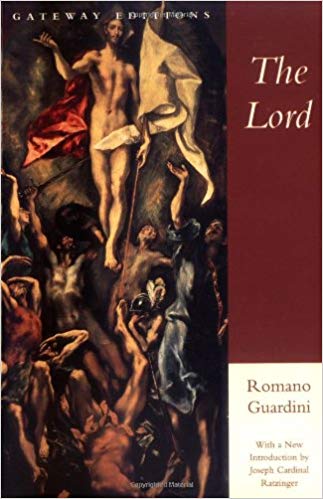
It's essentially a commentary on the New Testament, primarily the Gospels and the Apocalypse. I must say that the word "commentary" applied to scripture is not a word that awakens eager anticipation in me. Perhaps that prejudice arises from a few old and as far as I know never-read volumes in the ancestral bookcase in the house where I grew up. Its shelves were filled with volumes going back to the early nineteenth century, and they mostly looked dull, or even forbidding, to me. Some should have interested me: Scott's novels, for instance. Some of the religious titles seemed to capture in a physical way the dullness of a species of Christianity that, after the Enlightenment, was stranded between emotional evangelicalism and liberalism.
So I'll dump the word "commentary" and say that this book is a very close and impassioned reading of the text. The best way for me to communicate that is to give some examples. If you've been reading this blog during Lent you've seen some: this, this, this, this, and this.
I left roughly two dozen book darts attached to the pages (book darts?) , sometimes pointing to a paragraph or two and sometimes to an entire chapter. There would have been more but sometimes I didn't have the darts handy. Here is one such passage. It appears late in the book, in a chapter called "The Great Sign in Heaven," in the section on the Apocalypse. That section was for me one of the most enlightening: it produces from the text a kind of order which is intelligible–to a degree–without attempting to reduce it to simple allegory or to pin the content of the visions to specific earthly things.
But aren't we distancing ourselves from the simple meaning of the Gospels and the pure reality of Jesus? Isn't this after all more like mysticism and metaphysics? We must not be intimidated. The simple meaning of the Gospels–what is it? The pure reality of Jesus–which? The Gospels are anything but simple in the sense meant in the objection. Jesus is not at all the pure figure which criticism suggests. Behind these tenets stands a dogma–a shadowy, modern, man-made dogma–according to which Christian essence means pious humanism. The Gospels, however, know nothing of the sort, and before they can be made to read so, piece after piece must be eliminated on the excuse that it had crept in under foreign influence or was the product of collective elaboration. What then would be the significance of Revelation, or of faith? Then we human beings would be taking it upon ourselves to decide what is or is not divine. Then redemption would lose its power, for this self-doctored Christ would no longer redeem, but would only confirm our will. No, only one attitude towards Revelation is valid: readiness to hear and to learn.
That last sentence serves very well as a description of Guardini's approach throughout. Here are a couple of fairly brief intro-to-Guardini pieces, one in the National Catholic Register and one in Crisis. I note this observation in the latter: "the textbook Thomism devised as a bulwark against the errors of Modernism left him cold." I can certainly sympathize with that. The primacy given to dogma among many of Thomas's disciples is not necessarily wrong, but it does sometimes give an impression that correct doctrine is the only thing that really matters, whereas it is a necessary-but-not-sufficient thing. Doctrine and devotion may be different things, but they are not in opposition, any more than flesh and bone are in opposition. Either without the other is…well, the images summoned by that idea convey the magnitude of the error pretty well, with no need for more words.
I've long felt that Joseph Ratzinger/Pope Bendedict XVI was at least very high among the wisest of churchmen in our time, perhaps the wisest. And he was greatly influenced by Guardini. Maybe that means I'm now a Guardinian. Pope Francis also is said to follow Guardini in much of his thinking. So does that make me also a Bergoglian? Well, I wouldn't have said so, but it's okay. My reservations about Pope Francis have to do with his governance of the Church, not with his theology. At least not necessarily–it isn't always clear exactly where he stands.
 Light On Dark Water
Leave a reply to Cyrus Brewster Cancel reply