I mean the one in which they accuse Pope Francis of heresy. I've only read the first page, at which point I scrolled down to see the list of signers. The only one I recognize is Fr. Aidan Nichols, O.P. I've read several of his books and he is certainly not any sort of crank. Or at least he hasn't been in the past. I can only conclude that either there is something to the charges, or that Fr. Nichols has made a mistake in judgment.
The first page includes the first charge: that the Pope has "publicly and pertinaciously demonstrated his belief" that
A justified person has not the strength with God’s grace to carry out the objective demands of the divine law, as though any of the commandments of God are impossible for the justified; or as meaning that God’s grace, when it produces justification in an individual, does not invariably and of its nature produce conversion from all serious sin, or is not sufficient for conversion from all serious sin.
I've heard more or less the same charge from people who are theologically educated and are not cranks. It may be justifiable. Nevertheless, I don't plan to get into the controversy any further than the preceding remarks. It's been raised in a Facebook group for the Ordinariates to which I belong, and I posted the following comment there. I guess it's partly or mainly just an occasion for me to say something I've wanted to say for some time. And I want to say it more publicly.
This is a sort of meta-comment, about why I am not going to comment on the letter: as a lay Catholic with no knowledge of theology beyond some basics, I do not consider myself qualified or entitled or obligated to call anyone a heretic on any grounds more subtle than something like denying the physical Resurrection. This is much more emphatically the case where the accused is the pope. The same basic principle applies to the signatories of this letter: I am not qualified to evaluate their arguments.
And on a personal level I have, in my going-on-40 years as a Catholic, become almost as sick of heresy-hunters as of heretics, especially of self-appointed heresy-hunters among the laity. By "heresy hunters" I mean those who are clearly looking avidly for anything that can be construed as heresy or just savoring of it. I have had a lot of reservations about Pope Francis and in particular about his governance, and have said so publicly. I had misgivings about him from the beginning, initially for nothing any more concrete than "I've got a bad feeling about this," and I think they have been somewhat justified. Somewhat. But I have deeper reservations about the anti-Francis people who seem determined to put the worst possible construction on everything he says.
(That emphasized "Somewhat" was not in the Facebook post, because you can't do italics in Facebook comments.)
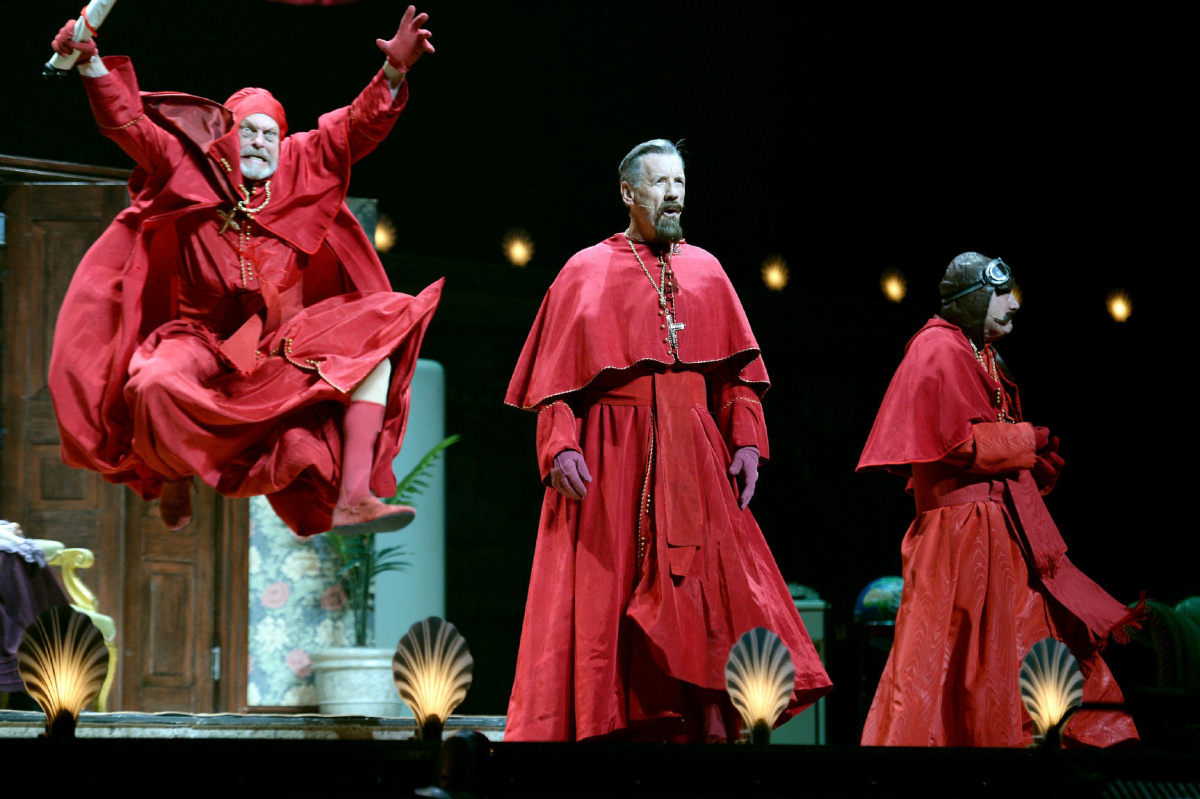
The inquisitorial spirit I'm talking about is partly a somewhat (at least) understandable reaction against the toleration and even advocacy of heresy on the part of many elements of the Church, most harmfully within the hierarchy and the academic establishment. I was an enemy of what can loosely be called Modernism as soon as I understood what it was, and I still am. But the inquisitorial impulse quite clearly often has a strong taint of pride and malice. And is probably at least as great a risk to the soul of the person exercising it as the profession of doctrinal error.
 Light On Dark Water
Leave a reply to Marianne Cancel reply