As I approached the end of The Mill on the Floss I was, naturally, thinking about what to read next (what novel, I mean). I think I mentioned in a comment that I was trying to decide between two re-reads, Dostoevsky's Demons and Kristin Lavransdatter. (Interesting that I name the author of the former but not the latter. I think that's because Demons seems to me a not entirely distinctive title; it would not surprise me to learn that there are quite a few other books with the same title. And also because the name of the book was established in my mind long ago as The Possessed.)
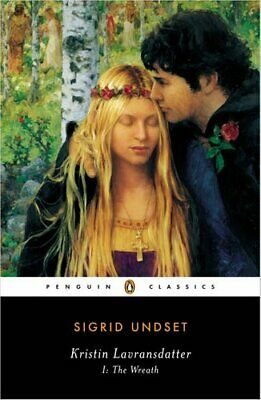 This is the cover of the edition I'm reading.
When I read Kristin back in the 1980s, the only available translation was the Archer one made in the 1920s. (Archer and Scott for the first volume; I do not know anything about either of the men.) A new one, by Tina Nunnally, appeared around 2000 (as best I can tell), and seems to be generally considered a great improvement over the old. But as a casual reader I don't find this to be obviously or entirely so.
The most significant charge against the old translation is that it is written in a deliberately archaic style which is not Undset's and which presents an obstacle to the contemporary reader. Well, the second of those is certainly true, and I will have to take the word of those who can read the original that the first is also. But one doesn't have to read Norwegian to know that Archer's English is not that of Kristin's 14th century, which was what we now call Middle English. It's closer to that of the 16th and early 17th centuries: much use of now-obsolete words and phrases–"I trow" and "I wot" and "'twere" and all that sort of thing. So it seems questionable on that ground, and I would like to know Archer's justification for his practice. And in general his prose leans strongly toward sentence construction which is at the very least old-fashioned to us. Here's one simple and straightforward sentence, chosen more or less at random from the opening pages of the book:
When the child Kristin was seven years old, it so fell out one time that she got leave to go with her father up to their mountain sæter.
One day when the child Kristin was seven years old, she was going to accompany her father up to their mountain pastures.
I don't think I need to tell you which is which.
As in this example, Nunnally's prose is certainly simpler and more clear, but it's also without character. I don't recall encountering anything in this volume which would be out of place in an ordinary magazine or newspaper story of our time. But neither do I recall lingering over any sentence for its elegance or flavor. I won't say it's clumsy, but I won't say it's graceful, either. Maybe I would think the same of the original; maybe Undset wrote a straightforward and not particularly rich prose.
Nunnally's simplicity certainly makes for an easier read. Archer's prose can be something of a struggle, but I breeze right through Nunnally's without conscious effort. Whether anything is being lost I really can't say with any authority, but as the two sentences above indicate, there are often differences of nuance: "got leave to go" and "was going to accompany" are not interchangeable. And "sæter" does indeed mean "mountain pasture," but with implications not present in the latter term; see this in Wikipedia. I have found myself sometimes opening the Archer translation to read his version of a paragraph, just to see if there is something I may be missing. And if it so falls out that I read the trilogy a third time it may be Archer's version again.
The Nunnally translation is said to restore some passages that were omitted in Archer's, including some with more explicit depictions of sex. If there were any of the latter in The Wreath, I didn't notice them, and one would think, considering the events narrated, that these would appear here if anywhere in the trilogy. I think I also read somewhere that Undset's style had at least sometimes a more modernist bent, but I see no trace of that, either.
In one respect I prefer Nunnally's translation without reservation: it is issued in three separate volumes. This makes the simple physical act of holding the book and reading it much more comfortable. It also has the psychological effect, for me at least, of making the trilogy seem less daunting: yes, I confess that I am daunted by a very long book, and tend to view it as a task to be completed rather than a pleasure to be anticipated. This is at least partly, I guess, the effect of my desire to read every worthwhile book ever written, which makes me just very faintly resentful when one book demands considerably more time than others, though all that disappears if the book is engaging enough.
The three volumes also make it convenient for me to absorb each separately, as Undset presumably intended (and to write about each in a separate blog post).
In any case, Kristin is more than worth it. Pros and cons of the translation argument aside, I am at least as impressed with the work now as I was on first reading. I had forgotten most of the details of the story; all I had left was the general outline. I recalled it as moving from one disaster to another, and my memory was accurate. The Wreath takes it up to the marriage of Kristin and Erlend. And reading it as a separate novel from the rest makes the impact of certain events, especially those happening right at the end, more concentrated and accordingly more affecting and memorable; you don't just turn a few pages and press on immediately.
There must be thousands of novels that could be broadly described like this one, apart from the medieval setting. "Sprawling family saga" is the typical blurb language; "one woman's story of love and loss." Etc. And no doubt some of them are good stories. Some stories can keep our attention almost independent of the telling: Crime and Punishment would be an unusual and interesting story in anyone's telling, as would The Lord of the Rings, and many an adventure story of no particular literary merit. But when the story is the more or less ordinary events of more or less ordinary lives, what makes a novel great?
One huge element–the biggest, I think–is the almost magical ability of a very few writers to make their characters live. I say it's almost magical because there doesn't seem to be any particular thing that creates the effect. It isn't a matter of detailed description of scene or action, or of extensive forays into the inner life of the character. It can be done with comparatively few strokes of that sort. If I were to examine the first few chapters of The Wreath carefully, I doubt I could say "I see–it's this, that, and this other thing" that make Kristin come alive. But she very much is by that point. And it's not only that characters created by this gift come alive; they engage us, even fascinate us, and we come to care about them.
As I mentioned, I didn't remember many details from my first reading, and had entirely forgotten a number of relatively minor characters. But I've remembered Kristin and Erlend, and Lavrans and Rangfrid, very vividly for somewhere close to forty years.
I'm now a hundred pages or so into the next volume, The Wife. Already I can see Kristin storing up the resentments, the far from unjustified resentments, which will be the source of so much trouble. The back-and-forth of wounding and being wounded between Kristin and Erlend is, I remember now, one of the saddest aspects of a very sad story–sad, and, to resort to the language of blurbs, unforgettable.
 Light On Dark Water
Leave a reply to Janet Cancel reply