I’m actually not a grammar martinet, although it may sometimes seem that way. I’ve never paid a lot of attention to rules of grammar, not in the sense of being able to state them, and talk of verb tenses and such usually confuses me. It’s just a matter of what sounds right or wrong, very much like hearing the right or wrong notes in music (leaving out the case where the “wrong” one is deliberately used, or the whole idea of wrongness is being subverted). Certain grammatical errors give me something like the pain of hearing a bad mistake in music.
One of these is the “lie-lay” distinction. I can’t quote the rule that governs them, but I know that “I’m going to go lay down” hurts my ears. This is now so common that the incorrect use probably occurs more frequently than the correct. The trend has been in place for a long time now. There were always a fair number of people whose native usage, so to speak–what they had grown up hearing–was the incorrect one. Teachers tried to change them, but it didn’t always work (to say the least). I remember when I was getting physical therapy for a back problem thirty years ago that the therapist would instruct me to “lay down” and do this or that exercise.
So I thought I was pretty much reconciled to the fact that this is a lost cause. But I had that realization driven home definitively a few weeks ago when I read a sentence written by someone with a PhD that went something like this: “Beneath this concern lays this other concern…”. It was not a PhD in science or engineering where language is merely functional, but in theology, where words are hugely important. (I do know where I read it, and just checked again to make sure I wasn’t misreading the text, but am not going to identify it, partly because I see no reason to expose the writer to ridicule for his grammar or myself to ridicule as a grammar martinet. Anyway, it’s possible that it was only a typo.)
Anyway, I think that use of the word “lie” is actually passing out of use altogether, with only the other word, “lie” as in “speak falsely,” remaining. Well, it’s certainly a word to which we need to resort quite often.
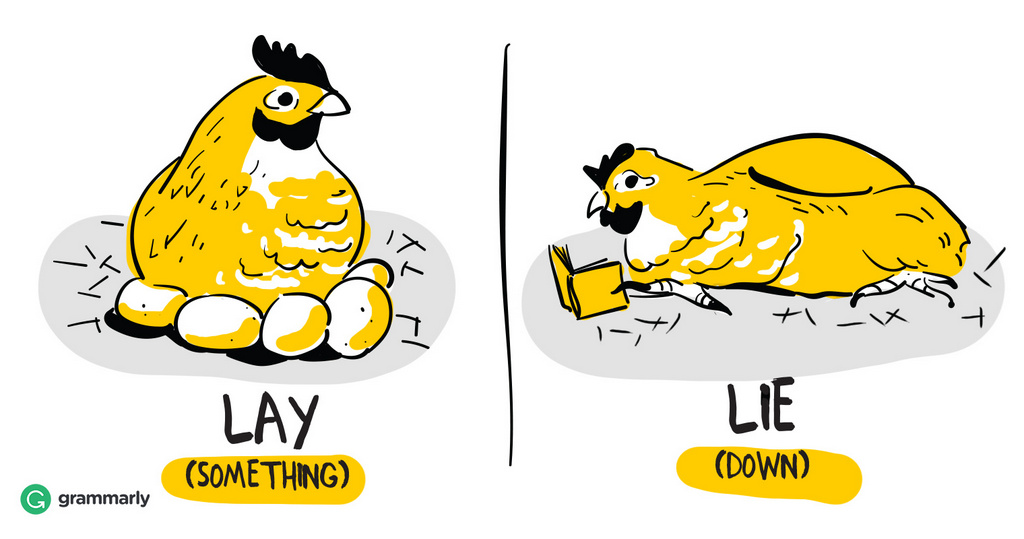
Oh, never mind (graphic from Grammarly.com)
EVEN THOUGH IT’S REALLY NOT THAT COMPLICATED IS IT?
 Light On Dark Water
Leave a reply to Anne-Marie Cancel reply