Hence, loathed melancholy. Something like that is what I'm thinking when I pick up a Wodehouse book. And it works, for when I'm actually engaged in the reading loathed melancholy is banished to its uncouth cell. (See the opening of Milton's "L'Allegro.") I feel the way champagne looks.
I can't remember where it occurs or even which of them said it, but either Lewis or Tolkien made a memorable response to the charge that the kind of fiction they wrote was escapism. Since I don't have it at hand, I will paraphrase broadly: people who want to escape are prisoners, and the people who don't want them to escape are jailers. And there are many good reasons why one wants, even needs, to escape.
There's a further point, which Tolkien at least made: that the world which he created was not safe, which one might expect (or at least hope) an escape to provide. On the contrary, though his work, and some of Lewis's, are set in nonexistent worlds, those worlds are hardly an escape from dark things. The central drama in their work is the conflict between good and evil, and the evil is real, serious, and deadly. Nor are the fictional situations idyllic: no one would want to be in Shelob's lair.
Wodehouse's work, on the other hand, can be fairly called escapist–pure escapism, in that the escape is complete, because his world is entirely apart from the one we shuffle around in. There is no real evil in it at all. At most bad things are glimpsed from a great distance, as in the character of Roderick Spode, a would-be fascist, based on Oswald Mosley and introduced in The Code of the Woosters. But nothing is said of the actual evil that he represents; he is simply mocked as a ridiculous figure: "Look at that frightful ass Spode swanking about in footer bags!" (football, i.e. soccer, shorts–his gang is called the Black Shorts, in mockery of Mosley's Black Shirts).
Nothing really bad ever happens in Wodehouse's world, and in fact a significant element of the humor is the disparity between Bertie's view of his really quite trivial troubles and reality–his fear of Aunt Agatha, for instance, or his desire to escape marriage–in the midst of which he fancies himself living up to a heroic family name (as The Code of the Woosters suggests).
Bertie as a satirical representation of an upper-class Englishman belonging to a club called The Drones is devastating, but when I'm reading about him I don't think of that connection to reality; I only see a goofy, bumbling, quotation-mangling young man of, as Jeeves puts it, negligible intellect. He and all the other Wodehouse creations live in a world which has only enough relation to reality to make it intelligible to us. This world and these people never really change across the decades and numerous novels in which they occur. And normally one might consider that to be a fault in a novelist. But they remain fresh because Wodehouse's gift for comedy never failed. So many artists (I think of pop musicians especially) have one or two spectacularly excellent works, but don't succeed either in getting out of their original pattern or equaling their best work in it, so that there are a few brilliant things and a string of others of which one says they are similar, but not as good. With Wodehouse it's as if the Beatles continued making albums similar to Revolver, yet of comparable quality, for decades. Somehow he managed to keep it fresh.
Waugh said it best, in a remark quoted on the dust jacket of all the Overlook Press editions:
Wodehouse's idyllic world can never stale. He will continue to release future generations from captivity that may be more irksome than our own. He has made a world for us to live in and delight in.
And which cannot be inhabited by melancholy; that's taken at the door when you enter. It will be a sad day for mankind when the only people capable of reading Wodehouse will be scholars of 19th and 20th-century English literature and culture.
So, about this particular book: it was published in 1949, well into Wodehouse's career, and by my count is the ninth of the Jeeves and Wooster series. I have to wonder whether Wodehouse, perhaps a little bored with the act, deliberately set himself the challenge of juggling as many balls as possible. In the other novels there is usually at least one romance to be threatened, rescued after many complications, and sent on its way to the altar. And frequently there's an anti-romance involving Bertie's attempts to avoid marriage. In this one there are no less than four romances, therefore eight lovers, with Bertie in danger of being captured by one of them, Madeleine Basset, if her engagement to Gussie Fink-Nottle falls through. The plot is wildly complex. Besides the four romances, Bertie and Gussie are obliged to impersonate each other, old friend Catsmeat Potter-Pirbright to impersonate Jeeves, Jeeves to pass as Gussie-Bertie's "man" under another name. And five aunts, not Bertie's but a menace to him nevertheless, in addition to Aunt Agatha. And a pest of a child, Aunt Agatha's son Thomas. And a dog named Sam Goldwyn. And a policeman.
It's a delight, as usual. I feel rather glum. Maybe I'll just read it again. 
The cover of the Overlook Press edition. That's Bertie, drinking port and singing.
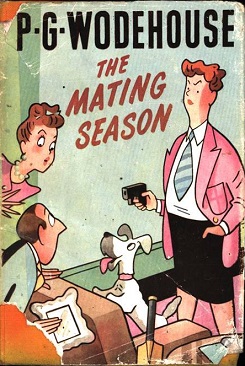
The original cover. That's Bertie behind the sofa.
 Light On Dark Water
Leave a reply to Anne-Marie Cancel reply