Don't be alarmed by the title, which I think is in fact a bit alarming. It strikes our ears as crude, at least, and is the product of a time and place in which Jews were seen as foreign and held in some suspicion, sometimes hostility. The time and place was a small town in Tennessee (fictionally named Concordia) in the 1920s, and the author of this book was the daughter of a Jewish merchant who, with his family, were the first and only Jews in the town, and whose store was therefore known to the town as the Jew store:
Bronson's Low-Priced Store was Concordia's "Jew store." There had been none until my family got there, and in those days it was the custom for every small Southern town to have one. A Jew store–and that is what people called it–was a modest establishment selling soft goods–clothing and domestics (bedding, towels, yard goods)–to the poorer people of the town–the farmers, the sharecroppers, the blacks, the factory workers.
Sure, "Jew store" smells of antisemitism. And the family did encounter hostility from some because they were Jews. But they thrived, and that was not unusual.
I long ago realized that the antisemitism of the South has been greatly exaggerated. Forty years after the Bronsons came to Concordia I went to high school in a southern town somewhat like it, though a little larger. I did not notice at the time that there was a small Jewish community there, that a couple of the stores on the town square were owned by Jews, and that a popular judge was Jewish. And that his daughter was the mother of one of my friends. I didn't notice it because it wasn't remarked. I never heard the term "Jew store," which either had never been used or had passed out of use by my time. And in any case there was more than one, and the clientele of Mr. Jaffe's department store was not considered déclassé–I recall my middle-class family shopping there.
There was a sort of pro-forma antisemitism among the same sort of people who take naturally to whatever form of bigotry is on offer. But that was something of an afterthought, amounting to little in comparison to the systematic oppression inflicted on blacks. Jews were safely on the "white" side of that divide. I can remember hearing only one explicit expression of antisemitism, and that was from a high school friend who was just trying to shock people. (I know enough of his later life to know that he outgrew that urge.)
It was even later that I learned that the situation in my town was, as Stella (Bronson) Suberman says, pretty standard throughout the South. There was in fact in the early 20th century a sort of mini-migration of Jews, recently arrived from Europe and Russia, to small Southern towns, where they opened businesses and prospered. The Bronsons were one of a great many families.
I say the Bronsons thrived, but not in every respect. The business thrived, and the husband liked Tennessee better than New York, and anyway considered that any difficulties they encountered had to be seen alongside others that they might have experienced elsewhere:
My father guarded against sentimentalizing Concordia, going "too easy" on it, as he said. He reminded himself that it was not a place of uniformly soft hearts and warm spirits, a place where the inhabitants were partial to Jews. He wasn't a fool; he knew Concordia wasn't that way. But the way it was was okay by him. And why not? Having in Russia been tormented, chased, and attacked by Cossacks, having in New York been insulted and ignored, whatever maltreatment he had endured in Concordia was minor league. The Ku Klux Klan? Their threats had not materialized, though my father did not kid himself. "It wasn't because they loved me so much," he would say. No, it was more that having experienced a Jew store, they were now convinced that having one in Concordia was a good thing.
The children were reasonably happy–sometimes too happy and too much at home to suit Mrs. Bronson, who never stopped pining for New York and the Jewish family and community of which she had been a part there, and who worried perpetually about her children finding Jewish spouses. That became a crisis when the older daughter Miriam approached marriageable age. In the end Mrs. Bronson got her way, and after roughly a decade in Concordia they moved back to New York.
The time in Tennessee encompassed the author's life until the age of ten or eleven. Not for the first time I'm just a little skeptical of the detailed accuracy and quantity of a memoirist's childhood memories. But if I remember correctly (I read the book some months ago) she says that she draws on the testimony of others in the family, those who were older than she at the time. At any rate, this is an extremely enjoyable book. I find myself reaching for the stock terms in which one praises a memoir of what we are too apt to call "a simpler time," which in some ways it was: warm, affectionate, nostalgic, wry, full of colorful characters, especially Miss Brookie Simmons, a well-to-do and educated "spinster," as she would have been called then, who is the family's general guide and protector. Well, if those terms are stock, they're still accurate, and let's add gracefully and engagingly written.
The story of these little Jewish communities often has in our time a sad ending, as the general movement of people and money away from those towns has seen many of those communities dispersed. It's good that chronicles like this exist.
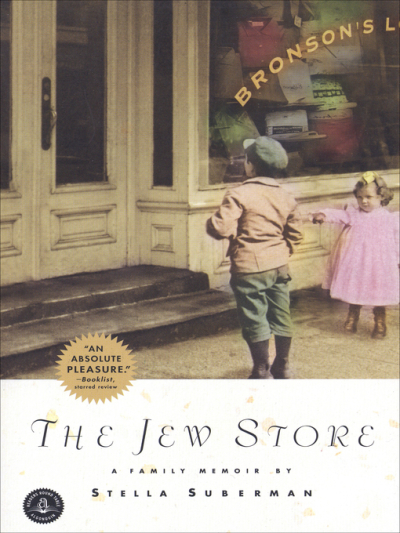
The little girl would be Stella, the little boy her older brother Joey. I think this depicts an incident in the book.
 Light On Dark Water
Leave a reply to John D. Horton Cancel reply