Dune

Usually when I write about books I put the author's name in the title of the post along with the title of the book. But in a few cases it seems superfluous. Doesn't everybody know that Frank Herbert wrote Dune? Or is the fact that I think so only a manifestation of my own insularity? 

Anyway, he did, and the claim I've seen that it's the most famous of all science-fiction novels is probably correct. Also the greatest? I don't know about that, but I'm not really in a position to judge.

Last February I saw the 2021 Denis Villeneuve movie which dramatizes the first half (roughly) of the novel. The second film was to be released this fall, and I made up my mind to read the book again before then. I was in the midst of doing so when I saw an announcement that the film will be delayed until March of next year. Oh well–maybe I won't have forgotten it completely by then. 

I said "again," and there is a little bit of mystery about that for me. I definitely read it around 1976, for what I think was the first time. But when I was in high school in the mid-'60s I was a science-fiction fanatic, and subscribed to Analog magazine, in which Dune was serialized at the time. As best I can tell from Wikipedia, this was done under two different titles, two years apart. The first, called Dune World, appeared in 1963, in two installments; the second, Prophet of Dune, in 1965, in five (!) installments. I'm pretty certain that was during the period when I subscribed. I even seem to remember this cover:
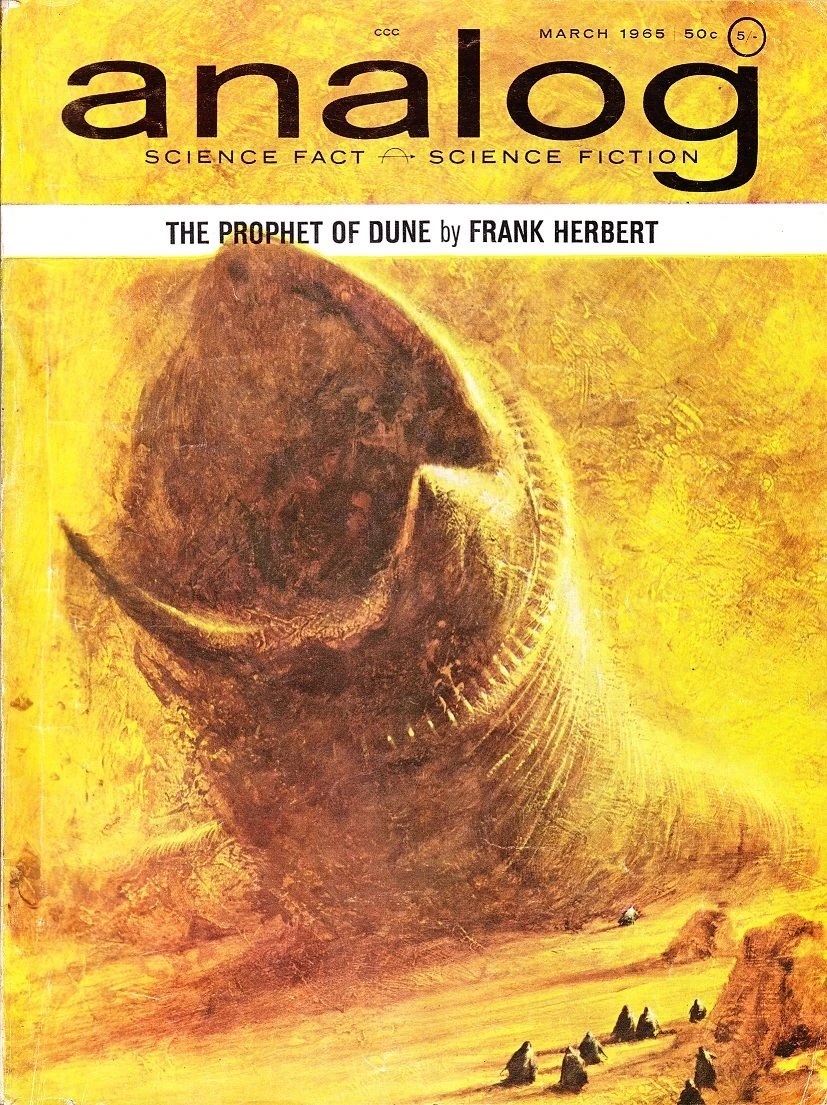
Analog_March_1965_The_Prophet_of_Dune_Pt._3_29

Yet I have no memory of reading it. If I didn't read it, why not? If I did, why don't I have at least some fragments of memory about it? Is it possible that I found it too complicated and slow-moving and gave up after reading only a little? I won't say that's probable, but it is certainly possible. There is, obviously, no way to answer that question, but it bothers me.

The book is indeed by science-fiction standards, at least those of the early 1960s, complicated and relatively slow-moving. I conjectured in my post about the film that it probably spent more time on spectacular action than the book. That was an understatement. There is in fact not a great deal of action in the cinematic sense in the book. The attack on the Atriedes family, which occupies a significant portion of the film is and is indeed spectacular, happens mostly offstage in the book. There are other such instances. Perhaps this is something of a Star Wars effect. But Dune is definitely not space opera ("a subgenre of science fiction that emphasizes space warfare, with use of melodramatic, risk-taking space adventures, relationships, and chivalric romance"), which Star Wars is.

The emphasis in the book is not on action but on a complex web of political intrigue, family and dynastic relationships, religion, ecology, and a sort of psychological mysticism. I won't bother with any further summary. Most people who are at all interested already know the basics of the plot, characters, and fictional world; anyone who doesn't can get plenty from Wikipedia.

That fictional world is a pretty impressive achievement. I don't think Dune is in the same literary class as The Lord of the Rings, but it bears comparison in the complexity and thoroughness of its imaginary world. When I say "bears comparison" I don't mean "is equal to"–on a 1-10 scale, if LOTR is a 10, then Dune is a 7 or 8. As far as I know Frank Herbert did not go so far as to create entire languages (which in Tolkien actually preceded the stories to some extent), nor is the history developed in as much detail, though I would guess that more of it is filled in by the many sequels.

The treatment of religion is also an interesting comparison. As all literarily-minded Christians know, religion does not exist in The Lord of the Rings, and yet the book is profoundly Christian. In Dune, on the other hand, religion is very explicitly everywhere. Yet it is in a sense not religious at all, but a sort of cultural tool, half-manufactured by worldly powers, especially the order of women called the Bene Gesserit who have a plan, implemented over centuries if not millennia, for producing a messiah-sort-of-person by directed breeding. And it's relevant to the book only through its effects on culture, and on behavior in general. Any notion of a transcendent spiritual reality is left very vague and very far in the background.

I recall that when I read the book in 1976 I scoffed a bit at the obvious way much of the culture of its Fremen, inhabitants of a desert planet, was drawn from Arabian culture, or others of the Middle Eastern deserts. That was unfair, and a result of my own ignorance. In those days I did not recognize such words as "jihad"; if I had, I would have realized that the Fremen are not copied from Arab-Muslim cultures, but rather are explicitly descended from them.

Dune takes place thousands of years in the future, when humanity has developed interstellar travel and populated many planets, but all of them began with ours. There are no "aliens" in the universe of Dune; every person is homo sapiens, though some have mental powers developed to a superhuman degree. The interstellar human society has reverted to a basic and ancient tripartite pattern: emperor, nobility ("houses"), and everybody else.

What it does have, which I don't think other science fiction of the time had, is psychedelic drugs, or rather drug: the substance called "spice" which is the foundation of the entire economic and political order. Frank Herbert had obviously had some experience along those lines–or if not, he knew people who did. There is a strong hint here of what would soon become known as the human potential movement. In that respect, as well as in its ecological focus, this strikes me as a very "Sixties" work. If I remember correctly, I first encountered the word "ecology" in Analog or some other sci-fi context. (Why do I remember that, but not whether I read Dune? Memory is a very hit-and-miss thing.)

In spite of what I said about the well-constructed world, I was left disappointed in my curiosity about certain things. In order for an interstellar empire to exist, there must be, one way or another, faster-than-light travel. Most science-fiction at least does a bit of hand-waving to explain this, usually one of the many variants of the "warp drive." Dune does not. The whole economic and political structure of the empire rests on the mysterious drug called "spice" which enables the powers of the monopolistic guild of navigators who alone can pilot interstellar craft. What's involved in that navigation, and how does the spice enable it? The book offers only the suggestion that it has something to do with the perception of possible future events. I suppose it's asking too much to want more information about that, just as it's asking too much to want to know how a warp drive works (though that doesn't stop people from trying).  

And about the famous sandworms: it was only a passing remark in an appendix that answered one question that kept occurring to me as I read, which was "what do they eat?" Answer: "sand plankton." Really? There's enough of that to support creatures that may be a quarter of a mile long and a hundred yards in breadth? Well, okay. But then why do they need all those extremely long sharp teeth? How and why does a plankton-eating creature attack and swallow anything that moves with single-minded intensity? How and why does it swallow a mobile factory or a spacecraft? How does it move at speeds which seem to be at least thirty or forty miles an hour while completely buried in sand?

Maybe I missed some of these answers. Maybe they're answered in the sequels, of which, as I mentioned, there are a lot. Herbert himself wrote five, and his son Brian has co-written, with Kevin J. Anderson, a number of others. I'm not sure what that number is; over a dozen, I think.

All in all, my reaction to Dune is much the same as it was 45 years ago: yes, it's impressive; yes, I enjoyed it; no, I'm not a devotee. I don't rule out reading the first sequel, Dune Messiah, but it's doubtful. 


,

62 responses to “Dune

  1. I just finished reading Stranger From a Strange Land by Robert A. Heinlein. I’ve owned the paperback for likely 25 years or more, and it claims on the cover of my edition at least to be “The most famous science fiction novel ever written”. So there you go. I actually sort of enjoyed it. It will sound odd to say this but I also recently read The Catcher in the Rye, and they seemed sort of similar simply because of the period in which they were written. One is of course much better than the other.
    All of that to say that yes I have read Dune, back in Junior High School, so really not that far from your 1976 date when you think you might have also. I recall it being complex and enjoyable, and none of the movies have seemed that interesting to me. After reading what you wrote above I think it is probably because the interesting stuff is maybe “unfilmable” so to speak, leaving action sequences that have now been filmed at least three times and so feel tiresome to me. Even though of course Villeneuve does them better than the first two directors did.
    I do want to read Dune again, but I still haven’t recovered from all the grokking of the past few weeks…

  2. Ha. “most famous” is arguable, but for quality I wouldn’t even put them in the same class. I read Stranger when I was in college and thought it was absolutely terrible, which was funny because on the face of it I should have been receptive to its proto-hippie message. I thought most of that was silly but in general just didn’t think it had a lot of literary merit.
    Catcher in the Rye, on the other hand, I suspect to be a fairly good book. I put it that way because I haven’t read it since my teens, when I liked it a lot. Later on I thought that was probably just an adolescent thing, but I’ve thought about it now and then over the years and some of what I remember seems worthwhile. I’ve been thinking about re-reading it.

  3. I read ‘Dune’ in the early 80s, and its sequel as well. Tried to read the 3rd installment but gave up and never went back. I have to admit that I’ve never been much of a s/f fan so that may have something to do with it.
    I remember liking Lynch’s ‘Dune’ film not because it was a great movie, but because it was so weird and interesting. Of course he eventually distanced himself from it, and I have no idea what I’d think if I watched it now.

  4. Personally I think Lynch’s Dune is fun (as opposed to good), and really because of its inherent weirdness a more enjoyable watch for me than the new one. The new one just looks amazing!
    I don’t know what I was expecting from Stranger, Mac. It was certainly a weird book, and funny. Of course Salinger is much better; what they had in common was that 1950s perspective and use of antiquated idiom and situations.
    I had last read Catcher in 7th grade English, and was worried that I would despise Holden Caulfield as an older adult. Pleasantly, I did not, and found it to be a quite interesting easy read in content hard to compare to anything else, at least that I can think of. Surely there must be hordes of imitators through the years; but it is quite distinctive.
    Dune is too. I own all of the original Herbert series in small paperbacks that I picked up at secondhand shops through the years. My plans is to read them, but all of these years on I have still only read the first one time. I’m sure like so much SF/Fantasy series the author will spend pages and pages repeating themes begun in the first novel.

  5. I found sf in general to be pretty disappointing after my teenage fascination faded away. By the time I read Stranger late in college, my literary standards were much, much higher, and Heinlein just didn’t make it. Now and then since I’ve read some more recent stuff but offhand don’t remember being very enthusiastic about any of it.
    I saw Lynch’s Dune back in the ’80s sometime. I’m wondering how now–maybe rented the video tape? Anyway, I don’t think my impression went much further than “weird.” I may take another look at it sometime, just because it’s Lynch.

  6. My first exposure to Dune was the Lynch movie, which I didn’t particularly like when it came out. But now I think it straddles the line between genius and absurdity.
    I read the original six books – I liked the first a lot. The second was disappointing. The third was completely incomprehensible. The fourth was weird but at least had a plot. 5 and 6 were sort of fun – not as difficult as the earlier ones (or maybe I didn’t care anymore).
    I would sort of like to reread the books, but there are so many ahead of them on my list (and I don’t read that much anymore).
    I’m disappointed that the next movie was delayed. I skipped the first one because I wanted to see them together. Oh well – what’s a few more months?

  7. That means you were going to stream them, I guess. They would probably be enjoyable in a theater. Or maybe not–they might be unpleasantly loud, as seems often to be the case these days.
    Sometimes I’m a little shocked when I recall the days when the first run of a movie was typically your only or at least best shot at seeing it, ever. Maybe it would turn up on late-night tv at some point. And on tv it would be only a shadow of itself.

  8. By “together” I meant in the same week. Not sitting down for 6 hours to watch them both. I’m assuming at least some theaters will show part I when part II is out. But I probably won’t drag myself out to see either one when I streaming is so much more convenient. Convenience probably dilutes the experience, but it also makes it much less annoying. ๐Ÿ™‚

  9. Yeah, I assumed you didn’t mean all at one sitting. Three hours is about my limit for that. Although there may have been a couple of instances in which I watched more than three one-hour episodes of video page-turners like The Wire and Breaking Bad in one evening.

  10. I sort of like the idea of a six-hour marathon, but realistically I’ll probably watch an hour and a half a night.
    My son and his friends did an Ava-Tรกr double feature. He’s not planning to to anything like that again. He liked Tรกr and hated Avatar, but overall it was just too much at once.

  11. Those are vastly different, aren’t they? I guess the double feature was suggested by the pun, or whatever you would call that play with the names?

  12. Yeah – they’re completely different types of movies and the double-feature was indeed suggested by the names. The plan had been to see Avatar first since that worked with the word-play, but they couldn’t get the schedule to work. Which was probably better since they saw the better movie before they were tired. The whole thing sounded tedious to me, but the young folk seemed to enjoy it (well, except for the second movie :))

  13. Anne-Marie’s Husband

    I read Dune for this first time this past summer.
    What disappointed me most was the writing. With minimal editing, it would be at least 10% shorter.
    I was glad to have read it at last, but I’d have been gladder had it been shorter.

  14. I’d be happy to see Dune 1 and 2 on the same day provided there’d be a break between them. Really couldn’t bear to watch something like that on the small screen unless I had no other choice.

  15. I thought it was fine on the small screen but then maybe I don’t know what I missed.
    I didn’t think of it in terms of length, but Herbert’s prose definitely gets no praise. Adequate is the most I would say.

  16. I read Stranger in a Strange Land when I was 19 or 20, so 1970-1. I am embarrassed to say that I thought it was wonderful. I read Out of the Silent Planet around that time, and didn’t get it at all.
    I read Dune a bit later, soon after I was married. Probably in 1972. I may have even read the second book in the series, but I don’t think I liked them much. I saw an earlier movie, which I vaguely remember, but I keep conflating it somehow with Dr. Zhivago.
    We watched Dune a few months ago, and I wasn’t particularly impressed. However, we re-watched Arrival a couple of nights ago, and it was as great as ever. I kind of want to watch it again.
    AMDG

  17. The court notes your regret, or at least embarrassment, at having liked Stranger. This will be taken into account at sentencing.
    I only saw Arrival the one time, when it came out. I’ve meant to see it again but haven’t done it yet. I’m fairly sure I would agree with you about it.

  18. LOL about Stranger. The two books are about as different as can be other than both being “the most famous science fiction novel ever written”.
    Where does that leave Foundation? I guess it’s the most famous science fiction trilogy ever written.
    Arrival is way better than the new Dune movie.

  19. Other than certain aspects of the visual style, I don’t even see Arrival and Dune as being the same sort of thing. Dune (the movie) is closer to Star Wars than to Arrival.
    I read Foundation in my teenage sci-fi phase and liked it, though I remember feeling like I didn’t really understand it. I sampled it many years later, maybe in the ’90s, when one of my children was reading it, and thought “man that was severely overrated.” I thought worse than that about another bit of Asimov. Wife and one of our then-teenaged-children tried listening to an audio book of some of the robot stories and all agreed to drop it because it was so very bad.

  20. I had that same Asimov experience with both series. Did you know that they eventually join up.
    AMDG

  21. No, I didn’t even know the robot stories were a series, just stories that happened to be about robots. I know it was a favorite subject of his.
    Really, all three of these sci-fi giants that we’re talking about are…overrated.
    I looked at the Wikipedia page for the Foundation series. Didn’t read it all, just sampled here and there. The story actually sounds kind of interesting. I don’t know what it was that I thought was not very good about it when I sampled it in the ’90s. It may have been just the quality of the prose.
    https://en.wikipedia.org/wiki/Foundation_series

  22. I read the Foundation series again recently (in the Everyman’s Library Classic edition, to make me feel a little bit better about reading it again), after having last read it sometime in my teenage high school years. And liked it overall, it was good not great. But in the second and third books enjoyed it quite a bit more when the Mule entered the story.
    There is a Foundation television series that I started watching, but stopped after a few episodes. It had great production values but was just too different from the book, and not for the best.

  23. A TDS sufferer of my acquaintance compared Trump to the Mule. I had forgotten what that suggests but having just read that summary at Wikipedia I think he had a point.
    Same guy, who is apparently an Asimov fan, mentioned the tv series favorably. Itโ€™s on Apple + or some other service I donโ€™t have, so I wonโ€™t be seeing it.

  24. I read Foundation and Stranger in a Strange Land in college – Science Fiction Literature (or
    Throw Away Dad’s Money 101″) and thought they were both overrated. SISL started off strong but then the hippie sex cult ruined it.
    I read Asimov’s robot stories in my 30s and enjoyed them quite a bit. Not that they are all that great, but there aren’t that many stories about debugging.

  25. Yeah, a friend of yours wrote a blog post about it, before he said anything, too.http://thethreeprayers.blogspot.com/2016/07/foundation-and-trump.html?m=1
    AMDG

  26. I was doubting whether I had ever seen that post until I saw the picture, which I very definitely remember. Well, it was so long ago…. The other person I was referring to made his remark considerably more recently, I think after Trump was out of office.
    At some point, closer to the election, you actually went as far as saying you thought Trump was going to win. I still credit you with being the only person I know of who called it, even if you meant it kind of tentatively. It was in a comment here but it would take a while to find it.
    Don, all I remember about my late experience of the robot stories was an absurd and cloying treatment of a robot as a dog. “His circuits lit up with anticipation…” kind of stuff. Awful. Not an android type of robot, obviously, but some sort of much more limited special-purpose mechanical thing.

  27. Itโ€™s been a while, so I donโ€™t remember too many details. But what stuck with me was that a lot of the stories had to do with the interactions of the three laws and people trying to figure out how to solve the problems caused by them. Maybe that wasnโ€™t as big a theme as I remember, but Iโ€™m sure thereโ€™s at least one story that centered on that. And I wish I could force every programmer to read it.

  28. Heh. Apart from the three laws themselves I don’t remember any of that, but I can imagine they could lead to a lot of “oops” moments. “I never thought of that,” etc.

  29. My son was talking about the upcoming Dune movie and I said I’d rather see Lynch’s version in the theater. A couple of minutes later he found this.
    https://www.fathomevents.com/events/dune-40th-anniversary/

  30. Yeah, saw a preview for that when I went to see the new Godzilla flick a couple weeks ago (which is fantastic, by the way. Saw it, then went back the next night to see it again). If I remember correctly that same series is doing ‘Gone With the Wind’ and ‘Rear Window’ later in the year, both of which I’d like to see on the big screen.
    Haven’t seen the first Villeneuve ‘Dune’ yet — I was hoping they’d re-release it before the new one came out.

  31. I havenโ€™t seen part 1 yet either. I didnโ€™t want to watch half the story and wait a couple of years. It supposed to be back in theaters, but Iโ€™ll probably watch it at home. Have to save my limited energy for going out for the original movie ๐Ÿ™‚

  32. According to Wikipedia Dune 2 is coming out in March. I’m pretty sure I won’t see it in a theater. Can’t say I have any interest in big-screening Lynch’s Dune.

  33. “I didnโ€™t want to watch half the story and wait a couple of years.”
    Ditto.
    I may try and catch Lynch’s ‘Dune’ while it’s here, but I don’t feel it’s a “must see” for me.

  34. I just got back from seeing Lynchโ€™s Dune. It was worse than I remembered (and it hasnโ€™t been that long since I watched at home), but I had a lot of fun.

  35. I’m asking myself if it could be worse than I remember. Probably, although my memory of it is pretty vague. My reaction may have been just sort of “what was that?”

  36. Saw a brief youtube video this weekend where Lynch answered a question about ‘Dune.’ He said that he was mostly sad about what transpired and how the film came out, and that the one good thing he learned was to never give away the right to the final cut. He also said something like he’s not happy with how the movie turned out but that there are parts of it he thinks are pretty good. He said this with a grin, so he undoubtedly had a curate’s egg sort of thing in mind.

  37. “itโ€™s not a crowd-pleaser” That’s a surprise! I expected it to be exactly that.
    I would have been quite interested in seeing this if it had come out sooner. As it is my interest has waned somewhat and I’ll wait till it’s available on Prime (as I assume it will be).

  38. I enjoyed Dune 1 more than Dune 2. In general I have a negative view of both which is probably more because I don’t like the main actors (Chalamet and Zendaya) who seem very uninteresting to me, than anything else. All of the more seasoned actors are quite good, but these two get the most screen time by far. I’m beginning to think that I don’t like Villeneuve that much as a director. His movies look very good, but maybe he is not as good with the other things needed for the audience to be more invested. I thought the riding of the sandworms looked just as ridiculous as it did in Lynch’s Dune and the miniseries Dune, but the author of this article thought the opposite. Perhaps some things are just better read than watched.

  39. You may have a point about Villeneuve. I wonder if he was the writer of Arrival, which certainly looked really, really good, and was also profound. At minimum he adapted someone’s story.

  40. I first got interested in Villeneuve back in 2013 with ‘Prisoners.’ Liked it a lot, so followed up with his earlier films ‘Incendies’ and ‘Enemy,’ which were both good (although the latter is very creepy in a Lynchian way and I don’t know that I’d watch it again). I haven’t seen the Dune pics, but I’ve liked what he’s done in the interim (Arrival, Sicario, Blade Runner 2049).
    I’m pretty sure that he’s written or co-written some but not all of his movies.

  41. I’d forgotten about BR2049. I found it a little disappointing as a sequel, but it, too, was very impressive visually. So that could be taken as evidence of agreement with Stu. I had intended to see it again, but when the Covington Catholic craziness happened one of the more vicious tweets that circulated about it came from one of the screenwriters, so I decided I’d seen enough.

  42. I think that generally speaking s/f is a tough genre in which to get the “humanity” right. Oddly enough, this was a facet of the recent Godzilla movie that critics and audiences both praised.
    As you said above, I think Villeneuve does get it right in “Arrival,” and I’d say he does so in his non-S/F movies as well.

  43. You’re correct Rob. About getting the humanity right. SF and Fantasy are tough genres to film. I rewatched Dune 1 last night (it is currently on Hulu and Max), and enjoyed it again. I’ve watched it three times. I feel like I need to give Dune 2 another shot. I was reading the first 60 or so pages of the book yesterday, which I last read in high school and I think once before that in jr high, and I found it compelling in a way the movie isn’t. Herbert is not a bad writer compared to so many of his “golden age of sci fi” contemporaries. I need to find Mac’s post on the book…I think he made one.

  44. LOL okay this is the post on the book! I always feel like I’m discussing something from before in a post on another subject. Okay, my bad. Happy Laetare Sunday everyone!

  45. Okay, I read through everything and apparently according to other posts I have just read Dune once, so that could be the case. As you said about memory ๐Ÿ˜‰

  46. I read Dune and the sequel either in college or just after, then started the 3rd book but didn’t finish it. I never went back to it, but that may not be Herbert’s fault — I’ve never been much of a S/F reader. I’ve read a handful of the older classics, and a few newer things in the 80’s, but that’s about it. So probably not the best judge!

  47. It’s not surprising that you didn’t finish book 3. I don’t think I’m interested enough to try book 2.
    I can’t offhand think of any really well-drawn characters in any sf I’ve ever read. But most of it was when I was in high school. Not only was that quite a long time ago, but I had no sensitivity to the literary values–I just liked the stories and the intrigue of the unknown.
    Somewhere in the early archives of this blog there is a comparison of Blade Runner and 2001. The latter now just seems almost ludicrous in characterization, but the former is very powerful. That’s partly in the nature of the story, which involves the question of what it means to be human, and moreover is a meditation on mortality.

  48. I haven’t watched 2001 in ages. Probably should revisit it. I recall not caring much for the sequel (2010?)
    I don’t remember very much of the S/F I read in the 80’s except for a couple books by Gregory Benford, and a big invasion novel in which Earth was attacked by a race of advanced elephants!
    Don’t know what I’d think of the latter now, but I recall the Benford books as being pretty good.

  49. When I watched 2001 ca 2004 I thought parts had aged poorly but still enjoyed it. I watched it again, with my wife, maybe seven or eight years ago, and that will be the last time. Much of it has aged really poorly. I watched it with my wife and it didn’t help that she made fun of the opening scene with the apes. ๐Ÿ™‚ I’d still call it by far the best sci-fi movie made before the 1980s, though.
    On the other hand, “Open the pod bay doors, HAL” has become embedded in popular culture, to the extent that Siri and other voice-recognition software will play along to some degree. Breathes there the man with soul so dead that he uses Siri or Alexa but never put that command to them? I received an irritated text from a friend who had tried it with Google’s lunatic new AI and gotten a very stuffy response. Sad!

  50. Rob G: Footfall! I read that book myself too, in my teens, and don’t remember much about it except for the “advanced elephants”
    https://en.wikipedia.org/wiki/Footfall

  51. Yep, that’s it! I remember liking it a lot at the time, but like you I don’t remember much about the book itself. I would have been 24 or 25 when I read it.

  52. Okay I finished the Dune novel again. I had to stop and read something more fun and palatable in the middle, but I did manage to go back and read to the end. It had been at least 40 years since I read it, and I did find it enjoyable, but not really as much as Stranger in a Strange Land, the only other classic SciFi book I have read in recent memory. This is mainly due to humor; Stranger has it throughout, and Dune has none. Yes, Dune is much better written and has a lot of “world building” as they like to go on and on about when talking Fantasy lit mainly, but sometimes SciFi too. Having seen both of the recent films, and enjoyed them for what they were, it really is an unfilmable novel in that interior dialogue and non-action comprises so much of it. But Villeneuve did what he does well in presenting a glorious picture for theatergoers to go slack-jawed over. Oh, and Herbert does explain why the sandworms don’t just roll over or dive into the sand and kill the Fremen on them. Watching these movies I kept having that question in my mind. I’m not sure I can ever tackle Dune Messiah or any of the others, but who knows, I may be moved to do so some day.

  53. I see I ended this post by saying it was “doubtful” that I would ever read Dune Messiah or any of the other sequels. I’ll amend that to “very doubtful.” If I was interested I should have jumped in right after finishing Dune.
    I was struck, reading Dune after seeing the first film, by how little spectacular action there is in the book as compared to the film. Like you said, I guess Villeneuve just decided to do what film (and a lot of money) can best do.
    I read Stranger in college and thought it was horrible, even though at the time I was more or less in sympathy with the “philosophy,” if that’s the right word. I certainly don’t remember thinking it was funny but maybe I’ve just forgotten.

  54. Re: special effects, I don’t know if anyone caught it but Godzilla Minus One got the Oscar for best visual effects this year. First time that the franchise has ever been nominated for an Oscar, let alone won one. I saw the film twice in the cinema, in the black-and-white version, and the effects were truly stunning, as is the movie as a whole. And all on a budget of $15M!

  55. I really should check that out. I find it hard to take anything Godzilla-related seriously.

  56. The only Godzilla film that was truly serious (until now) was the first one. The franchise became more and more juvenile as time went on, and later efforts to make the films less so didn’t succeed all that well — they were still seen largely as kids’ stuff. This new one is a game-changer. My own view is that Toho should stop making them for a while and let the effects of this one percolate.
    Oh, and if you haven’t seen Oppenheimer yet, that’s not to be missed either.

  57. I’ve seen the first one and it just didn’t make that much of an impression on me. I understand the atomic myth significance and import, it just didn’t strike me as an exceptional work of art. Though it’s certainly in a different class from all the silly followups.

  58. The idea to go “silly” with the follow-ups was the studio’s, but SFX director Eiji Tsuburaya agreed with it because he felt the genre’s audience could be increased by making the movies more child-friendly. From what I remember director Ishiro Honda was initially very hesitant to go that route but eventually warmed to it.

  59. I guess he was right in that the audience was increased, but at the cost of making the whole thing a bit of a joke. Even people who never saw the movies understood jokes about movies called “Godzilla vs. ….” As with the “Son of…” thing.

  60. Godzilla vs the Son of a Son of a Sailor

  61. ๐Ÿ™‚

Leave a reply to Janet Cancel reply