This poem is now in the public domain. So I've copied it from another site. It is of course appropriate for today, the Feast of the Epiphany in the Catholic calendar. Normally I set off quotations longer than a sentence or so as "block quotes," which means that they're indented on the right, which means, if line breaks are significant, as they are for a poem, they may not appear as they should. Just how they appear may be partly dependent on the browser. To avoid that, I'm not making this a block quote, but will switch typefaces instead. It probably won't look right on your phone anyway, but that's the price you pay for reading on your phone.
———-
T.S. Eliot: Journey of the Magi
'A cold coming we had of it,
Just the worst time of the year
For a journey, and such a long journey:
The ways deep and the weather sharp,
The very dead of winter.'
And the camels galled, sorefooted, refractory,
Lying down in the melting snow.
There were times we regretted
The summer palaces on slopes, the terraces,
And the silken girls bringing sherbet.
Then the camel men cursing and grumbling
and running away, and wanting their liquor and women,
And the night-fires going out, and the lack of shelters,
And the cities hostile and the towns unfriendly
And the villages dirty and charging high prices:
A hard time we had of it.
At the end we preferred to travel all night,
Sleeping in snatches,
With the voices singing in our ears, saying
That this was all folly.
Then at dawn we came down to a temperate valley,
Wet, below the snow line, smelling of vegetation;
With a running stream and a water-mill beating the darkness,
And three trees on the low sky,
And an old white horse galloped away in the meadow.
Then we came to a tavern with vine-leaves over the lintel,
Six hands at an open door dicing for pieces of silver,
And feet kicking the empty wine-skins.
But there was no information, and so we continued
And arriving at evening, not a moment too soon
Finding the place; it was (you might say) satisfactory.
All this was a long time ago, I remember,
And I would do it again, but set down
This set down
This: were we led all that way for
Birth or Death? There was a Birth, certainly
We had evidence and no doubt. I had seen birth and death,
But had thought they were different; this Birth was
Hard and bitter agony for us, like Death, our death.
We returned to our places, these Kingdoms,
But no longer at ease here, in the old dispensation,
With an alien people clutching their gods.
I should be glad of another death.
———-
I've always been a little puzzled by that last line. The last two lines, really. The Magi (or this Magus at least, but I'll keep it plural because he keeps saying "we"), have understood that the coming of the child means the end of the culture or civilization of which they are a part, and in which they have a privileged place. That's the "hard and bitter agony."
But do they know something pretty specific about what is coming? Have they, in some sense, been converted? Why else are their own people now "alien" and "clutching…gods" for whom the Magi seem to have no respect? Surely these people and these gods were their own before their journey, but that no longer seems to be the case.
And what death would he be "glad of"? His own? That's probably true. But he doesn't say so, and the vagueness of the reference makes me wonder. Is he glad that his culture has received its death warrant and looking forward to its actual death? That seems a little odd, but maybe it's just a measure of his sense of exhaustion. Maybe it's both, just a broad resigned Let's just get it over with. But it seems to me that there is an intimation of the Child's death, and what it will mean, and why the birth, the necessary first step toward that death, is hard and bitter, but at the same time something to be glad of.
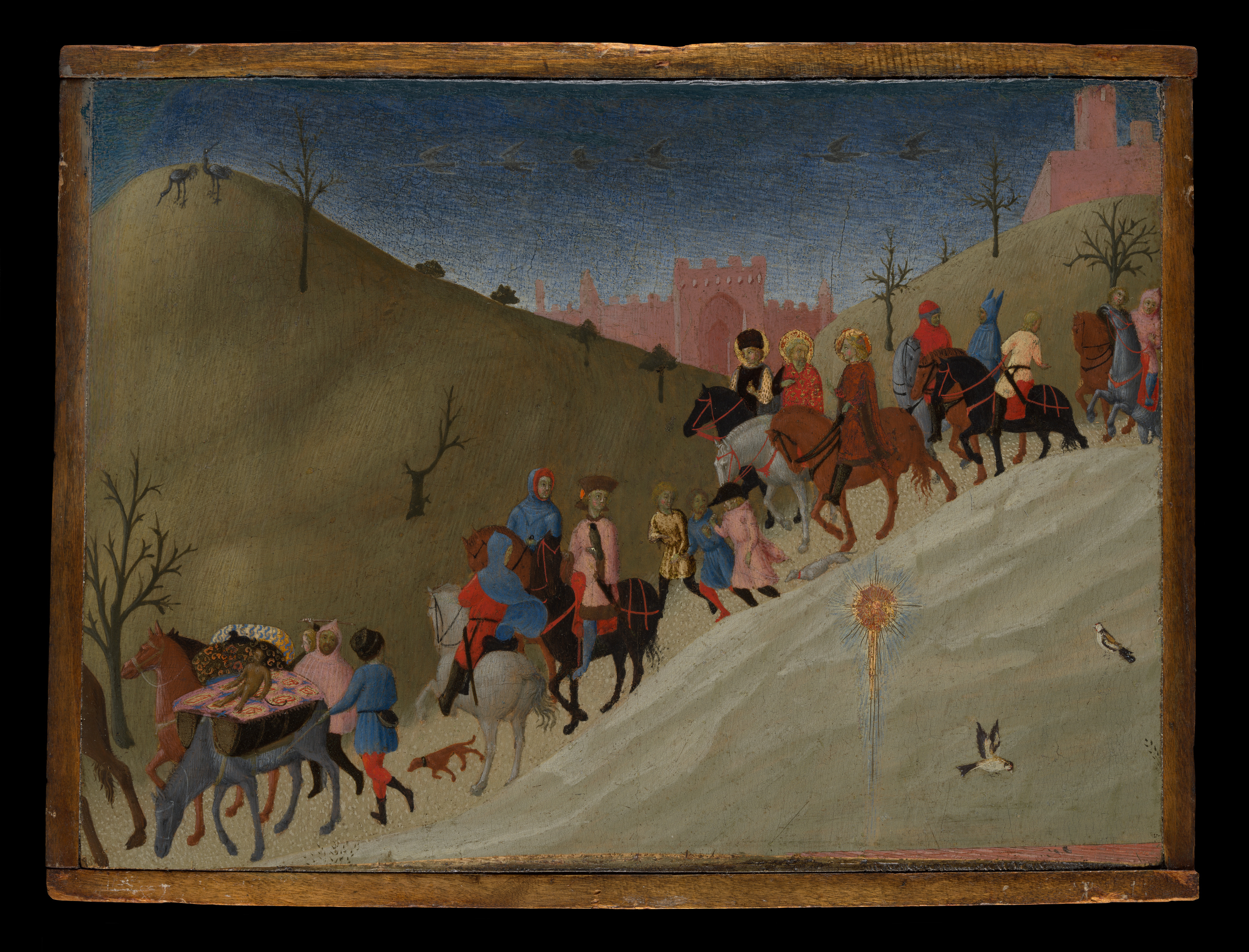
Journey of the Magi, Sassetta (Stefano di Giovanni). Image lifted from The Metropolitan Museum, where you can see a much larger version.
 Light On Dark Water

Leave a reply to Rob G Cancel reply