I think it's been almost thirty years now since I discovered that the works of P.G. Wodehouse are a wonderful anti-depressant, producing a bubbling levity which I have previously described as feeling the way champagne looks. This effect, though, is sadly brief, and I've been a little concerned that, as with alcohol, steady use might reduce it, so I don't read Wodehouse all that often.
I'm speaking mainly of the Jeeves and Wooster books, of which there are, I think, fourteen; it's a little difficult to fix the number because the U.S. and U.K. editions differ somewhat. Not wanting to go through them too quickly, I haven't read them all. Certainly they will continue to be delightful on re-reading–I've read Joy In the Morning and Code of the Woosters at least twice. But the happy shock of the first encounter with an especially funny bit can't be repeated.
Lately, however, I've been thinking that this careful husbandry could be a mistake: being pretty old now, I might, if I'm too dilatory, die or be incapacitated with some of the novels still unread. And that would be very regrettable.
So it was time for another, and Ring For Jeeves was the next one in the approximately chronological order in which I've been reading them. Somewhat to my surprise, it doesn't seem to me to be quite up to the usual mark. When I noticed the publication date–1953–I speculated that this slight lessening in quality–and it is fairly slight–may have had something to do with Wodehouse's situation at the time. World War II had left him somewhat disgraced. Stranded in France in 1940, he had made several broadcasts at the behest of the Nazis, and although they were humorous and not political in content they caused Wodehouse to be reviled as a Nazi collaborator, which naturally cast a shadow over the following years. He had begun the previous Jeeves and Wooster novel, The Mating Season, in 1942, though it was not published until 1949. Ring For Jeeves seems to be the first one written entirely after the war.
It seems to have been an experiment: it is the only novel to include Jeeves but not Bertie Wooster. Perhaps–this is pure speculation–Wodehouse thought the pattern had become a little stale, and wanted to vary it. The novel takes note of its actual situation in time in a way that I don't recall others doing. There is explicit mention that the time is the early 1950s. Television is acknowledged to exist, and even figures slightly in the action, though it remains offstage.
The plot involves the high taxation of the wealthy and the general leveling which were occurring at the time. Bertie is absent because he is at a school in which the aristocracy are taught the rudiments of taking care of themselves in the new order. Jeeves is in the employ of William Egerton Bamfylde Ossingham Belfry, ninth Earl of Rowcester, pronounced "Roaster." The Earl, who for most of the book is referred to simply as Bill, is the inheritor of a vast and dilapidated mansion, Rowcester Abbey, which he cannot afford to keep up, and which he is desperate to sell. His sister Monica believes she has a likely buyer, a twice-widowed, rich, and still beautiful American woman, who, as the story opens, is on her way to view the place. But there are complications. Of course. And of course they're zany.
In a desperate move to get hold of some cash so that he can marry the young neighbor Jill Wyvvern–one of Wodehouse's delightful down-to-earth and pretty "girls"–Bill has gone into the bookmaking business, at the suggestion and under the direction of Jeeves. Calling himself Honest Patch Perkins, he frequents the race tracks in disguise:
…in addition to wearing a very loud check coat with bulging voluminous pockets and a crimson tie with blue horseshoes on it which smote the beholder like a blow, he had a large black patch over his left eye and on his upper lip a ginger moustache of the outsize or soupstrainer type.
He seems to have been doing all right until a bet went against him at spectacularly long odds, leaving him owing three thousand pounds, which he does not have, to a Captain C.G. Brabazon-Biggar, a fierce White Hunter stereotype who has spent some large part of his life Out East, with, for some reason, a particular emphasis on Kuala Lumpur. The Captain is also on his way to Rowcester Abbey, in hot pursuit of Honest Patch. And it turns out that both he and Bill have had previous involvement with the rich and beautiful widow.
Naturally it all gets more and more complicated, with more and more elaborate stratagems and deceptions and narrow escapes when the stratagems go wrong. But it all works out in the end. And Jeeves will be returning to Bertie, who is no longer at the school, under circumstances which I would enjoy relating but must refrain from doing so, for the sake of your enjoyment, on the presumption that you haven't read the book.
I hope it isn't because I've become jaded that this book seems to sparkle less than others. Bertie's absence is part of that; though Bill is a somewhat similar character, he lacks Bertie's effervescent goofiness. And this makes him less effective as a foil for Jeeves. Perhaps as a consequence, Jeeves himself seems to me a bit overdone. His circumlocutions and literary quotations become at times obtrusive, a little too frequent and lengthy. And I felt that the winding up of the plot threads was a bit rushed. Still, less than the best Wodehouse is very, very good.
In my limited experience the Blandings books are just as good as the Jeeves and Wooster ones, so I have several of those to look forward to as well. I've only read one novel that was part of neither series, Picadilly Jim, and although it was enjoyable it was not in the class with the others.
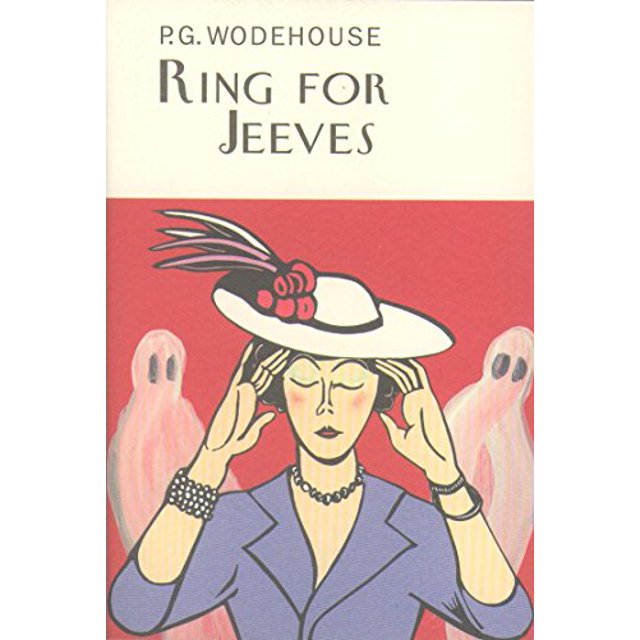
The rich widow is interested in psychical research, and is thrilled by the family lore which holds that an old family ghost, Lady Agatha, wife of Sir Caradoc the Crusader, is sometimes seen in the chapel (ruined, naturally).
 Light On Dark Water
Leave a reply to Marianne Cancel reply