I think perhaps it was your representative at the piano who gave me a bad impression of your first piano concerto. And perhaps it was only the visual distraction of his mannerisms and his gold lamé jacket that got the performance off on a bad footing with me, more or less ruining the first movement, which of course constitutes more than half of the work, from which I only partly recovered before the end of the performance. But I am happy to say that on further acquaintance with the work I have completely recovered.
*
I thought I would wait a while after my less-than-wonderful experience with Tchaikovsky's first piano concerto two weekends ago (see this post) to listen to a recording of it. By "a while" I had in mind, very vaguely, a month or two. But curiosity* got the better of me. Within a week I had listened to no fewer than three recordings of the concerto.
(New paragraph, for emphasis) I am now announcing officially that I love this concerto. I'll go even further: I very much love it.
The first recording I listened to was Van Cliburn's of 1958. Although I was only ten years old when Cliburn won the International Tchaikovsky Competition in that year, I was vaguely aware of the event. It had gotten massive publicity because of the Cold War implications of this young pianist from Texas beating the Russians at their own game, on their own turf. I heard Cliburn's name, at least, and knew that he played the piano, which was not the sort of information that would typically be found in the head of a country boy in Alabama. Now that I think about it, it occurs to me that I may have heard it from one of my aunts, who was herself a pianist and a music lover.
The conductor on this recording is Kiril Kondrashin, and there's something bit odd about the packaging: the orchestra is not named. It's not on the cover, which is a little unusual.
 But it's not on the back, either. And unless I managed to miss it, it isn't mentioned in the text, which I doubt you can read. (These are not photos of my copy, but they seem identical. The photos were poached from Discogs.)
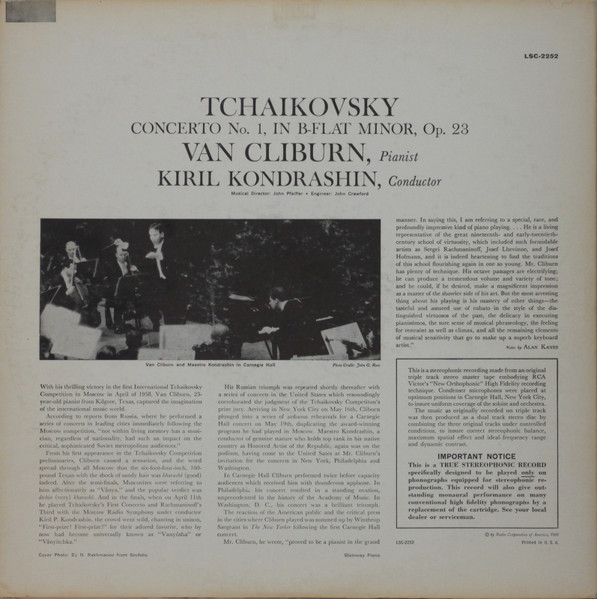
According to Wikipedia, it's the RCA Victor Symphony Orchestra. So I speculate that RCA omitted the name because they were not confident that their own orchestra was so highly regarded as to constitute a selling point.
Anyway: this recording sufficed to get me over my bad experience. I was curious about others, and discovered that I own two more. One is Yevgeny Sudbin with the São Paulo Symphony. Fifteen years or so ago a friend acquainted me with Sudbin's Scarlatti recordings, which I like very much, and I suppose that must be why I bought the Tchaikovsky recording on MP3. But I don't think I had ever gotten around to listening to it. I like it, and I doubt that there's an argument about Sudbin's performance being technically first-rate, but I kept having the feeling that the orchestra didn't quite match the vitality of the piano.
Then on to the third: Sviatoslav Richter and the Czech Philharmonic conducted by Karel Ančerl. It's a 1960 recording on the Czech Supraphon label, released in this country on the Parliament label. Small print on the jacket says it's 'A Parliament "Cultural Exchange" Presentation.' Which I suppose was another Cold War thing, Czechoslovakia being a Soviet thing, and Supraphon a state-run thing.

I found this one really exciting, and moving, and everything else that one could ask for. Nor is the 1960 sonic quality an obstacle; good recordings of that period may not match the clarity and dynamic range of what has come since, but are still excellent (and sometimes even preferable, but that's another topic). And it made me really appreciate the concerto, which, as I said, I now love.
So the question arises: is this performance really superior, or was it only that, as the third hearing (fourth if you count the concert) it benefited from my increased familiarity with the work? I really don't know, but I can say one thing: it seemed to me that the piano and the orchestra were more evenly matched than in the others. The orchestra seemed a more present and vital part of the performance.
Also, I suspect now that part of what put me off in the concert performance was that the piano seemed in almost violent competition with the orchestra. I think this was the doing of the soloist, Maxim Lando, who really seemed to be crashing and banging excessively. But perhaps it was relative weakness in the orchestra, which, after all, is not composed of full-time professionals. I'm not a skilled-enough listener to judge definitively, but I do trust my ears enough to say that in the opening bars the beautiful theme played by the orchestra, which should be accompanied, not overpowered, by those powerful chords in the piano, was very much in the background. The overall effect was of bombast instead of the deep passion that I hear in these recordings, especially the Richter/Ančerl one.
* Why do we not spell "curiosity" as "curiousity"? I usually type it that way, then notice the red underlining indicating that the software does not approve. What was wrong with adding the "ity" suffix to the word "curious"?
 Light On Dark Water
Leave a reply to Stu Cancel reply