I was going to mention this in the post about Dombey and Son, but it was already rather long: my pleasure in reading the novel was enhanced by the nature of the physical object which contains it. A few years ago I came into possession of several Dickens volumes which, along with a lot of other books, would otherwise have gone to Goodwill (it's a longish story, not important to tell). I didn't look at them very closely at the time, and there wasn't space for them on our shelves, so they went into a closet and didn't come out again until the fall of 2022, when we moved to a new house. Before the move we culled our book collection fairly severely, getting rid of everything that we had read and didn't expect to read again, or figured we would never read.
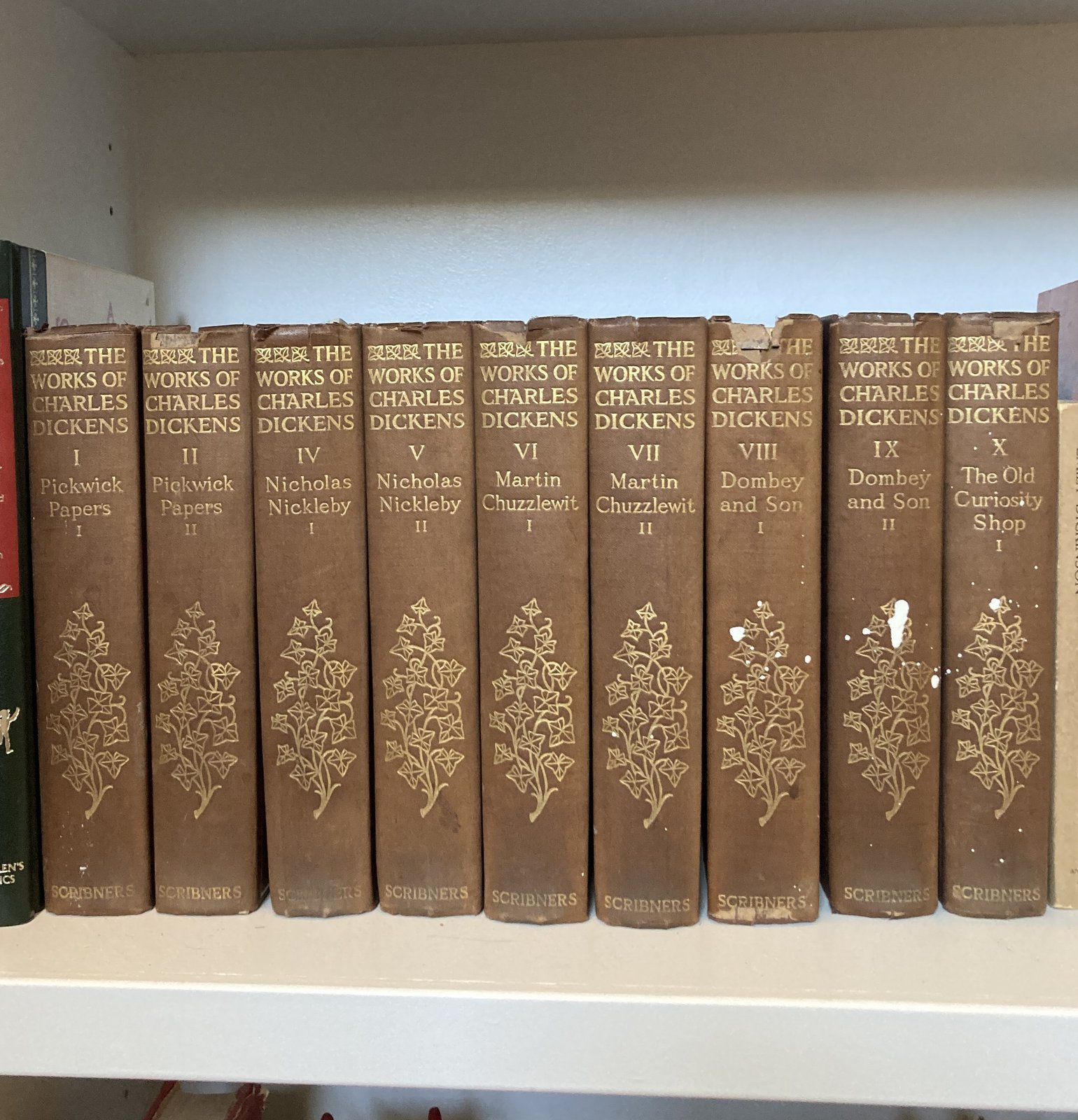
I considered getting rid of these, but on finally taking a good look at them realized they were treasures. They are part of a complete Dickens published by Scribner's ("Charles Scribner's Sons") in 1911. And I very much wish I had the whole set. If you want one, Abebooks currently has it available for $500. Which is really a pretty reasonable price, around $14 per volume. When I put it that way, it's actually sort of tempting….
Here are the nine volumes in their new home. The white spots seem to be paint, the work of some sloppy painter of who knows how long ago. It's lamentable that I only have volume one of The Old Curiosity Shop.
Here are a couple of sample pages from Dombey and Son. The illustrations are the original ones by "Phiz," Hablot Knight Browne, and they're delightful.
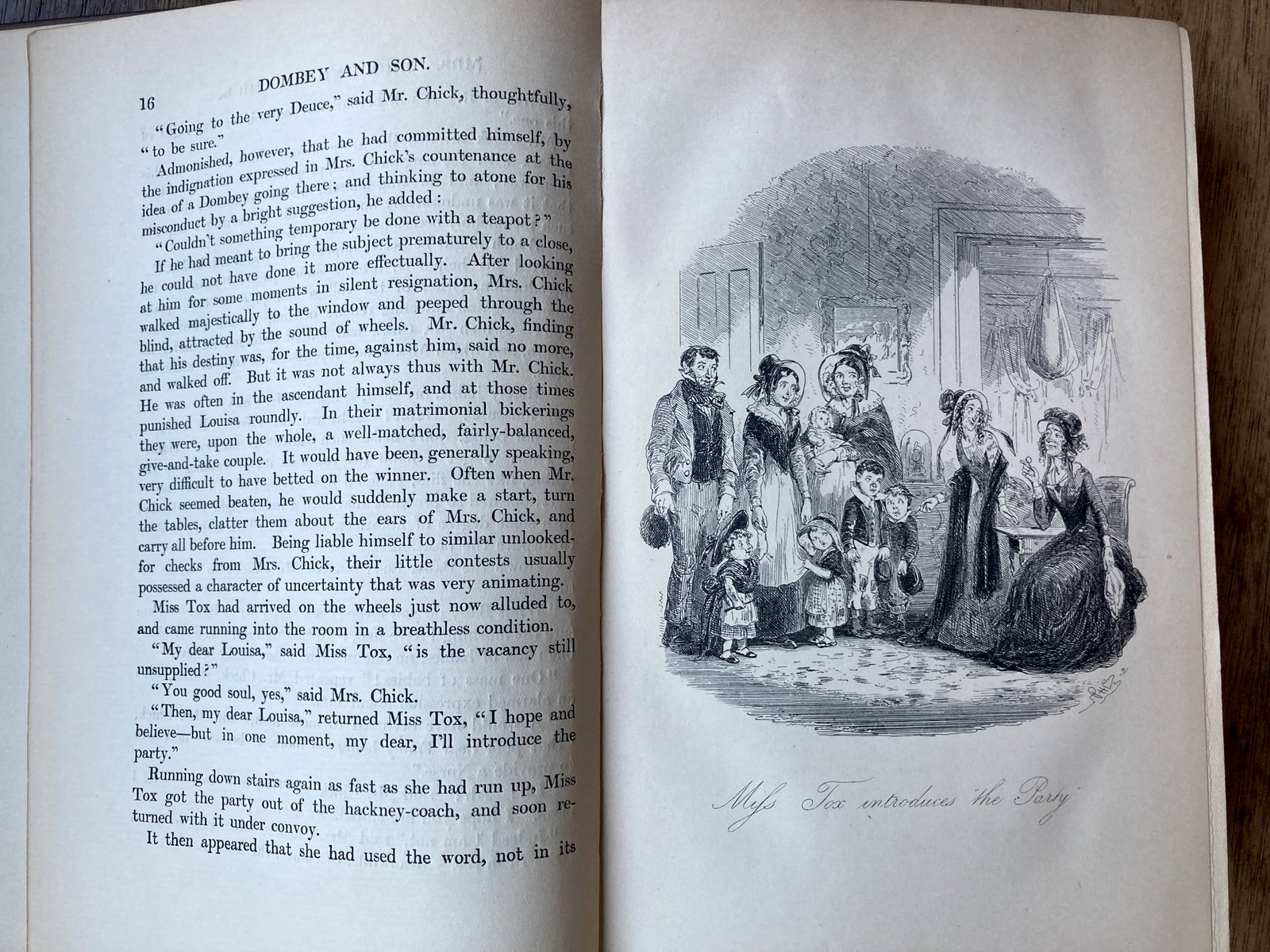
Reading these is a physical pleasure. Splitting the novels into two volumes of four or five hundred pages makes for very comfortable handling and reading, in a typeface and size that are easy on the eyes (an increasing consideration for me), and margins that don't make the pages seem crowded. And because they were printed with real movable type you can actually feel the impressions on the paper: a slight but genuine pleasure.
I'm not a bibliophile, not any sort of collector. A book doesn't have to have any particular charm or excellence for me to like it. It just needs to be a physical book. Too many of mine are really pretty poor physical specimens, bought used or picked up from library discard shelves. Sometimes these are pretty dilapidated, having permanent marks of their library career, sometimes in the form of those rather ugly library bindings, or defaced by the underlining or highlighting of a student (though more than a few instances of the latter will prevent me from getting the book in the first place). But when I read anything longer than, say, a blog post, I want a book, a book made of paper.
I know a lot of people find reading on a Kindle or similar device perfectly acceptable, with various convenience factors actually making the electronic device more appealing than a book. But I think I can safely say that I never will do that. I've tried it, and I just don't much like it. I could go into more detail about that, but "I don't like it" is sufficient. It's not just my age, as I know several people of similar age, including my wife, who have made the transition. I have a Kindle Fire but only use it to read journalism and similar stuff online. I once tried reading one of those public domain electronic versions of The Pickwick Papers on the Kindle and abandoned it after fifty pages or so. I look forward to reading the Pickwick you can see in the photo above.
I do like one thing about a book in electronic form: the ability to search for words and phrases. I have electronic copies, obtained from Project Gutenberg, of both Dombey and Son and Bleak House on my computer, and have used them as, for instance, I did yesterday, to refresh my memory about who Gridley is in Bleak House. But I wouldn't sit and read the novels that way, unless I had no other choice. Which may be the situation someday, but not in my lifetime.
 Light On Dark Water
Leave a comment