I had planned to post this last week, but a combination of computer problems and the nastiest cold I've had for some time got in the way.
Last Sunday afternoon I heard the Mobile Symphony and the University of South Alabama Concert Choir in the Messiah–the first time I'd ever heard it performed live, and at my age most likely the only time, and the first time the Symphony had ever performed it.
It was also the first time in decades that I'd heard it. The last time I can say for certain was when I was still in college; I had it on LP then, and thinking of it brings me an image of the apartment and my little portable stereo. Surely somewhere in those fifty or so years I must have heard a recording, but if I did I can't recall it. That LP set disappeared along the way somewhere, and then I acquired another in the great vinyl sell-off of the '90s. But I can't recall that I ever listened to it until this week, after the concert.
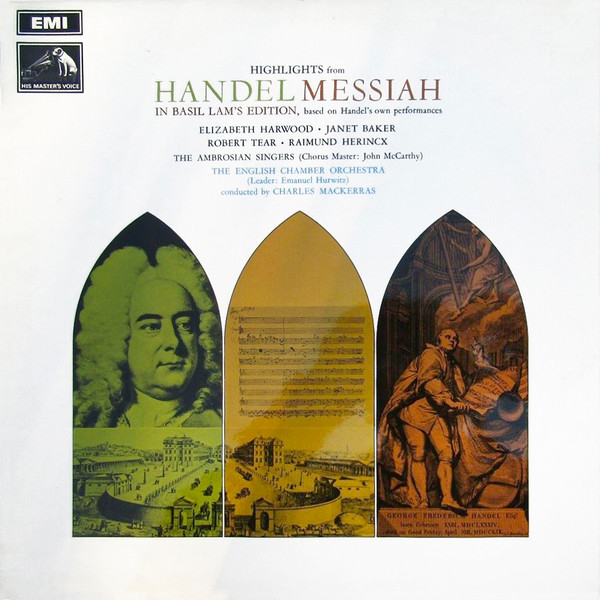
Not actually the cover of my copy–this is the British edition, on EMI, while mine is on Angel, a US subsidiary of EMI. The performance was recorded in 1966. It was one of the early attempts at performing the piece with resources closer to what Handel would have had available.
It was Sunday afternoon instead of the usual Saturday night, because we had a conflict with another event on Saturday night. We ended up being late because of traffic delays, but an usher kindly seated us, and we only missed the prelude. The opening recitativ, "Comfort ye," had just begun when we walked in, so I missed most of it; it could have been worse, but was still regrettable, as it's a very beautiful part of the oratorio; those first few words are deeply sweet and touching.
Is there any other great work as purely lovable as this one? It's so accessible, so tuneful, and yet it's not lightweight. Anybody who can enjoy a tune can enjoy most of it. Most people, I would think, can enjoy the bits where Handel plays with the words: the way the melody goes wandering on "All we like sheep have gone astray-ay-ay-ay-at-ay-ay-ay," the similar way it stutters when God threatens to "sha-a-a-a-a-a-a-a-a-ke the heav'ns and the earth." And yet experts and connoisseurs still find it rewarding and regard it as a great masterpiece. The word "noble" keeps coming to my mind: it is a noble work.
Perhaps some of what makes it, in a sense, easy, is in the fact that it does not spend much time on the Crucifixion. Parts One and Two consist of quotations from the Old Testament prophecies, Part Three of triumphant declarations from the New. The suffering servant prophecies occur in Part Two but are a much smaller part of the whole than the others. And speaking for myself only, but probably not alone, I consider it a great providence that Handel was resident in England and used the King James Bible and the Book of Common Prayer as his texts. I'm pretty sure I would not love the work quite as much if all the words were in German. (Yes, Bach, perhaps I could love you even more if you had come over to England, at least for a while.)
I don't really have anything of interest to say about the performance. As far as I'm concerned it was great, and I would not have been listening with a critic's or connoisseur's ear even if I had one. The symphony had hired professionals for the solos, and I will tell you their names, with links to their web sites, in case you're interested:
Kathryn Mueller, soprano; Emily Marvosh, contralto; James Reese, tenor; Jonathan Woody, bass.
Mr. Woody is a fairly slight young man, which made his huge bass voice all the more striking.
I will make one remark about the soloists, all of them: they didn't seem quite as forward as I expected. They didn't stand out from the orchestra and chorus as I expected. A day or two later I listened to part of my recording of the oratorio and had the same thought. Then it occurred to me now that I was probably comparing them to opera singers, who have to punch through everything else, not blend in. Checking the credits of the singers at their web sites, I notice that they seem mostly to perform baroque and earlier music. So that explains that, I guess.
I was pleased to see that the custom of standing for the Hallelujah Chorus is still observed. Depends on the location and audience, perhaps? Some people–not most, as far as I could judge–seemed to think it meant that the work was over.
The next symphony concert, the last of the season, is only two weeks away. One of the works on the program is Berlios's Symphonie Fantastique, another work which I can't recall having heard since I was a college student. I was never very keen on it; maybe I'll like it better now. Also, Saint-Saëns's Second Piano Concerto, which I don't think I've ever heard.
 Light On Dark Water
Leave a reply to Thaddeus Gotcher Cancel reply