Is just “Sayers” enough, or should I have said “Dorothy L. Sayers”? She was particular about the “L,” which stands for “Leigh, her maiden name. Her last name is perhaps right at the threshold of fame where it needs no additional specification. It’s enough for me–I don’t know another literary Sayers–but perhaps not for the world at large.
After finishing Longfellow’s Dante translation, I wanted to read something lighter, and this looked like a good possibility. I had read most or perhaps all of Sayers’s Lord Peter Wimsey detective novels back in the ’70s–she was very popular then, due in part I think to the feminist movement–and enjoyed them. But as far as I recall I hadn’t read them since.
Strong Poison introduces Harriet Vane, the somewhat Sayers-like character who becomes a romantic foil to Wimsey and eventually marries him. I assumed that that placed the novel among her earlier work, but I was mistaken: Sayers was already a very successful mystery writer when she added Harriet, and the resultant romance, to her stories. The romance begins most improbably: Harriet is on trial for murder, and Peter, attending the trial, falls in love with her at first sight, which of course establishes her indisputable innocence in his mind. This, obviously, means that he must prove that she did not poison the ex-lover with whom she had cohabited for a while.
The case against her is extremely strong, seemingly air-tight. And casting at least reasonable doubt on that case in turn involves figuring out who else might have done it, and how–especially the “how,” as this novel involves the sort of very complex scheme that seems to have been favored by the mystery writers of the time. Very complex, and to me somewhat implausible–but then if I were ever driven to murder someone it would probably be a pretty crude business, perhaps ending with “Yes, I killed him, and I’m glad I did, because he deserved it,” and holding out my hands for the cuffs.
I really had forgotten how much fun Sayers’s work can be. Strong Poison opens with the judge’s charge to the jury at the end of Harriet’s trial, and it’s an excellent bit of writing, capturing equally the old judge’s dry plodding recitation of the facts, glimpses of his distinctive and perhaps not always so dry personality–he seems to have a special interest in the food which plays a part in the crime–and the reaction of certain spectators, including Wimsey. It goes on for some twenty pages, and the fact that it is not dull is a tribute to the author. At the end of it we know all the details of time and place and possibility, regarding the crime, and Harriet’s means, motive, and opportunity are firmly established. It could have been a tedious exposition, but it isn’t.
I had forgotten that Wimsey can be pretty amusing. I had forgotten about Wimsey’s manservant Bunter, and that the two of them often make one think of Bertie Wooster and Jeeves, except that Wimsey only appears to be goofy. The resemblance had already occurred to me when I read this exchange:
“I endeavor to give satisfaction, sir.”
“Well then, don’t talk like Jeeves. It irritates me.”
And I had forgotten about the Dowager Duchess of Denver, Peter’s mother, who combines the chatter of an aristocratic flibbertigibbet with shrewd perception. I would like to see more of her, which is perhaps to be found in some of the other books.
Implausibilities pile up as the narrative continues. Bunter is if anything more omnicompetent than Jeeves himself, with his knowledge of experimental techniques in chemistry providing a crucial item in Harriet’s defense. We are expected to believe that Wimsey supports an office staffed by mature ladies who are as skilled at detective work as secretarial and research, and who can be called upon if a mature lady is needed, for instance, to infiltrate a household, also implausibly. A little less implausibly, though for me still a little hard to believe, we have at least two instances of a person tagging “what what” to the end of a sentence, which is always funny in books and movies though it would probably be pretty annoying in real life.
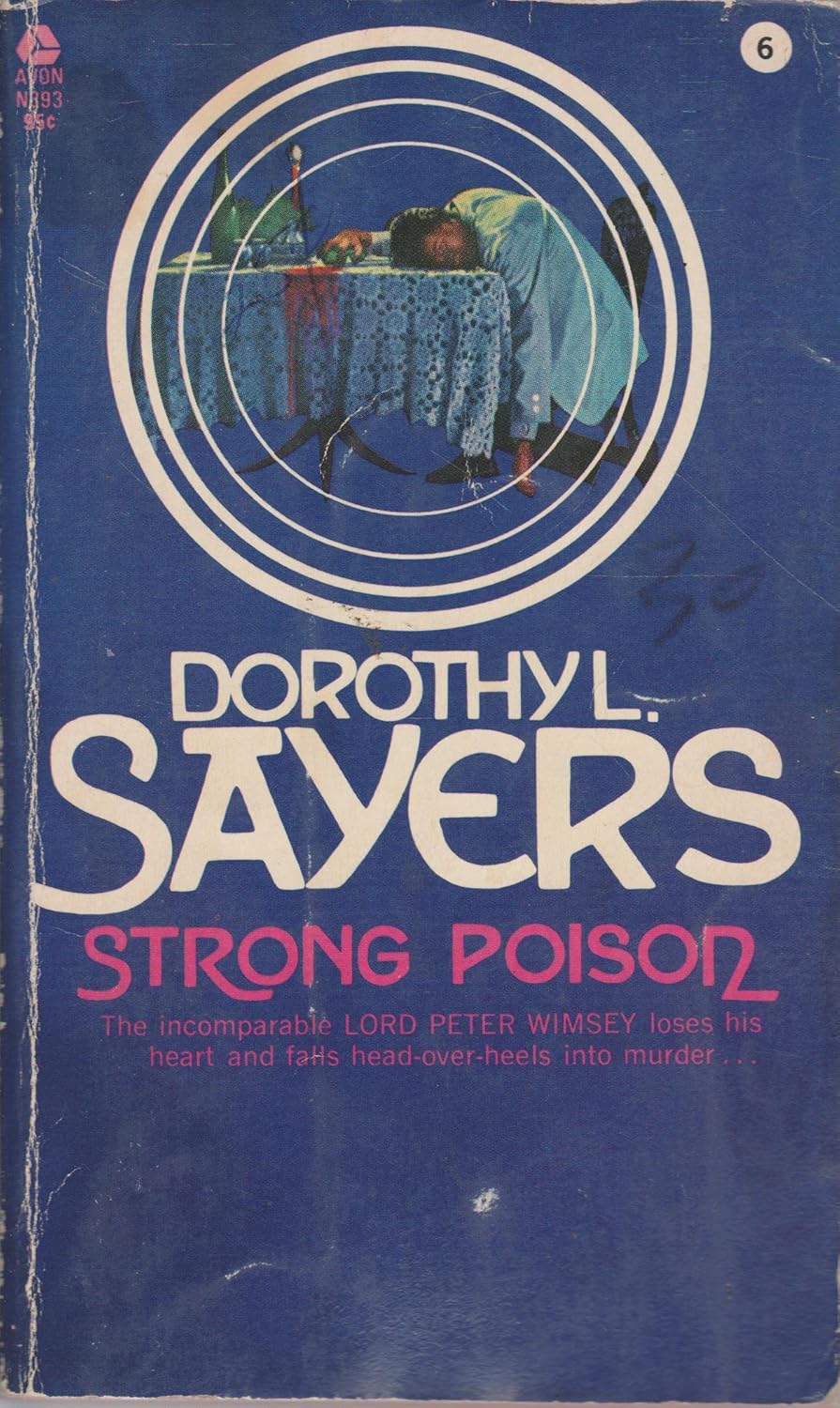
But plausibility doesn’t matter much–the novel is a skillfully executed and engaging construction, enlivened by wit, with an undertone or implication of seriousness about the situation of the young woman, disgraced by a love affair which has far less significance for the man’s reputation. I have several more of these little Avon paperbacks which were the readily available editions of Sayers’s work in the early ’70s, and expect to read at least one more this year.
The murder of which Harriet is accused is loosely based, or perhaps just suggested by, the case of Florence Maybrick, an American woman who married a rich Englishman who treated her rather badly and whom she was accused of poisoning. Personally I don’t think she did it, though he may have deserved it.
I ran across a very interesting Substack post on Harriet and Lord Peter by Laura Thompson, who has written biographies of Agatha Christie and several other notable women. If you are at all interested in the subject, I think you’ll find it worth reading. You’ll see why I associate the ’70s vogue for Sayers with feminism. It discusses one of the last novels in the series, Gaudy Night, which I recall being of particular interest to young feminist-inclined women at the time (especially one who was of particular interest to me). Among other things, it’s all about Harriet.
I read Sayers’s translation of Dante’s Inferno back in the ’80s, and as I recall I thought the translation, in Dante’s verse form, had problems but that her notes made it worthwhile. I think I’d like to look at it again.
 Light On Dark Water
Leave a reply to Marianne Cancel reply