Fascism and Communism, Again

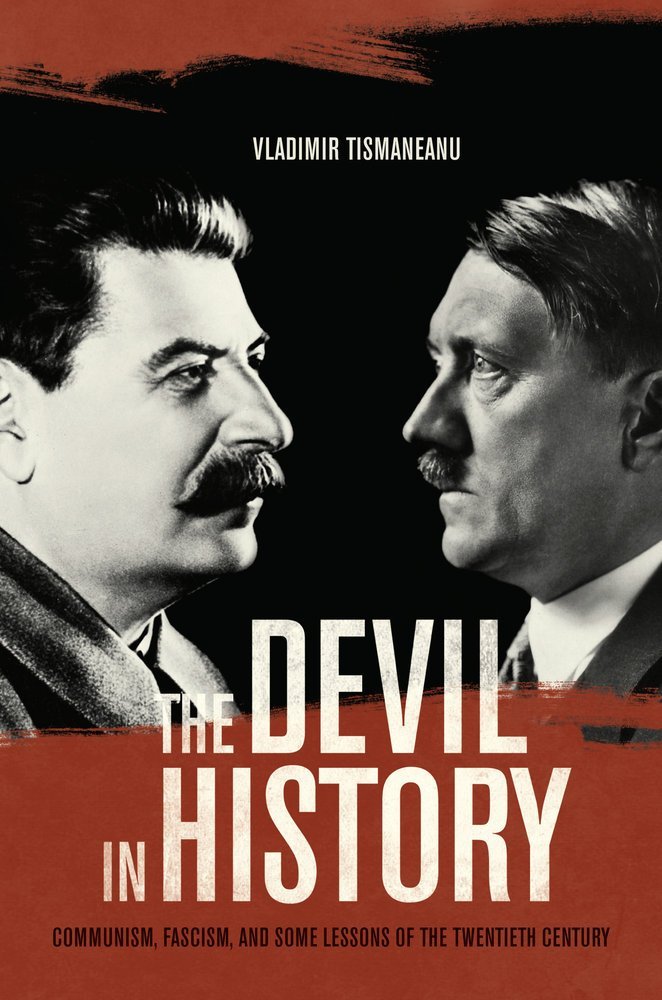
Leafing through a year-old issue of The New Criterion the other day, I came across a book review I'd forgotten. It's very relevant to something I wrote here back in March, "Socialism, National and International", in which I talked about the socialist element of Nazism. (I can never decide whether to say "Nazism" (or nazism) or "fascism" in this context, but one naturally tends to focus on German fascism because its monstrousness was so extreme compared to others.) The book is The Devil in History: Communism, Fascism, and Some Lessons of the Twentieth Century, and the author is Vladimir Tismaneanu. The reviewer, Paul Hollander says this:

It takes determination and formidable erudition to wade into the controversies which for several decades have enveloped and often obscured the concept of totalitarianism….

Tismaneanu has undertaken to demonstrate that the concept is meaningful and to elucidate the significant similarities (without ignoring the differences) between Nazism and Soviet communism—similarities which are at the heart of the idea of totalitarianism as well as its most contentious attribute.

And I discover the following quotation from Tismaneanu in his Wikipedia entry:

I was also discovering a theme which was to puzzle me throughout my professional career: the relation between communism, fascism, anti-communism and anti-fascism; in short, I was growing aware that, as has been demonstrated by François Furet, the relationship between the two totalitarian movements, viscerally hostile to the values and institutions of liberal democracy, was the fundamental historical issue of the 20th century.

I'm inclined to agree with that "fundamental historical issue" assessment, at least if you confine history to politics and external events rather than ideas. It's a question that has occupied me a good deal since I shed my youthful leftism,  in particular the question of why Western liberals have remained so indulgent of communism. And it does seem true that the totalitarian mentality, rather than any economic program, that constitutes the most fundamental common element between the two systems.  I don't read many books on politics, but I may read this one. The entire review is online here.
DevilInHistory


,

120 responses to “Fascism and Communism, Again”

  1. Marianne

    In that quote by Tismaneanu that you provided, he mentions François Furet, whom I’ve never heard of, so I went to Wikipedia and there found that he was an expert on the French Revolution. And that reminded me of a piece I’d read several years ago in the City Journal that put Robespierre down as the first totalitarian, describing him as “a monster who set up a system expressly aimed at killing thousands of innocents. He knew exactly what he was doing, meant to do it, and believed he was right to do it. He is the prototype of a particularly odious kind of evildoer: the ideologue who believes that reason and morality are on the side of his butcheries. Lenin, Stalin, Hitler, Mao, and Pol Pot are of the same mold.”
    The full article is here.

  2. Thank you. I didn’t know who Furet was, either. I’ll have to wait till a little later to read the article, but the mention of Robespierre in this context reminds me of something I read a long time ago. I can’t remember who the author was, a journalist of some kind I guess, reporting on the meetings of a radical left-wing group–maybe of the ’60s, maybe one of the later successors of that crowd. Anyway, he referred to one of the leaders, who seemed particularly malicious, as “Robespierre Junior.” I don’t think ’60s radicalism had the steel required ever to produce the kind of killing that we associate with totalitarianism (not to mention the more enticing lure of drugs and sex), but you could certainly find examples of the basic personality type. Not that there were many of them, but there weren’t many Robespierres, either.

  3. Just read the article. It’s very good. I especially like those two paragraphs beginning “An ideology is a worldview…”. You can certainly see ideology in that sense all over the place in current politics. I think it’s also important to realize that the Catholic faith can become an ideology, too. Sometimes some traditionalists make me a bit nervous on that score.

  4. Rob G

    Looks like an interesting book. Furet’s name comes up often in discussions of the FR and also of totalitarianism, but I’ve not read him.
    Coincidentally I read a couple days ago that the conservative historian and essayist Stephen Tonsor had died in January. I’d not read him but knew his name, and have since ordered a book of his essays published by ISI.
    Seems that one of the things he’s known for is his work on the FR, and also for an essay on Nazism called “National Socialism: Conservative Reaction or Nihilist Revolt?” I’m hoping that that essay is in the book.

  5. Grumpy

    There was a crazy practicing Catholic Marxist legal theorist at my former University who used to argue that the Nazis were nihilists. I was never convinced. His arguments always seemed to be that they swerved from their ideologies in practice. My reaction to this was that all politicians do, but that doesn’t mean they have no beliefs, but just that it is impossible not to be flexible in practice.

  6. Some people seem to use the word “nihilism” in ways that don’t make sense to me. I don’t understand how it could be applied to the Nazis. They must mean something other than I would by it.

  7. Grumpy

    I agree. I often don’t know what people mean by ‘nihilist’.
    I tend to think the word is over-viewed. Many intellectual conservatives would say we live in a nihilist culture, but look at the predominant moral questioning of the Sopranos, Breaking Bad, The Americans, The Wire.

  8. Grumpy

    I meant to say, ‘over-used’. What strange Freudian impulse substituted Over-viewed for over-used. Another highly moralistic soap is Justified.

  9. I became very interested in seeing “Justified” several weeks ago when I learned that Elmore Leonard was involved in it, and considered it a very successful rendering of his work.
    “Nihilistic” is definitely the wrong word for contemporary culture in general, I think. The strain is there, but…it’s complicated.

  10. Grumpy

    I enjoyed the first couple of series of Justified very much. Then when it came to the third series, I just could not pay enough attention to it to remember who all these people were and what had happened in the previous episode. I skipped the fourth series and went straight to the fifth one – or I think I did, because I can never remember if I’ve seen an episode or not. I have watched the first episode of the fifth series, and keep trying to remind myself to go on to the second one. But the two first series were really enjoyable. Not up there with The Wire or Breaking Bad, but very enjoyable TV.

  11. I would already have started it if it were streamable on Netflix. But I’ve had other things I wanted to get on DVD. For instance another Leonard adaptation, Jackie Brown, which was good, not great.
    The weirdest use of “nihilist” I’ve seen was from James Fallows (I think) in The Atlantic. He said the Republicans were “objectively nihilist” for opposing everything Obama did. Fallows is not stupid and I’ve wondered if the word has acquired some new meaning. But probably it’s just a reflection of how inseparable liberalism and morality itself have become merged in the minds of liberals. I.e. opposition must arise from rejection of the concept of morality itself.

  12. Marianne

    About Justified — Maybe it’s because I’m way too impressionable and can’t get distance to protect myself from films, but watching the DVD of the first season was enough for me. I got hooked right away because of the lead character mainly, but the unrelenting darkness of it all and some of the really bad characters just left me feeling empty and sort of hopeless.

  13. Marianne

    It’s not only James Fallows with the “nihilist,” it’s a meme!
    I did a search on “republicans are nihilists” and these are on the first page of the return hits:

    The Rise of Republican Nihilism | New Republic
    Extremists, Not “Nihilists” – The Washington Monthly
    On Calling Out Republicans for Political Terrorism, Nihilism …
    The Nihilist Party: Republicans Who Believe in Nothing
    We Have To End Republican Nihilism « The Dish
    Ignore Republican nihilism. Obamacare is already working …
    How America Has Paid for Republican Nihilism – The Atlantic

    Haven’t looked at any of them except that “The Nihilist Party: Republicans Who Believe in Nothing,” which is in the Huffington Post, dated 2011, and here’s how it explains the nihilism:

    Some people’s only exposure to nihilism comes from the German gang in The Big Lebowski who said things like “We are nihilists, we believe in nothing” and “Tell us where the girl is or we cut off your johnson, Lebowski.” Or the nihilist humor of comedian Brother Theodore, who liked to say things like “I looked at the void, the void looked back — and neither of us liked what we saw.”
    That’s exactly how I feel when I watch the Republican Presidential debates.
    The void that looks out through their eyes is the absence of any underlying principle, ideology, or ideas, especially on economic issues. It’s not that their beliefs are different than yours or mine. It’s that, as now seems clear, they don’t actually believe in anything — anything, that is, except greater power for themselves and greater wealth for their financial backers.
    Nothing in nihilism’s long intellectual history has prepared the world for its latest incarnation as the 21st century Republican party, or in its ultimate flowering in the likes of Mitt Romney and Herman Cain.

  14. Well, that sounds very faithful to Leonard. Years ago when someone first recommended him to me it was with the warning that it might be a venial sin to read him. Not that the books are so terribly salacious (especially not in comparison with most these days), but that their general view of the world is quite dark, and the evil is pretty oppressive. Although in the ones I’ve read the good guys do eventually win (unlike in the Leonard-influenced No Country for Old Men, it is sort of unpleasant to be immersed in that world. I guess that’s why I haven’t read any more than I have (three or four), although I was very impressed with those. He certainly knows how to tell a gripping story. Maybe Justified diffuses that more.

  15. That was a reply to the comment about Justified, obviously. Hadn’t seen the next one when I was writing it.

  16. Ok, having read the Puffington nihilism quote, I can only say that the liberal view as represented there does not even seem sane to me.

  17. Grumpy

    The first time I heard this generalized use of the term ‘nihilism’ was from a political conservative – a guy who at that time worked in a conservative think tank and now runs a conservative magazine. I had translated one book and he wanted me to translate another one, because his boss, a big shot in the think tank, wanted it. I had just got a job in a University for the first time. I had to publish to keep the job. I explained to the conservative guy that I couldn’t spend my time translating some obscure bishop-friend of the bigshot, because I needed to write and publish to keep my university job. He said, ‘I did not know British Universities had succumbed to this nihilism.’ Actually, ever since then I’ve associated the use of the word ‘nihilism’ with a certain level of humbug. How many ‘fellows’ of the *** *** Institute, where this guy worked, were appointed because of translations they had done, and how many were appointed because of their own original writings? About 100% of the latter.

  18. I feel like I’ve taken a wrong turn and am in a town where they don’t speak ordinary English. I thought I had some idea of what the word “nihilism” means but I cannot grasp this new usage. There seems to be something in common between the liberal and conservative examples, but I’m not sure what it is more specifically than a pompous way of saying “I don’t like it.” The Fallows thing I mentioned, which I don’t think was all that long ago–has to be less than 6 years, because Obama was already in office–was my first encounter with it.

  19. Skimming the Wikipedia article on nihilism, I didn’t find any suggestion that the usage of the word in the contexts we’re talking about here makes any sense. I did, however, find this passage, which strikes me as settling the question:
    “Three of the antagonists in the 1998 movie The Big Lebowski are explicitly described as “nihilists,” but are not shown exhibiting any explicitly nihilistic traits during the film. Regarding the nihilists, the character Walter Sobchak comments “Nihilists! Fuck me. I mean, say what you want about the tenets of National Socialism, Dude, at least it’s an ethos.”
    Surely our liberals and conservatives can grant each other as much.

  20. Grumpy

    Yes, that lady does not have an exciting singing voice!

  21. Rob G

    The nihilists in The Big Lebowski are like cartoon or pantomime nihilists — purely farcical. Towards the end of the film when the “good guys” confront them outside the bowling alley Donny (Steve Buscemi) asks Walter if they are Nazis. Walter replies, “No, Donny, these men are nihilists. There’s nothing to be afraid of.”
    Unfortunately some of these people using the term seem to know nihilism ONLY via The Big Lebowski and are thus way off on what it really is. The statement above about GOP nihilism is ludicrous.
    Some writers, Flannery O’Connor for instance, have used the term to describe an atheistic existentialism taken to its logical conclusion or gone to seed, as it were. Her story “Good Country People” is an example of this. Remember her famous comment about nihilism being in the air we breathe.
    Also, writers like the late philosopher/aphorist E.M. Cioran and the horror writer Thomas Ligotti (the one a lapsed Orthodox, the other a lapsed Catholic) could be considered nihilistic, although I don’t think that either calls himself that. They’d more likely consider themselves philosophical pessimists.

  22. “…some of these people using the term seem to know nihilism ONLY via The Big Lebowski …”
    That’s exactly what I thought when I saw the mention of BL in the Wikipedia article. That would make some sort of sense out of the usage: “nihilist” meaning something along the lines of “pointlessly mean.”
    Flannery O’Connor’s sense of it is pretty much mine.

  23. Grumpy

    I love Planxty – one of my favourite ever bands
    http://www.youtube.com/watch?v=4vQvr3iiZOY
    I think part of the problem is the ‘nihilism as the air we breathe’ notion. Once it’s the air we breathe it’s everything, and ceases to be distinguishable from anything else. If something is everywhere it is not anywhere in particular.

  24. FOC means something pretty definite, though: the loss of a sense of objective meaning that pretty well dominates modern culture.

  25. I like the Planxty video. I don’t know the name of that second tune but it’s very familiar. What are those instruments the two guys on the left are playing? Basically like mandolins, but bigger. I guess there is a mandolin family.

  26. Rob G

    Those are bouzoukis, which are Greek in origin. They were adapted into Celtic music at some point, and sometimes even you see a modified “Irish” version, which has a larger, wider body like an onion rather than a teardrop.
    Some Celtic bands use similar instruments instead of/in addition to the bouzouki — the cittern, mandocello, mandola, and octave mandolin are also popular.
    And yes, my understanding of nihilism would be that of FO’C.

  27. Oh yeah, I’ve heard of bouzoukis, but it never occurred to me that they would be used in Irish music.

  28. Rob G

    “Oh yeah, I’ve heard of bouzoukis, but it never occurred to me that they would be used in Irish music.”
    Probably not prior to the 60’s “folk revival,” when a lot of cross-pollination was going on. Maybe even later than that.

  29. For that matter, the guitar is not strictly authentic for that music. Don’t know when they came in.

  30. Grumpy

    FOC may be right that there’s a lot of this about, but the problem is that now ‘nihilism’ has become a catch all term for everything someone dislikes, like ‘gnosticism’.
    Here is another nice one – I love the whole of Cold, Blow and the Rainy Night.
    http://www.youtube.com/watch?v=a2As4LRkZa0

  31. It’s a question that has occupied me a good deal since I shed my youthful leftism, in particular the question of why Western liberals have remained so indulgent of communism.
    Just to throw out a hypothesis. People seek recognition and have an affinity for markers which demonstrate their particularity. To be indulgent of communism is to set oneself apart from those whose political views are ordinary (and whose sensibilities are ordinary). See Thomas Sowell on ‘The Anointed’ and ‘The one-uppers’. Paul Hollander addressed the matter in a more academic idiom in Political Pilgrims but was less successful at crafting a coherent and cogent description.
    Various strands of political discussion (none of which have much public purchase) seem to manifest this – see The American Conservative for examples.
    Should not that properties of foreign political movements – communist or neo-peronist or fascistoid have properties which can render their votaries (or their attorneys) not ‘particular’ but ‘creepy’.
    When I started perusing opinion journalism 35 years ago, Soviet fandom was considered embarrassing and passe, but Latin American reds were all the rage. Some of the same characters were still knocking about as recently as four years ago making the case for whatshisname, the deposed President of Honduras; he’s anti yanqui, no? Others make the case for gruesome Arab particularism, the closest cognate to inter-war fascism there’s been in the last sixty-odd years. Vladimir Putin now has his advocates (Steven Sailer).

  32. Grumpy

    The business about particularity markers nails it. Ordinary people do not like communists.

  33. About nihilism: I intend to carry on using the word as it’s normally been defined and hope the people who learned it from Big L get tired of it.

  34. “Ordinary people do not like communists.”
    And vice versa, despite professed devotion to the people. That is an excellent point about particularity, if I understand it correctly. The influence of the desire to set oneself apart from the herd, or to get revenge on the herd for its rejection or disinterest in one, shouldn’t be underestimated as a factor in radical political and social movements. I certainly felt it very strongly when I was an adolescent.

  35. “Lakes of Ponchartrain” is a good one. But as so often happens, the first version of a song one hears sticks as the favorite, and for me it’s the Be Good Tanyas:
    http://www.youtube.com/watch?v=Xlx3OwfXkP8
    Very mannered vocal, possibly not pleasing after the smooth Planxty style.

  36. Grumpy

    well I cannot play it now because I have a guest staying in the spare room…

  37. Rob G

    “About nihilism: I intend to carry on using the word as it’s normally been defined and hope the people who learned it from Big L get tired of it.”
    Amen to that.

  38. I was thinking I had heard a pretty good version of Pontchartrain by Dylan, but this isn’t it: http://www.youtube.com/watch?v=Xck09CgQ-Hc
    I mean, it’s ok, but…

  39. My Oxford Companion to Philosophy here in my office states that the word nihilism was invented by the Russian novelist Turgenev, Mac. “To describe young rebels in Tsarist Russia.” The definition does not mention The Big Lebowski. 🙂

  40. Louise

    FOC means something pretty definite, though: the loss of a sense of objective meaning that pretty well dominates modern culture.
    That reminds me of The Objective Room for some reason.

  41. Remember this? (“Objective room” techniques in current practice.) The O. Room was one of the creepiest things in That Hideous Strength.

  42. I’m pretty sure Wikipedia agrees with Oxford, Stu. Though it also mentions Lebowski.

  43. Robert Gotcher

    There is a church here in Milwaukee county that I’m absolutely convinced was designed using the principles of the Objective Room. It has the same effect on me that it had on Studdock.

  44. Louise

    I knew we had discussed this before! I’m going to read that again.

  45. Louise

    There is a church here in Milwaukee county that I’m absolutely convinced was designed using the principles of the Objective Room.
    Terrible, but not surprising.

  46. A Catholic church?! Well, I guess I shouldn’t be that surprised if it is.

  47. Rob G

    Received the book of Tonsor’s essays yesterday but was disappointed to discover the one on Nazism and nihilism isn’t in it, apparently because it’s a longer essay that was published as a monograph, and is readily available elsewhere. I’ve ordered it on I.L.L.
    The book of essays looks excellent otherwise, I must say.

  48. The name of that essay didn’t really register with me when you posted it the other day: “National Socialism: Conservative Reaction or Nihilist Revolt?”
    It was certainly a reaction, all right, but it’s hard to see how it could be called conservative. I don’t think I’d call it nihilist, either, except maybe in some subtle technical philosophical which is probably not what the Nazis were actually thinking.

  49. Marianne

    Didn’t the Nazis become associated with nihilism in the eyes of many because of their close association with Nietzsche’s sister? And also because they latched onto a few of Nietzche’s phrases like “will to power.”

  50. I was sort of vaguely wondering that myself, but I’m not sure. I was thinking of that when I said “some subtle technical philosophical sense”–oops, I see I left out “sense” above. That maybe you could argue that they were “nihilist” in the sense of believing that the great man/people molds reality to his/their own wishes and means whatever he/they choose for it to mean. But once they began gaining power did any of that stuff matter? I don’t know.

  51. Robert Gotcher

    I’m thinking of that Christopher Plummer character in The Scarlet and the Black. He wasn’t a nihilist. He was just a power-hungry racist. “I’m oppressing the Jews so I can have a nice German Christmas in my Roman palace. Rome: its mine! Put on the Beethoven!”

  52. Haven’t seen the movie but I think that has more to do with it than nihilism.

  53. Grumpy

    Nietzsche was not a nihilist.

  54. You surely know more about him than I do, but on the basis of what I’ve read I would say he often spoke in a nihilistic way, as suggested in the last paragraph of the Nietzsche section of the Wikipedia article on nihilism.

  55. Rob G

    The watershed piece for me for my understanding of modern nihilism is D.B. Hart’s “Christ and Nothing.” I’ve read it numerous times and learned something every time. I think he’s dead on.

  56. Rob G

    In discussing nihilism I forgot about a book that was fairly popular among certain conservatives ten or twelve years ago called Shows About Nothing, by a fellow named Hibbs. The subtitle was “Nihilism in Popular Culture,” I believe. I read it three or four years ago but wasn’t particularly impressed. I thought his definition of nihilism was too broad, and thus his examples were to me a bit stretched.

  57. I remember seeing the book discussed but was not interested enough to read it. I know the title comes from a description of the Seinfeld show–maybe by Seinfeld himself?–a show I didn’t find funny or interesting on the two or three occasions I watched it, so I am willing to agree with the description as applied to it. I mean, not that it was necessarily “nihilistic” in any strict sense, but that it was about nothing (much).

  58. Marianne

    Both Seinfeld and the later Curb Your Enthusiasm aren’t so much about “nothing,” as they are about coming out the other side of nothingness — in their case with jokes and silly, shallow characters, rather than Übermenschen.

  59. Sounds more like getting comfortable with nothingness than coming out on the other side of it.
    Starting back in the ’70s sometime there’s a kind of popular humor that seems somewhat nihilistic to me: it’s ironic and contemptuous of everything, including itself. I don’t know what he’s like now but when I saw David Letterman a few times 30 years ago he struck me that way. Dylan said something around that time that struck me–he said a coldness had appeared in our society that was represented by “computers and cocaine and David Letterman.”

  60. I mean, I think I came out on the other side of belief in nothing, to belief in something.

  61. Rob G

    I actually think Seinfeld is very funny, largely because the characters are so intentionally shallow, without they themselves realizing how shallow and ridiculous they are. They’re idiotic like the 3 Stooges, but the slapstick and pratfalls are verbal and situational instead of physical.
    The “show about nothing” line reflects the fact that in the show’s world, the episodes weren’t supposed to be pre-written or pre-plotted. Basically, they were about these four people and their daily lives, and nothing else. There was no arc — the characters never progressed.
    I do not think that the characters were so much comfortable with nothingness but oblivious to it.

  62. Just to be clear, I didn’t not watch Seinfeld because I thought it was nihilistic–I just didn’t find it especially funny. And the characters were vaguely off-putting. But then I didn’t give it much of a chance. But then why should I?–if it’s only a sitcom, and you don’t find it funny, you’re probably not running the risk of missing great art. I haven’t seen Curb Your Enthusiasm at all.
    There’s another show that I think is somewhat in that vein…can’t remember the name of it…it was recommended to be but I didn’t much care for the one episode I watched. Oh yeah, Arrested Development.
    Now, The Office, American version, I find very funny, though I’ve only seen a few episodes. How does it compare to these others in the “nothingness” department?

  63. Rob G

    Generally speaking I don’t like sitcoms much at all. The only one that I can remember watching with any real interest between All in the Family and Seinfeld was Cheers. I do think that Seinfeld is unique, and a cut way above the rest. Haven’t watched The Office.

  64. Typepad has been offline almost all day today. Still intermittent. Don’t know if this will post or not.

  65. Taking advantage of what I hope will not be a brief period of operation. My inability to post more or less this same comment earlier today was my first clue that something was wrong with Typepad.
    I don’t make any big claims for The Office except that it made me laugh, which is by no means to be assumed of sitcoms. I thought it made excellent humor out of the typical office environment, rather like the movie Office Space, which I love.
    I never grasped the appeal of All in the Family. It mostly seemed like fairly heavy-handed liberal preaching to me, and that was when I was more or less on the same side as the producers.
    Never saw Cheers. Oh wait, there was one sitcom I enjoyed through a number of episodes: Everybody Loves Raymond. Nothing great, but it was often funny. My wife and I got mildly hooked on it six or seven (or eight or nine?) years ago, when we first got cable.

  66. Robert Gotcher

    Cheers was extremely funny, even if morally problematic. We liked Home Improvement, too. Not all the scripts were great, but it sure made us laugh. I haven’t watched sitcoms since Home Improvement went off the air.
    Oh, I watched a few episodes of That 70s Show, which, in its first season, reminded me of what it was like to go through the 70s in high school in the Midwest. I think the first episodes was about trying to get a keg of beer for a party. It got the ethos pretty well. I couldn’t watch too many of them, though, esp. the later seasons.

  67. Oh, I watched a few episodes of That 70s Show, which, in its first season, reminded me of what it was like to go through the 70s in high school in the Midwest.

    Aye. Since I’d been there in person, a few episodes were enough.

    The Office could be engaging. However, I’ve gotten to the point in my life where the only thing I can sit through are documentaries, travelogues, and detective serials of one sort or another. Don’t know why. Haven’t seen the inside of a cinema in nearly ten years.

  68. Robert Gotcher

    I think the reason I couldn’t stomach too many episodes of That 70s Show is because I have absolutely NO nostalgia for the 70s. Zilch. It was unpleasant then and it is unpleasant to watch a show about it, esp. one that actually seems to understand what it was like.

  69. I don’t think it ever crossed my mind to watch That ’70s Show. For me the ’70s were the morning after the ’60s, and a bleak and queasy one it was.

  70. In principle I like seeing movies in a real movie theater. In practice I rarely get around to it. So in effect we older people cede the market to kids, and then complain that they never show anything we like. Not counting the Metropolitan Opera’s Wagner series, the last movie I saw in a theater was the third Narnia movie. It did not constitute positive reinforcement of my behavior.

  71. I think the reason I couldn’t stomach too many episodes of That 70s Show is because I have absolutely NO nostalgia for the 70s.
    Escalating divorce rates, escalating crime rates, escalating drug use, decay of academic institutions, bad haircuts, ugly clothes, and a general sense of entropy. It was an era. Still, the characters portrayed are my contemporaries (or would have been – the actors in question are a decade and a half my junior). We were in our mundane lives sometimes happy, and always well fed.

  72. Terry Teachout’s reviews in Crisis were my guide for a while, though some of the best I seem to recall seeing on video. Some films I’ve very much enjoyed (when I still could), but I cannot recall if I saw them in the theatre or not. (I lean toward ‘not’). (My memory is fuzzy). I am sure I saw Mel Gibson’s effort in a cinema in February 2004, but that may have been the last time.

  73. Rob G

    I go to a fair number of movies, one or two a month on average, but on the other hand I watch hardly any TV so I guess it evens out. I haven’t had cable since the last season of The X Files. Any sitcoms I’ve seen I watched with my father as reruns, and I watched most of Breaking Bad either on DVD or at a friend’s house.

  74. Robert Gotcher

    I frankly don’t know how people have as much time as they seem to have to watch tv, watch movies (in theater or at home), or read. Everyone talks about watching seasons of shows, like Breaking Bad or Downton Abbey. Or reading all kinds of long novels and long journal or magazine articles. I do almost none of any of them, yet I seem not to have enough time to fulfill my obligations. Maybe I should stop reading LODW. Or playing Settlers with my kids. I DID stop Facebook.
    A guy I met this weekend asked me “What books have you read lately?” I drew a blank. It was only later that I remembered that I had read recently Pieper’s essay on faith. It is very short and it took me several days to read.
    That is one of the reasons I always feel so dumb in the presence of the good people on this blog.

  75. You have children at home, right? I don’t, anymore, and that makes a huge difference. Even so, I don’t really get through that many books, and the big reason is the internet. The reason I see, for instance, all of Breaking Bad is that my wife and I have gotten into the bad habit of watching something while we eat dinner. We’ve been unable to break the habit but at least manage most of the time to limit it to one hour, which means episodes of a tv series are ideal for the purpose.

  76. Did Fawlty Towers make it to the US?
    I don’t know if Yes Minister or Only Fools and Horses would travel, but both of them were very entertaining (or I thought so when I watched them, 20 years ago).
    There was a science fiction sitcom called Red Dwarf that was generally poor (from what I saw of it) but could occasionally crack me up completely.’

  77. I have to say I have very happy memories of growing up in the 1970s. Unlighted evenings and unheated classrooms and bomb warnings just seemed normal.

  78. Oh yes indeed, Fawlty Towers did make it to the US. Along with several of the Marx Bros. films it’s my favorite comedy of all time. Monty Python was sometimes very funny, and sometimes not, but to my taste Fawlty hits the mark most of the time.
    I’ve sampled Yes Minister briefly and it didn’t make a strong impression, but I probably should give it another try. I gave Red Dwarf multiple tries, probably hoping for a Dr. Who surrogate, but never could make anything of it at all.

  79. Louise

    The 70’s may well have been the best time in my life. But that’s because I lived in a rather sane little pocket of civilisation and the sun was always shining, it seems. 🙂
    The clothes were a drag, though!

  80. I miss flared trousers. Bit of a pain when cycling, though.

  81. I’m pretty sure I’ve seen the third Narnia film, Mac, but I can’t remember a thing about it.

  82. Unlighted evenings and unheated classrooms and bomb warnings just seemed normal.
    The last bomb drill I can remember happened in about 1970. The civil defense rations remained stored in a stairwell off the school cafeteria until 1976 (when that section of the building was razed), but no drills.
    I recall Richard Nixon’s misbegotten initiative in 1973/4 to have daylight savings time year round, but I cannot recall ‘unlighted evenings’, just that it was dark out when school started and we were all wearing reflector tape on our jackets.

  83. I wasn’t talking about drills, so much as about bombs. Went on after the 70s, too: http://en.wikipedia.org/wiki/1996_Manchester_bombing

  84. And rolling blackouts meant learning to play chess by candlelight, rather than watching television. Good times.

  85. Grumpy

    Yes, Paul, I remember all those things. We loved it at school when the lights went out.

  86. I figured you were talking about IRA bombs. But what produced the blackouts?
    I grew up at the height of the Cold War but cannot recall the bomb drills that everyone else talks about. Maybe the South was too poor to afford them.

  87. Grumpy

    The coal miners were on strike.
    The Americans gives me 70s nostalgia, and it’s set in the 1980s!

  88. Re the Narnia movies: in my opinion the first was pretty good with a few bad touches; the second was not very good with more bad moments; the third was pretty bad with a few good moments.

  89. And if there’s a fourth I don’t plan to see it.
    I haven’t seen The Americans. I hear it’s pretty good.

  90. The IRA weren’t the only bomb-planters around, either, just the most professional.
    I’ve just been reading Joseph Pearce’s conversion memoir, Race with the Devil, and it really takes me back to living in South London at the turn of the 1970s-1980s. Completely different atmosphere from South Yorkshire: fewer anarchists, more skin heads.

  91. I grew up at the height of the Cold War but cannot recall the bomb drills that everyone else talks about.
    No duck and cover. They just lined us up in the school cafeteria all along the wall. A bell at the wrong time of day meant a bomb drill. A horrible buzzer meant a fire drill (during which we were marched outside, told to line up in alphabetical order, and bellowed at by a teacher with a megaphone).

  92. It’s good you had those drills, because lining up against the wall would surely have saved many lives. (Yes, that’s sarcastic, although I suppose it could have made a bit of difference in the case of a building collapse.)
    We didn’t have fire drills, either, as far as I can remember.
    I think I’d like to read Joseph Pearce’s book. I read one of his others and wasn’t that impressed, but the story in this one seems worth hearing.

  93. His Shakespeare book was dreadful, and his books on Belloc and C.S. Lewis were so-so (focusing too much in the one case on why Belloc wasn’t an anti-semite, and in the other on why Lewis wasn’t a Catholic, but without getting beyond what Christopher Derrick had to say on that). His biographies of Chesterton, Solzhenitsyn and Roy Campbell are very good, though, and his book on Oscar Wilde is the best thing on Wilde I’ve read. He did a sort of collective biography called Literary Converts that was pretty good too. His enthusiasm as a reader comes through very strongly, which is nice. Too many literary critics or literary historians give you no clue as to how or why their subject is captivating in the first place.

  94. Grumpy

    I might read Pearce’s book. I saw the Lewis one and it seemed to be lifted without credit from Derrick. The Literary Converts one didn’t look appealing, to me at least. But I must admit the idea of an accurate portrait of growing up in south London in the 1970s is appealing.
    Mac I confess I’ve been addicted to The Americans. I think I mentioned that I bought the DVD of the first series from Barnes and Noble and then crashed out of my Lenten abstinence by watching the second series on Amazon instant video. Unlike the HBO series I’ve enjoyed over the years, the Wire and Breaking Bad, there is too much gratuitous sex on display in The Americans (I know, I know, ‘how much gratuitous sex would be the right amount?’). And it could be argued that it makes the two protagonists, who are KGB agents, into heroes – just by the fact that they are protagonists they tend to hold the audience’s sympathy. But I still think it shows the pure evil of living behind a false mask. And the story line is completely gripping. The second series is better than the first.

  95. I haven’t looked at Pearce’s book on Lewis but just from reading a review or two it certainly seemed to say the same things Derrick said.
    I think I checked on The Americans on Netflix and it wasn’t available for streaming. I’ve heard other good things about it but I don’t know if I need to see that much on-screen sex. We just started a BBC series called Island At War (or is it islands?) about the Channel Islands during WWII. It promises to be well-done but not exactly a pleasant experience. I assume it has some basis in fact.

  96. Louise

    I miss flared trousers.
    Say it ain’t so, Paul! I don’t think we can be friends any more. 😦

  97. Louise

    Although I think maybe your critique of Pearce’s books makes up for it. Maybe we can stay friends after all.

  98. Louise

    Re: flares. I have clear memories of having to tuck my jeans cuffs into my socks for bike riding and many other clear memories of rescuing those same cuffs from the bike chain whenever I didn’t bother.

  99. Rob G

    I recently watched ‘The Corner,’ which was the HBO mini-series that led to ‘The Wire.’ It shows a similar drug-ridden Baltimore world, but from the standpoint of a family caught in the middle rather than from the perspective of law enforcement. It’s very good.
    After that, I began watching ‘Homicide: Life on the Street’ which was sort of a network TV precursor to The Wire. It too is excellent, definitely some of the best network TV I’ve seen.

  100. I remember reading about them when I watched The Wire, and thinking that after I finished that I would check those out, but never did. Thanks for the reminder.

  101. I’d not heard of The Americans; it sounds interesting (apart from the seemingly obligatory cable-TV gratuitous bits).
    Did anyone see that cop mini-series that aired a few months back that had Woody Harrelson and Matthew Macougnahay (sp?) in the cast? I can’t remember what it was called… oh yes: True Detective. I remember seeing a few strong reviews when it began airing, but I don’t know if it continued strong through its finish.

  102. I haven’t seen it, but have the vague impression that at least some reviewers found it disappointing as it progressed.

  103. Fascism and Communism: The Blog Post Goes On, part 25

  104. And nothing whatever to do with fascism or communism.

  105. Rob G

    Received and read Stephen Tonsor’s little booklet, National Socialism: Conservative Reaction or Nihilist Revolt? This is from a series of such little books published by Holt, Rinehart in the late 50s & early 60s called “Source Problems in World Civilization.” Tonsor lays out the four most common general interpretations of the rise of Nazism, including lengthy quotes from primary sources, and then compares and contrasts them.
    He sees the Marxist interpretation as partly valid, but argues that it places too much emphasis on economics and not enough on ideology to accord with all the evidence.
    The “Vansittart school,” a group of historians that saw the primary source as something inherent in German history itself that came to a head in Nazism, Tonsor sees as overemphasizing history to the exclusion of other factors.
    The “liberals” (he’s writing here of German historians) have what he calls a plausible thesis in that they argue that “there were certain connections between German history, German idealist philosophy, and [post WWI German] neoconservatism…and National Socialism,” but he believes that they assert too much and prove too little, and mistake the movement as “conservative,” when it was “basically nihilist and without any philosophy.”
    The German conservatives he states argue too much in self-defense, either their own or that of the German people. They make the same mistake the Marxists do in blaming certain “amoral forces.” He does grant, however, that “the conservatives are quite justified in their contention that National Socialism was far more nihilist than conservative in outlook.”
    The purpose of these booklets seems to be to present the various views to the reader to enable him make his own decision, or at least to follow up in additional study. As such, Tonsor doesn’t lay out what he thinks is the correct view, at least in this booklet. My guess, however, is that he sees Nazism as largely a nihilist revolt, albeit with certain aspects of a reactionary conservatism present.

  106. Surely anyone who claims to wrap a phenomenon like this into a neat little bundle with a one- or two-word label is obviously oversimplifying. Seems to me that there is something to all those views, and that none is entirely sufficient.
    I do think there was something uniquely German about it, or perhaps uniquely northern-European-Teutonic-Nordic. (Notice that I can say that without worrying too much about being called a racist, although to some people it would qualify if applied to groups you’re not supposed to generalize about.) Countries that allied themselves with it didn’t come near to duplicating it. You can certainly see that there was something in 19th century Romanticism, especially of the German variety, that had the potential to mutate into something pretty ugly.
    I think it’s true that there was something in it that can fairly be called conservative, but also something radically modern.

  107. Marianne

    I’m inclined to the view that the Nazis and all their horror were mostly the result of the insanity and horrors of World War I. All the rest of the stuff — Romanticism, conservatism, modernism — were there, of course, but it took that particular hell to make a ghastly stew of them all.

  108. Countries that allied themselves with it didn’t come near to duplicating it.
    The Ustase perhaps.

  109. The Iron Guard in Romania is another group that comes to mind.
    Jerome K. Jerome’s Three Men on the Bummel (1900), about a cycling holiday in Germany, has some unintentionally chilling comedy about German behaviour over a decade before the First World War:
    The German citizen is a soldier, and the policeman is his officer. The policeman directs him where in the street to walk, and how fast to walk. At the end of each bridge stands a policeman to tell the German how to cross it. Were there no policeman there, he would probably sit down and wait till the river had passed by. […] Of the Germans you might say they are a people who will go anywhere, and do anything, they are told. […] For the direction of German character into these channels, the schools, of course, are chiefly responsible. Their everlasting teaching is duty. It is a fine ideal for any people; but before buckling to it, one would wish to have a clear understanding as to what this “duty” is. The German idea of it would appear to be: “blind obedience to everything in buttons.” It is the antithesis of the Anglo-Saxon scheme; but as both the Anglo-Saxon and the Teuton are prospering, there must be good in both methods. Hitherto, the German has had the blessed fortune to be exceptionally well governed; if this continue, it will go well with him. When his troubles will begin will be when by any chance something goes wrong with the governing machine. But maybe his method has the advantage of producing a continuous supply of good governors; it would certainly seem so.

  110. That’s a pretty astonishing and chilling quote.
    I know the Iron Guard and the Ustase were as brutal as the Nazis, but were they as successful? I mean, within their own countries–were they able to establish the level of dominance and control that the Nazis did? I was thinking of “duplicating it” in that sense–turning the whole society into a machine that pretty much did what they wanted. Although I guess they do disprove the “didn’t come near” part of my statement.

  111. I don’t know whether WWI produced the particular type of pathology that Nazism was, but it seems to be generally granted that the condition Germany was in after the war was ripe for some sort of ultra-nationalist demagoguery.

  112. Rob G

    “Surely anyone who claims to wrap a phenomenon like this into a neat little bundle with a one- or two-word label is obviously oversimplifying. Seems to me that there is something to all those views, and that none is entirely sufficient.”
    Agreed. Tonsor looks at what he calls the “four major interpretations” and finds some truth in each of them, while seeing none of them as anywhere near exhaustive.
    Btw, I read a really good little book over the past week, The Revolt Against the Masses by Fred Siegel. It goes a long way in explaining why the modern Left hates the middle class, and why liberalism is so “top-bottom,” that is, so dominated by the affluent Left and the underclass. Well worth a read, and only about 200 pp. I strongly disagree with him in some details but I think his overall picture is spot on. Unfortunately the book has neither notes nor a bibliography, so there’s no way to trace his quotations — that’s a real publisher snafu there.

  113. The Ustase was not much in and of itself. The German occupation gave them risers on which to stand. The Iron Guard and its electoral affiliates were consequential in Roumanian politics. You had a series of authoritarian regimes in Roumania over the period running from 1938 to 1947, and the Iron Guard was a participant in the second of these, which was in essence a military regime. Marshal Antonescu and the military turned on them in 1941, banned the organization and massacred their leadership. The conduct of the Roumanian government over the period running from 1940 to 1944 was wretched and compared unfavorably to every Axis ally bar Croatia and perhaps Slovakia. About half the country’s Jewish population was deported during those years; the Roumanian military did that, not the local fascist parties.

  114. I’ve seen that book mentioned, Rob, and thought it looked interesting. But that is a big mistake, not to give sources for the quotes. If you’re going to make your case on that basis, you need to cite chapter and verse.
    The phenomenon of liberal contempt for the masses is striking. I wonder if it’s really so much that there are more of them as that the old left that was focused on economics and was morally traditionalist has pretty much faded away.

  115. Rob G

    “But that is a big mistake, not to give sources for the quotes. If you’re going to make your case on that basis, you need to cite chapter and verse.”
    Yes — I was very disappointed by that flaw in the book. I’ve only read one or two reviews of it and I can’t recall if either of them pointed that out.
    I think you’re right about the old left/new left divergence. While the old left may not have “liked” the masses and their bougeois culture they at least saw a need to try to assist them economically, however wrongheaded their attempts may have been. But the new liberalism doesn’t seem to care about them at all — they’re interested in the underclass and the upper class and that’s it. That’s how they maintain power.

  116. I can’t help feeling that for some of the upper-class left that their main interest in the underclass is to use them as a stick to beat conservatives with. Especially social conservatives, as upper-class leftism seems to care most of all about sexual and other forms of personal liberation.

  117. What I think has occurred in the last six decades has been the escalating culture crevasse between the professional-managerial bourgeoisie and the rest, the escalating intramural homogeneity of that class re certain questions that have political implications, and the antagonism of that class to democratic institutions if it means they do not get their way and people they fancy their inferiors do. Robert Bork wrote on this subject.
    It’s been understood for half a generation now that the political parties are competitive among the most affluent. I’ll wager you control for occupation, region, and certain affiliation, you find the affluent stratum is composed of a hodgepodge of homogeneous subcultures. I’ll wager you also find that the best lack all conviction and the worst are filled with passionate intensity. One result of this has been the destruction of disinterested professionalism in this society; no one can trust supposed experts because they’ve all got skin in the game.

  118. Grumpy

    I tried to watch The Corner but found it too depressing

  119. I can imagine. The Wire was pretty depressing but the fact that it was fiction gave you a little distance.

  120. “no one can trust supposed experts because they’ve all got skin in the game.”
    Indeed. I sometimes find myself distressed at my own willingness to simply write off as biased what some expert says, even in something where bias should not be allowed professionally any more than humanly possible. But the experts themselves have given me grounds.
    “the antagonism of that class to democratic institutions if it means they do not get their way and people they fancy their inferiors do. ”
    This is becoming more blatant all the time.

Leave a reply to Grumpy Cancel reply