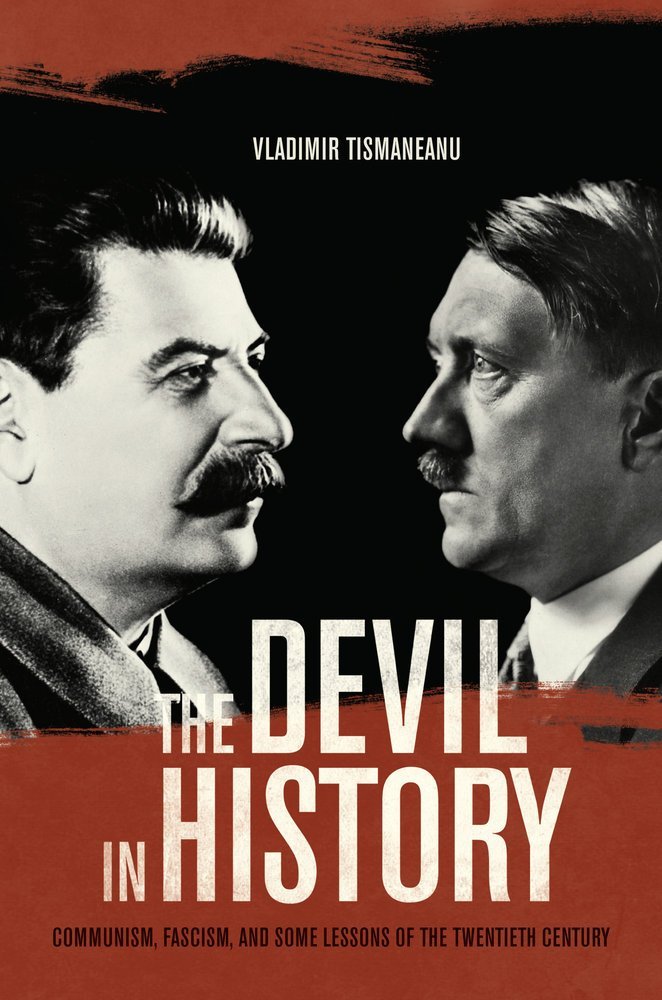
Leafing through a year-old issue of The New Criterion the other day, I came across a book review I'd forgotten. It's very relevant to something I wrote here back in March, "Socialism, National and International", in which I talked about the socialist element of Nazism. (I can never decide whether to say "Nazism" (or nazism) or "fascism" in this context, but one naturally tends to focus on German fascism because its monstrousness was so extreme compared to others.) The book is The Devil in History: Communism, Fascism, and Some Lessons of the Twentieth Century, and the author is Vladimir Tismaneanu. The reviewer, Paul Hollander says this:
It takes determination and formidable erudition to wade into the controversies which for several decades have enveloped and often obscured the concept of totalitarianism….
Tismaneanu has undertaken to demonstrate that the concept is meaningful and to elucidate the significant similarities (without ignoring the differences) between Nazism and Soviet communism—similarities which are at the heart of the idea of totalitarianism as well as its most contentious attribute.
And I discover the following quotation from Tismaneanu in his Wikipedia entry:
I was also discovering a theme which was to puzzle me throughout my professional career: the relation between communism, fascism, anti-communism and anti-fascism; in short, I was growing aware that, as has been demonstrated by François Furet, the relationship between the two totalitarian movements, viscerally hostile to the values and institutions of liberal democracy, was the fundamental historical issue of the 20th century.
I'm inclined to agree with that "fundamental historical issue" assessment, at least if you confine history to politics and external events rather than ideas. It's a question that has occupied me a good deal since I shed my youthful leftism, in particular the question of why Western liberals have remained so indulgent of communism. And it does seem true that the totalitarian mentality, rather than any economic program, that constitutes the most fundamental common element between the two systems. I don't read many books on politics, but I may read this one. The entire review is online here.
 Light On Dark Water
Leave a reply to Paul Cancel reply