I first became acquainted with Mark Helprin’s fiction in the late 90s, when for some unrecalled reason I picked up a copy of his novel Memoir From Antproof Case. I absolutely loved the mix of humor and pathos, delivered in a fairly madcap but very well-drawn narrative, and to top it all off, I thought the writing was spectacular. I raved about the book to friends, but for some reason never followed up with any of Helprin’s other work.
For several years he was off my radar, until an online acquaintance began singing (actually shouting, more like) the praises of his then-new book of short stories, The Pacific (2004). My friend recommended anyone who had not read Helprin to pick up the book, read the first and third stories, and “if you’re not hooked, you need go no further with Helprin.” I took his advice and was bowled over, especially by the third story, “Monday.” I read the rest of the book and rather than being disappointed, continued to be stunned. While Antproof was more of a comic novel, a romance in the old sense, many of the stories in this collection were quite serious, and serious in a beautiful way. There was no doubt in my mind that what was at work here was a writer of incredible talent, a brilliant imagination and a very strong and surprisingly traditional moral sense. In the ensuing years I’ve read all his fiction except the children’s stories, some of it twice and three times.
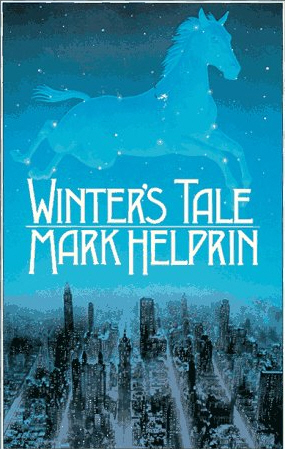
Helprin’s first book of fiction, a collection of stories called The Dove of the East, was published in 1975. Since then he has published two more collections of stories, six novels, and a trilogy of children’s books based on Swan Lake. His best known work is Winter’s Tale, a hit fantasy/magic realist novel set in turn of the 20th century New York City, published in 1983.
To be frank I don’t read a whole lot of contemporary fiction, as much of it leaves me cold. So I’m not really in a position to compare Helprin’s work with anyone else’s. If I’d have to describe it I’d say that he uses some of the techniques of modern and post-modern literature, but in a way that is very much supportive of traditional ideas and the “permanent things.” As one reviewer put it, his fiction is “unabashedly concerned with the great questions of love and death, beauty and honor.” This makes his work simultaneously very contemporary and winningly old-fashioned.
One of the most amazing things about his writing is his ability to blend the riotously funny with the genuinely moving, and pull them off equally well, often in the same story or novel, yet with no sense of inappropriateness or “jarring.” He’s a lot like Dickens in that regard, and in some ways you could very well call Mark Helprin “our” Dickens.
Not a Christian, but (I believe) an observant Jew, much of his work reflects that fact. He obviously respects his heritage, but is not above poking innocent fun at some of its foibles, always with obvious fondness, however. He’s never mean-spirited, except against the mean. The humor, while often riotous, is never vulgar or crass, he uses very few obscenities, and I can’t recall ever coming across a sex scene. Like old movies he always cuts away and leaves things like that to be imagined. His action scenes can be violent, but moderately so, and they are never needlessly graphic, as they often are in this era of hyper-realism. All told he is a very “virtuous” writer, that word being used in its best sense, and in that way his work often feels like it comes from an earlier era.
A couple of brief examples of his writing, chosen at random, will give you the sense of the wordsmith at work:
The Saromskers had taken in many survivors of the Holocaust, mostly children who had been babies when their parents had been murdered. Their devotion to mothers and fathers they had never known was fiercer and more concentrated than anyone might have dreamed, except perhaps for the parents themselves in the very moment that they were parted from their children. Their prayers for the union of souls, and their silent and intense petitioning of God had the strength of all the winds of the world, of its invisible magnetism, of oceans and seas. But they were petitions that, for all their power and urgency, and though perhaps answered in time or beyond the limits of time, were not answered then.
–from the novella “Perfection”
In the days of furious work, and the nights, when they had labored in the blaze and heat of lights, something arose that made it easy. It was not merely a rhythm or a sense of progress. Nor was it the unusual speed of the work, nor the caffeine, nor the music, both of which powered them on all their jobs and neither of which was capable of sustaining them as they now were sustained, power and perseverance flowing so voluminously and steadily that they were lifted from their fatigue, lifted above their difficulties, just as Fitch had imagined, as if on a wave in the wind. Such waves can without effort lift even immense ships, because the power of the wave comes from the great mass and depth of the sea.
–from the story “Monday”
Helprin’s humor is harder to describe, and transcribe, because it often comes via dialogue, but some of it is hilariously funny, at certain times recalling Wodehouse, at others Monty Python or Woody Allen.
For the newcomer to his work I’d say to try the short stories first, especially the ones in The Pacific. I’d recommend “Monday,” “A Brilliant Idea and His Own,” and “Charlotte of the Utrechtseweg.” Also in this collection is the brilliant novella “Perfection,” mentioned above, which manages to be both the funniest baseball story I’ve ever read and a profound moving reflection on the memory of the Holocaust. In addition, I’d highly recommend the long title story from his Dove of the Eastcollection, which is marvelous.
Regarding his novels, I must say that I think A Soldier of the Great War is one of the best novels of the last 40 years or so. It’s the only novel ever that I, upon finishing, wanted to read the beginning again right then and there. I did so, immediately jumping back in and rereading about the first 70 pages. In Sunlight and In Shadow is right up there next to it, a gorgeously written adventure and love story that no one should miss. Both are outstanding. My next favorites would be Antproof and Winter’s Tale, both of which are excellent, but not quite up to the level of the other two, in my opinion.
In a word, Mark Helprin is a great writer, a great storyteller, and a great moralist. If there’s anyone else out there like him writing right now, I haven’t found him.
(Hopefully this brief look at Mark Helprin’s work has made you curious. If so, check out his website, www.markhelprin.com, which features synopses, excerpts, and reviews of all his books.)
–Rob Grano has a degree in religious studies which he's put to good use working on the insurance side of the healthcare industry for the past 20 years. He's published a number of book and music reviews, mostly in the small press, and sometimes has even gotten paid for it. He lives outside of Pittsburgh, Pa.
 Light On Dark Water
Leave a reply to Rob G Cancel reply