52 Authors, Week 4: Mark Helprin

I first became acquainted with Mark Helprin’s fiction in the late 90s, when for some unrecalled reason I picked up a copy of his novel Memoir From Antproof Case. I absolutely loved the mix of humor and pathos, delivered in a fairly madcap but very well-drawn narrative, and to top it all off, I thought the writing was spectacular. I raved about the book to friends, but for some reason never followed up with any of Helprin’s other work.

For several years he was off my radar, until an online acquaintance began singing (actually shouting, more like) the praises of his then-new book of short stories, The Pacific (2004). My friend recommended anyone who had not read Helprin to pick up the book, read the first and third stories, and “if you’re not hooked, you need go no further with Helprin.” I took his advice and was bowled over, especially by the third story, “Monday.” I read the rest of the book and rather than being disappointed, continued to be stunned. While Antproof was more of a comic novel, a romance in the old sense, many of the stories in this collection were quite serious, and serious in a beautiful way. There was no doubt in my mind that what was at work here was a writer of incredible talent, a brilliant imagination and a very strong and surprisingly traditional moral sense. In the ensuing years I’ve read all his fiction except the children’s stories, some of it twice and three times.

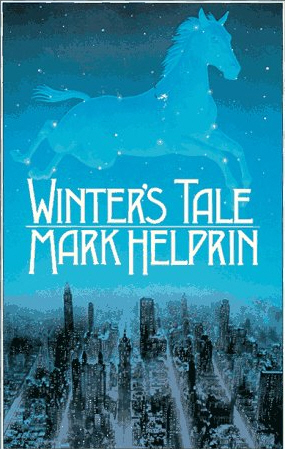
Helprin’s first book of fiction, a collection of stories called The Dove of the East, was published in 1975. Since then he has published two more collections of stories, six novels, and a trilogy of children’s books based on Swan Lake. His best known work is Winter’s Tale, a hit fantasy/magic realist novel set in turn of the 20th century New York City, published in 1983.

To be frank I don’t read a whole lot of contemporary fiction, as much of it leaves me cold. So I’m not really in a position to compare Helprin’s work with anyone else’s. If I’d have to describe it I’d say that he uses some of the techniques of modern and post-modern literature, but in a way that is very much supportive of traditional ideas and the “permanent things.” As one reviewer put it, his fiction is “unabashedly concerned with the great questions of love and death, beauty and honor.” This makes his work simultaneously very contemporary and winningly old-fashioned.

One of the most amazing things about his writing is his ability to blend the riotously funny with the genuinely moving, and pull them off equally well, often in the same story or novel, yet with no sense of inappropriateness or “jarring.” He’s a lot like Dickens in that regard, and in some ways you could very well call Mark Helprin “our” Dickens.

Not a Christian, but (I believe) an observant Jew, much of his work reflects that fact. He obviously respects his heritage, but is not above poking innocent fun at some of its foibles, always with obvious fondness, however. He’s never mean-spirited, except against the mean. The humor, while often riotous, is never vulgar or crass, he uses very few obscenities, and I can’t recall ever coming across a sex scene. Like old movies he always cuts away and leaves things like that to be imagined. His action scenes can be violent, but moderately so, and they are never needlessly graphic, as they often are in this era of hyper-realism. All told he is a very “virtuous” writer, that word being used in its best sense, and in that way his work often feels like it comes from an earlier era.

A couple of brief examples of his writing, chosen at random, will give you the sense of the wordsmith at work:

The Saromskers had taken in many survivors of the Holocaust, mostly children who had been babies when their parents had been murdered. Their devotion to mothers and fathers they had never known was fiercer and more concentrated than anyone might have dreamed, except perhaps for the parents themselves in the very moment that they were parted from their children. Their prayers for the union of souls, and their silent and intense petitioning of God had the strength of all the winds of the world, of its invisible magnetism, of oceans and seas. But they were petitions that, for all their power and urgency, and though perhaps answered in time or beyond the limits of time, were not answered then.

–from the novella “Perfection”

In the days of furious work, and the nights, when they had labored in the blaze and heat of lights, something arose that made it easy. It was not merely a rhythm or a sense of progress. Nor was it the unusual speed of the work, nor the caffeine, nor the music, both of which powered them on all their jobs and neither of which was capable of sustaining them as they now were sustained, power and perseverance flowing so voluminously and steadily that they were lifted from their fatigue, lifted above their difficulties, just as Fitch had imagined, as if on a wave in the wind. Such waves can without effort lift even immense ships, because the power of the wave comes from the great mass and depth of the sea.

–from the story “Monday”

Helprin’s humor is harder to describe, and transcribe, because it often comes via dialogue, but some of it is hilariously funny, at certain times recalling Wodehouse, at others Monty Python or Woody Allen.

For the newcomer to his work I’d say to try the short stories first, especially the ones in The Pacific. I’d recommend “Monday,” “A Brilliant Idea and His Own,” and “Charlotte of the Utrechtseweg.” Also in this collection is the brilliant novella “Perfection,” mentioned above, which manages to be both the funniest baseball story I’ve ever read and a profound moving reflection on the memory of the Holocaust. In addition, I’d highly recommend the long title story from his Dove of the Eastcollection, which is marvelous.

Regarding his novels, I must say that I think A Soldier of the Great War is one of the best novels of the last 40 years or so. It’s the only novel ever that I, upon finishing, wanted to read the beginning again right then and there. I did so, immediately jumping back in and rereading about the first 70 pages. In Sunlight and In Shadow is right up there next to it, a gorgeously written adventure and love story that no one should miss. Both are outstanding. My next favorites would be Antproof and Winter’s Tale, both of which are excellent, but not quite up to the level of the other two, in my opinion.

In a word, Mark Helprin is a great writer, a great storyteller, and a great moralist. If there’s anyone else out there like him writing right now, I haven’t found him.

(Hopefully this brief look at Mark Helprin’s work has made you curious. If so, check out his website, www.markhelprin.com, which features synopses, excerpts, and reviews of all his books.)

–Rob Grano has a degree in religious studies which he's put to good use working on the insurance side of the healthcare industry for the past 20 years.  He's published a number of book and music reviews, mostly in the small press, and sometimes has even gotten paid for it.  He lives outside of Pittsburgh, Pa.
MarkHelprin_WintersTale


,

84 responses to “52 Authors, Week 4: Mark Helprin”

  1. I read the first couple of paragraphs and now I can’t wait to read the rest, but I have to.
    AMDG

  2. I am going to have another shot at reading this fellow. I bought one of the long novels and didn’t get past the first paragraph. I’ll try starting with the short stories.

  3. Rob G, I read The Soldier of the Great War a few years ago on your recommendation, and I agree that it is a terrific novel. I loved it. I have A Winter’s Tale on my shelf, but I haven’t found the time for it yet.

  4. I’m just really glad now that I didn’t go see the movie (Winter’s Tale.
    I think I might stop at the library on the way home.
    AMDG

  5. Marianne

    I picked up Memoir of Antproof Case many years ago and liked it, but didn’t read a great deal of it. Maybe because its 528 pages seemed too much of a committment at the time. Now I see that Winter’s Tale is 768 pages, Soldier of the Great War 880 pages, and In Sunlight and In Shadow 720 pages. Whoa. The 528 pages seem a breeze by comparison!

  6. I’m beginning to feel a slight sense of stress brought on by the lengthening of my reading list. And we’re only on the 4th week.
    I started Winter’s Tale once (after one of those eyes-bigger-than-stomach trips to the library) and it seemed rather intriguing, but I was just too distracted with work and family matters at the time to keep going. That was probably fifteen years ago.

  7. Well, I started it about an hour ago and I’m really concerned because I need to read chapters 8-10 of Augustine’s Confessions by Saturday evening and I can see it’s going to be extremely hard to make myself do it.
    AMDG

  8. El Gaucho

    I can’t believe I have never heard of this author, but he sounds wonderful, and I love the quotes, Rob.

  9. Whoever designs the covers of his book is certainly doing a good job.
    AMDG

  10. The novels are long, but the narratives move well; thing is, the beauty of the writing makes you want to read them slowly. There are passages you’ll want to read again, or underline. Beach books they are not, but neither are they challenging in the manner of Henry James or Dostoevsky.
    Winter’s Tale is a great book, but I’m not sure it’s the best place to start with Helprin, unless you’re a little familiar with the magic realism thing. He uses that to some degree in all his novels except Sunlight and Shadow, but in WT it’s on with full force. That makes it rather different than his other books.

  11. “I can’t believe I have never heard of this author, but he sounds wonderful, and I love the quotes, Rob.”
    I think he gets missed sometimes because he’s one of these writers who’s sort of on the cusp between the literary and the “popular” novelist. He’s too literary for the folks who read mostly genre fiction, but I get the impression that he’s not considered “serious” enough for the more academic critical types (which I think is a huge mistake). He is, however, almost always reviewed in the big newspapers and in journals such as Commentary, National Review, The Atlantic, etc.

  12. Oh, I’m loving the magical realism, Rob. He just conjures up one fantastic image after another.
    AMDG

  13. It’s an incredibly visual book.
    AMDG

  14. Agreed, Janet. But I remember the first time I tried to read it I really didn’t know what to make of it. But when I gave it a second go after I’d already read a few of the other things, I got it right away.

  15. By the way, the movie’s supposedly pretty bad, alas.

  16. I don’t think you can decide what to make of it; you have to just let it happen. The problem with any movie would be that part of the experience of the book is having these images build up in your head, and the movie would do that for you. I’m not sure I would like even a good movie.
    AMDG

  17. Robert Gotcher

    Which brings me to my own perennial problem: What IS literary and what is “just” popular? Is Twain literary? He certainly was popular. Dostoyevsky is literary and is difficult. Like James. It is a requirement to be hard to read? Austin is easy to read, but does she go deep enough into the humanum? Alcott is “juvenalia.” Lewis isn’t good literature, although he deals with deep subjects. Is it “artistry?” Because “light” fair can be very well crafted. Doyle is very well written, but perhaps not “deep.” Fr. Brown is supposedly deep, but not well written. What about Scott? Literary? Just popular? Both? Not as “literary” as, say Cervantes or Waugh? Rolling is popular and deals with some fundamental human problems perhaps even with some sophistication, but I don’t think the HP books are very well written. In fact, I can’t read them.
    I guess I haven’t gotten beyond the “I know what I like” level. I rarely read a book because it is “literary” or because it is “entertaining.” I usually read a book because it addresses something I am interested in considering about the human condition and because it is reasonably well written (although I’m not usually that picky about that).

  18. Marianne

    The Paris Review had an interview with Helprin in 1993, which itself comes across as a bit of magical realism, especially in the details about his life. He also talks about his Republican political views and somewhat acrimonious relationship with fellow writers and academicians, and why literary awards hadn’t come his way:

    …you can imagine how well I and my work are received in academic circles, when I assert plainly and without apology that deconstructionism, like Nazism or Stalinism, is less a system of thought than a sign of mental illness. …
    …let me say in summary that relativism and politicization have so smothered the universities and the world of publishing that to state, as I do, that it is possible to serve universal ideals and appeal, non-politically, to the fundamental needs of human nature by addressing its fundamental questions, is perceived as heresy. The end and the beginning of it is that I dissent from the dominant orthodoxies that cradle the profession I practice, that, despite what some assert, I have never been shy about it, and that, therefore, I find myself not only out of the mainstream, but playing the role, at times, of moving target. As I have an activist nature, I fire back.

    The whole interview is here.

  19. That’s a very impressive quote.
    AMDG

  20. Rob, I didn’t realize you were recommending a Bad Person.

  21. I refer of course to the fact that he “can’t even remain in the same room with coffee.”

  22. Yeah, I know. And I’m a coffee snob!
    It’s worth noting that Helprin’s fiction is never political. Though he is outspokenly conservative in his other writing, that seldom if ever finds its way into his fiction. He wouldn’t be nearly as interesting a writer if his work was politicized or didactic, imo. His fiction does really reflect the fact that he believes “it is possible to serve universal ideals and appeal, non-politically, to the fundamental needs of human nature by addressing its fundamental questions.”
    Deconstruction isn’t the issue it was 20 years ago, but literature departments still do seem, on the other hand, to be quite politicized.

  23. Robert, that’s a very interesting question–literary vs. popular. I think it’s one of those dichotomies where there is an extremely broad middle ground. There are all sorts of similar ones, like classical vs. popular music. There are some things, a lot of things actually, that fall clearly on one side or the other. But there are also a lot that don’t.
    The definition of “literary” really ends up being “what literary people like”, but only after a certain time. You can call Dickens and Scott literary, because they are still, after 150 years or so, of interest to educated people with an interest in literature. But it’s harder when you’re talking about contemporary work. The depth you mention is part of it.
    I’m reading and very much enjoying a book right now which falls very much in the middle–it’s really much too well done to be thrown in with Harold Robbins or whatever his current equivalent is. Yet I don’t think it’s quite on the level of certain other writers who are definitely considered literary. I am deliberately not naming the book because it’s going to be discussed in this series, and I don’t want to start a conversation about it now.

  24. “You can call Dickens and Scott literary, because they are still, after 150 years or so, of interest to educated people with an interest in literature. But it’s harder when you’re talking about contemporary work. The depth you mention is part of it.”
    Yes, that’s exactly what I was going to say. Generally speaking, when I consider contemporary popular fiction I’m thinking of genre writing. This doesn’t mean that there aren’t very good genre writers — there are writers and books that “transcend genre,” as we say. But most popular or non-literary readers seem to read primarily for plot, and writers that focus more on character or psychology or what-have-you will tend to be less popular than the genre writer who can produce a good page-turner.
    But as Mac says, there is a fair amount of overlap, and a broad middle.

  25. I didn’t recognise the name, but I do recognise the book cover.

  26. “… literature departments still do seem, on the other hand, to be quite politicized.”
    That’s certainly the impression one gets. I think the cases that get a lot of publicity–some prof tells a student he can’t voice Christian views in class, etc.–tend to be in the departments of which the whole point is political–women’s studies and the like. And you get the occasional English teacher in that. But I suspect that more than the flagrant indoctrination it’s an assumption of progressive orthodoxy that becomes simply normal, with abnormality unwelcome at best.

  27. Robert Gotcher

    My daughter points to Dorothy Sayers and the Lord Peter Wimsey series as an author that transcends genre and becomes then, I suppose, literary. She points to Gaudy Night specifically, which is one of the two LPW books I’ve read and the only one I’ve read recently. The other was read decades ago.

  28. El Gaucho

    I really love discussions of books and literature when they expand like this! To me the difference between genre and literary is that when you are reading literary fiction there is more to it than just finding out what might happen next to your protagonist and his/her situation. Does that sound about right? If that’s all it is — I hate to point fingers but Dan Brown’s fiction comes to mind — then I really have a hard time with it. Of course there are some that I enjoy, Stephen King (don’t think he is on Mac’s list so he’s fair game to throw out there). I’ve been reading King since Jr High or so and I continue to – but it’s mainly because I find his characters so interesting and real. Not always – he writes too much to always have winners – but when he’s good he’s really good. And if you like Dan Brown, then great. Genre fiction is like watching TV and we all need to relax and not tax our brains sometimes. That said, I mostly stick to literary fiction for my reading pleasure.

  29. Marianne

    Stephen King and Cormac McCarthy both write about the dark side. I’ve never read anything by King, but I read McCarthy’s The Road. What is it that makes his work “literary,” while King’s is not? Mostly style? Or does he go deeper into character? Or…?

  30. I don’t think I have read enough King to make any comment about him.
    Part of what makes McCarthy’s work literary is his voice. He is writing about a particular group of people and he gets it right. Nothing seems extraneous or out of place. You never seen the writing behind the story. And the story is the reason for the the story. He doesn’t seem to have any agenda except to follow the characters where they go. For instance, he doesn’t write to shock the reader which, of course, King must do. Shock there is, but it’s the natural outcome of the story.
    While his stories are regional, his underlying themes are universal. His portrayals of love, passion, loyalty, evil, etc. will be recognizable as long as this world lasts.
    He breaks the rules, but it doesn’t matter because his breaking of the rules doesn’t seem arbitrary. I don’t know why he eschews quotation marks, but I’m sure he knows. I don’t think he does it for some stupid reason.
    I probably should have chosen McCarthy.
    AMDG

  31. Joyce didn’t use quotation markes either. Right?

  32. El Gaucho

    Cormac McCarthy would be a lot of fun to write about and I have read several of his novels. Yes, he is literary while Stephen King is unashamedly genre fiction. King is not just horror, but also delves into crime fiction; but he is pretty “pulpy”. McCarthy is strictly a bare bones stylist telling a broad story but writing about the human condition.

  33. When I read Robert’s and El Gaucho’s comments this morning, especially the latter’s reference to just finding out what will happen next, I immediately thought of Cormac McCarthy. I haven’t read Stephen King at all, and of CMC I’ve only read No Country. And it’s as much of a page-turner as anything I’ve ever read. But there’s much more there–all the things that Janet mentions, and the addressing of the Big Questions. because even though I don’t recall God being mentioned, you can’t read it without thinking about the whole question of the meaning of human life.
    No Country reminded me a lot of Elmore Leonard’s work–he’s a crime/thriller writer, possibly the best there’s ever been, and I think I read that McCarthy admitted being influence by him. He’s one of those genre writers whom people say transcends genre, and that’s true. So I wouldn’t just dismiss him as “popular.” But I don’t think he goes as deep in reflecting on the problem of evil as McCarthy does.
    My wife and I are currently watching a Spanish TV series called Grand Hotel. It’s very soap opera-ish, somewhat similar to Downton Abbey, but way more melodramatic and implausible. It’s an example of a work where you’re only interested in finding out what happens–you won’t be left with much when it’s over. You won’t be reflecting on its themes. At least I won’t. I’d put it in the purely “popular” category: once you get to the end of the story, you’re finished with it.

  34. Marianne

    I found an interesting recent article in the New Yorker looking at genre and literary fiction. Some excerpts:

    The distinction between literary fiction and genre fiction is neither contemporary nor ageless. It’s the product of modernism, and it bears the stamp of a unique time in literary history. …
    The modernists [like Virginia Woolf] saw, correctly, that novel-writing, once an art, had become an enterprise. More fundamentally, it had internalized a mass view of life—a view in which what matters are social facts rather than individual experiences. It had become affiliated with manufactured culture, with the crowd, and with the sentimentality and repetitive stylization that crowds, in their quest for a common identity, often crave. In reaction, they created a different kind of literature: one centered on inwardness, privacy, and incommunicability. The new books were about individuals, and they needed to be interpreted individually. Instead of being public resources, novels would be private sanctuaries. Instead of being social, they would be spiritual.
    Something of that spiritual aura still hovers around our sense of what it means to read and write “literary fiction.”

    The article then goes on to look at a system of classification developed by the literary critic Northrop Frye:

    Frye’s scheme is simple. In his view, the world of fiction is composed of four braided genres: novel, romance, anatomy, and confession. “Pride and Prejudice” is a novel. “Wuthering Heights” isn’t: it’s a romance, an extension of a form that predates the novel by many hundreds of years. (“The romancer does not attempt to create ‘real people’ so much as stylized figures which expand into psychological archetypes,” Frye writes. “That is why the romance so often radiates a glow of subjective intensity that the novel lacks.”) Novels take place in the regulated world—in “society”—and are driven by plots. Romances take place “in vacuo,” on the moors, where “nihilistic and untamable” things tend to happen. The characters in romances are often revolutionaries, but “the social affinities of the romance, with its grave idealizing of heroism and purity, are with the aristocracy.” For that reason, novels, which thrive on social sophistication, often incorporate romance in an ironic way (“Don Quixote,” “Lord Jim”).

    The author of the article says that McCarthy’s The Road is an example of a nearly pure romance.

  35. I guess the author of the article doesn’t realize that The Road is the real world that we are living in at this moment. 😉
    AMDG

  36. and the addressing of the Big Questions
    I meant to stick the phrase eternal verities in that comment somewhere,but it got overlooked in between the answering of the phone and the answering of the door.
    AMDG

  37. Somebody posted that piece from the New Yorker on Facebook, and I was so intrigued I immediately bought Station Eleven, which turns out to be pure pulp but with middle-brow pretensions (which rather get in the way of enjoying the pulp). The only halfway decent writing in it is in the descriptions of a comic book. Dean Koontz has a better prose style.

  38. Unlike Cormac McCarthy’s “The Road,” which asked what would remain after the collapse of culture, “Station Eleven” asks how culture gets put together again
    The Road IS about how culture gets put together again.
    AMDG

  39. I may not have time to read that New Yorker piece, but the excerpt seems pretty accurate to me. I’m sure the literary-popular distinction as we know it didn’t exist in the 19th century with respect to fiction. Probably a more important distinction was that between high and folk art–between the work of highly trained composers, for instance, and folk music. Fiction in the modern sense–the novel, in Frye’s scheme, I guess–had only fairly recently come into being.
    I don’t think the distinction is only a product of artistic modernism, though. It’s also partly a result of the whole tendency toward elaboration and specialization in the modern world. That’s how we got genres like mystery and sci-fi and fantasy: writers took the basic elements from Poe and Mary Shelley and whoever, where they were found along with other things, extracted them and developed specialized varieties of story.
    Tom Wolfe’s novels seem to be very deliberate attempts to go back to the “social” novel which the NY writer says modernism was reacting against. That may account partly for the argument about whether they are literary or popular.

  40. Error in my essay! The third story in the collection, the one that bowled me over, is called “Monday,” not “Tomorrow.”
    Aargh!!!!!! Please fix it if you can, Mac!

  41. Ok, will do as soon as I can.

  42. Great — thanks!

  43. Ok, done. you’re welcome

  44. El Gaucho

    I am pleased to report that I just found a pristine copy of A Soldier of the Great War here in our used bookstore on campus for $2.50, which I now own!

  45. And that’s the one Rob says is the best. Lucky you!

  46. See Maclin, now don’t you wish you had been at work?
    AMDG

  47. I am at work, just not at that place. But no.

  48. Nice find, Gaucho. Hope it’s at least a trade paperback you found, as the mass market edition is something like 900 pages of tiny print!
    As I wrote, ASOTGW is my favorite contemporary novel, and I think one of the best novels of the last 30 or 40 years, period. My other two favorite contemporary novels are Berry’s ‘Jayber Crow’ and Marilynne Robinson’s ‘Gilead.’ I used to consider A.S. Byatt’s ‘Possession’ one of my favorites, but I reread it two or three years ago, and while I still enjoyed it very much, it didn’t quite do it for me the same way the second time around. I have not had that experience with anything of Helprin’s, nor of Berry or Robinson for that matter.

  49. El Gaucho

    Yes, large trade paperback, and the first 45 pages definitely has me wanting more!

  50. Marianne

    Just checked my local public library’s online catalog to see if they’ve got A Soldier of the Great War; they do and they’ve got the opening of the book in the catalog record — the very first paragraphs leave me wanting more:

    ROME, AUGUST
    ON THE ninth of August, 1964, Rome lay asleep in afternoon light as the sun swirled in a blinding pinwheel above its roofs, its low hills, and its gilded domes. The city was quiet and all was still except the crowns of a few slightly swaying pines, one lost and tentative cloud, and an old man who rushed through the Villa Borghese, alone. Limping along paths of crushed stone and tapping his cane as he took each step, he raced across intricacies of sunlight and shadow spread before him on the dark garden floor like golden lace.
    Alessandro Giuliani was tall and unbent, and his buoyant white hair fell and floated about his head like the white water in the curl of a wave. Perhaps because he had been without his family, solitary for so long, the deer in deer preserves and even in the wild sometimes allowed him to stroke their cloud-spotted flanks and touch their faces. And on the hot terra cotta floors of roof gardens and in other, less likely places, though it may have been accidental, doves had flown into his hands. Most of the time they held in place and stared at him with their round gray eyes until they sailed away with a feminine flutter of wings that he found beautiful not only for its delicacy and grace, but because the sound echoed through what then became an exquisite silence.
    As he hurried along the Villa Borghese he felt his blood rushing and his eyes sharpening with sweat. In advance of his approach through long tunnels of dark greenery the birds caught fire in song but were perfectly quiet as he passed directly underneath, so that he propelled and drew their hypnotic chatter before and after him like an ocean wave pushing through an estuary. With his white hair and thick white mustache, Alessandro Giuliani might have seemed English were it not for his cream-colored suit of distinctly Roman cut and a thin bamboo cane entirely inappropriate for an Englishman. Still trotting, breathless, and tapping, he emerged from the Villa Borghese onto a long wide road that went up a hill and was flanked on either side by a row of tranquil buildings with tile roofs from which the light reflected as if it were a waterfall cascading onto broken rock.

    Interesting thing about our earlier discussion of Helprin not being well thought of in academia — I also checked the University of Otago’s catalog (that’s the university here in town) and they’ve got only two books by Helprin, The Pacific and Other Stories and Digital barbarism : a writer’s manifesto, which is an expansion of an op-ed he wrote for the NY Times a few years ago. By comparison, the library seems to have every book ever written by Philip Roth and that’s a lot. It’s even got a copy of Stieg Larsson’s The Girl with the Dragon Tattoo.

  51. I like that sparkling excerpt, Marianne. I’ll have to see what books by Helprin are available at the local library or bookstores (there still are some).
    Rob G: If generating interest in a writer is any measure (and I think it is), your essay is big success.

  52. Great excerpt, Marianne. Just from that you can see how Helprin’s prose is designed for a slower reading experience. Zip through those three paragraphs and they can come across as cloying, even clichéd. But taken at the right tempo you can see how wonderfully well-crafted it all is.

  53. I’ve been re-reading Memoir From Antproof Case, and have kept a pen and paper handy to jot down memorable passages. Yesterday I came across this little gem: “If innocence sometimes has a bad name, it is only among those who do not or cannot remember purity.”
    A good response to those modern cynics who make a habit of badmouthing nostalgia, which is, after all, simply homesickness for a time as well as a place.

  54. That’s a great quote. I will be writing about innocence in my next post.
    AMDG

  55. Finished Helprin’s new novel Paris in the Present Tense last night — wonderful! It’s his most realistic novel so far, having many of the qualities of the non-fantastic shorter fiction he has written over the years. And it’s also his smallest so far, both in length and in scope.
    The story concerns a 74-year old French music teacher and cellist, child of the Holocaust and Algerian war veteran, who on the eve of retirement is confronted with a series of challenges/threats which test both his mettle and his character.
    If you’ve read Helprin before you’ll know what to expect — no let-downs here. And if you’ve not read him this is a very good place to start.

  56. I still haven’t read him at all. Too much to read. So maybe the smallest would be the best place to start.

  57. I mean not that Helprin specifically is too much, but that there’s just too much in general. I think I’m about to start a re-reading of The Lord of the Rings.

  58. If you stopped re-reading LOTR every other year you would have more time for other books. 🙂

  59. Yeah, this new one is a little less than 400 pages; the others all run to 500+.

  60. I have wanted to read some Helprin ever since this post was written, but I guess I keep re-reading Anna Karenina and other 19th century tomes.

  61. I’ve finally been reading Hillbilly Elegy. I’m really liking it.
    AMDG

  62. I tend to like older fiction myself, but Helprin and Wendell Berry are my favorite contemporary writers, so I always make room when something new of theirs comes out.

  63. Actually, Stu, it’s probably been 20 years since I read LOTR. Maybe 25. I think I read it 3 times between roughly 1975 and 1995, and not since. I’ve avoided it since the movies came out, because I didn’t want those images to completely dominate my imagination. Maybe they will anyway.

  64. I hope not, Mack.
    AMDG

  65. Mack is a replicant who sometimes tries to pass himself off as me. Supposedly he’s been retired now. Let’s hope so, but there seem to be some anomalies in the records.

  66. Anybody read Andrew Lytle?
    AMDG

  67. I’ve read some of the essays and most of the short fiction. Haven’t read any of the novels yet.

  68. Yes, but it didn’t make a real big impression on me, as witnessed by the fact that I can’t remember what it was. It was fiction, a novel I think. I have The Velvet Horn on my shelf, but glancing at it now it doesn’t seem very familiar. Sorry, not helpful.

  69. I was just asking because a friend was asking me, and I don’t know him at all. Southern Agrarian I think?
    AMDG

  70. Yes, he was one of the original ’12 Southerners’ of I’ll Take My Stand fame.

  71. Chris Nathan

    Thank you, Rob, for writing so compellingly about this magnificent author.
    I can’t say enough about Helprin’s talents as a novelist and short story writer. The best fiction changes something in us. What it changes, exactly, avoids definition and distinction but it’s there, as anyone passionate enough about literature to still be reading this comment thread must know from direct experience. Helprin illuminates the part of us which yearns for the eternal, for the place outside of time, for the honorable and sublime, but to leaven it he brings a robust sense of the tragic and a magnificent sense of humor. Go read him. You won’t be disappointed.
    One more thing: Helprin is one of the most visual authors you will ever read, and part of the fun I have had reading him comes from the way his writing has altered my experience of my own visual field. In one of the stories from the The Pacific Helprin describes a kitchen in which the appliances roll forward for cleaning like elephants, or maybe grey circus beasts, and even now, years after reading that story, I find myself noticing beneath the cold metal skin of a large dark refrigerator the elephant spirit waiting or wanting to roll out to me. Or to take another even more common example, ASOTGW is filled with tender, careful descriptions of the sky and clouds. At first you read these with puzzlement. Beautiful, yes, but not exactly plot points. I tended to hurry through them. And then at some point reading the novel I let myself slow down. I started to go swimming in these pools, enjoying their luxury. By the end of the novel I found myself putting the book aside to look out of the window and paint my own sky in words or feelings. Mark Helprin taught me to see the sky in all its variety and beauty, to really look at it, to find the plain miracle mixed there. Twenty years after I read Helprin’s novel, and ten years since I’ve read anything else by him I still see the sky newly over and over again. It takes something extraordinary in a writer to produce an effect like that.

  72. I am about 50 pages from the end of In Sunlight and in Shadow and I have enjoyed it. That said, it could easily have been a tighter 500 page novel rather than its 700 page length.

  73. That’s quite a testimonial from Chris. Eventually I’ll get around to Helprin….

  74. “it could easily have been a tighter 500 page novel rather than its 700 page length”
    I think there is a sense in which one could say that about almost any big novel, those by the Victorians and the Russians included. As for Sunlight, I didn’t find it so. The only Helprin novel that felt a little “padded” to me is Freddy and Fredericka, but even that one seems consciously to be picaresque, and I think in that case “padding” comes with the territory.

  75. That is certainly true, Rob. I guess I give the classic authors a pass and tend to be more critical of modern authors for great length. Although there were certainly long sections of Les Miserables I could have done without. I wouldn’t cut anything from War and Peace! This of course gets into the area of subjectivity. Anyway, I liked the book.

  76. And I want to read Soldier of the Great War too…

  77. Btw, it probably goes without saying that I’m in agreement with what Chris wrote above. Imo, Helprin is unique among contemporary writers in that he is able to combine three things not often found together in one author, esp. in our day and age: beautiful writing, compelling characters and storytelling, and a strong “traditional” moral sense.

  78. Yes, I assumed that. 🙂

  79. I am currently reading The Shadow of the Wind by Carlos Ruiz Zafon. His writing reminds me a lot of Mark Helprin.

  80. I was just downloading that to listen to.
    AMDG

  81. I think you will like it, Janet. He is a pretty engaging writer and the story is fun! A friend recommended it – I think she has read all four of the books now.

  82. Has anyone here read Anthony Doerr’s Cloud Cuckoo Land? Reason I’m asking on this thread is that I read a book of his short stories a few years back and his writing style reminded me of Helprin’s. The book did leave me a little cold however, in that it seemed to have no grasp of the eternal — it was all very “this worldly” — despite the stylistic similarity.
    I tried to read Doerr’s Pulitzer-winning novel All the Light We Cannot See, but found its style taxing, if not downright tedious. From what I read it seems that the entire thing is written in the present tense:
    “Now the bombers are so close that the floor starts to throb under her knees. Out in the hall, the crystal pendants of the chandelier suspended above the stairwell chime. Marie-Laure twists the chimney of the miniature house ninety degrees. Then she slides off three wooden panels that make up its roof, and turns it over.
    A stone drops into her palm.
    It’s cold. The size of a pigeon’s egg. The shape of a teardrop.
    Marie-Laure clutches the tiny house in one hand and the stone in the other. The room feels flimsy, tenuous. Giant fingertips seem about to punch through its walls.”
    There’s just no way I could manage 500+ pages of that.

  83. I haven’t read anything by him. Not sure I’ve even heard the name, actually. I agree about the present tense thing. It can work in a short story…I think…seems like I’ve read something(s) where it worked, but I can’t name any examples.

  84. Right – I’ve encountered it in short stories, and also as part of longer works. But a whole novel written like that would be a challenge.
    I know Doerr only because he won the Pulitzer, and because a friend had read the book and liked it. I started it but didn’t get very far, so I tried his collection of stories instead.

Leave a reply to Mack Cancel reply